Anniella sp.
California Legless Lizard
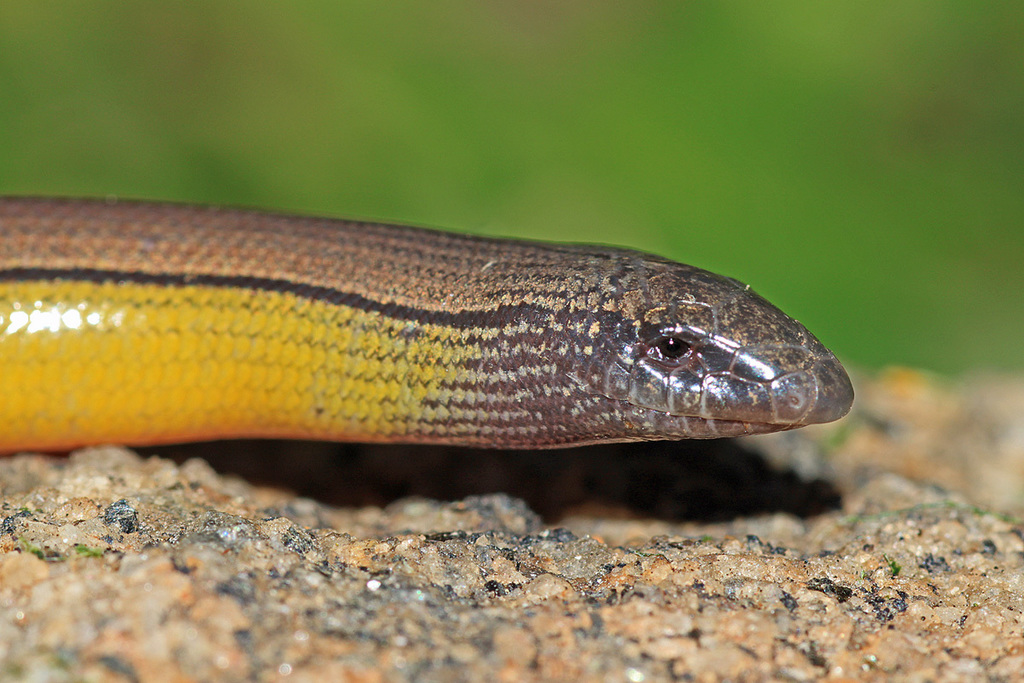
(c) Chris Brown, some rights reserved (CC BY) · licence
Family: Anniellidae · Class: Reptilia · Order: Squamata
Conservation status: G3G4 S3S4
Anniella sp. (California Legless Lizard) is a California animal in the Anniellidae family.
California legless lizards (Anniella sp.) are elongated, snake-like reptiles measuring 10 to 18 cm (4 to 7 inches) in total length. The body is cylindrical and smooth-scaled, lacking functional limbs though vestigial hind limb bones remain internally. Coloration varies among populations, with dorsal surfaces ranging from silver-gray to brown, yellow, or black. A distinct dark lateral line often extends along each side of the body. The ventral surface is typically lighter, appearing white to pale yellow. The head is small and conical, barely distinct from the neck, with tiny eyes covered by transparent scales and no external ear openings. The tail is blunt and nearly as thick as the body, distinguishing them from snakes. Historically considered a single species (Anniella pulchra), recent genetic studies have revealed multiple distinct species within the genus distributed along California's coast and interior valleys. These lizards occur from Contra Costa County south through the Central Valley and coastal regions to Baja California, Mexico. Populations are documented from sea level to approximately 1,500 meters (4,900 feet) elevation in areas including the San Francisco Bay Area, Central Coast, Los Angeles Basin, and Peninsular Ranges. California legless lizards inhabit sandy or loose soils in chaparral, oak woodland, pine-oak forest, and coastal dune systems. They require friable substrates that allow for easy burrowing, including beach sand, decomposed granite, and leaf litter. The species shows strong preference for areas with moisture retention, often found beneath logs, rocks, or dense vegetation that provides cover and maintains soil humidity. They avoid clay soils and areas with compacted surfaces. These fossorial reptiles spend most of their lives underground, emerging primarily at night or during cool, overcast conditions. They create shallow burrows 15 to 30 cm (6 to 12 inches) deep, using lateral undulation to move through loose substrate. Diet consists primarily of small arthropods including beetle larvae, moth caterpillars, termites, and spiders encountered while foraging in soil and leaf litter. California legless lizards are ovoviviparous, with females retaining eggs internally and giving birth to 1 to 4 live young after a gestation period of approximately four months. Reproduction appears tied to seasonal moisture, with births typically occurring in late summer or early fall. With a Global/State Rank of G3 S3, California legless lizards are considered vulnerable to moderately vulnerable. Populations face significant threats from habitat loss due to urban development, agriculture, and coastal construction. Their specialized habitat requirements and limited dispersal ability make them particularly susceptible to fragmentation. Beach populations are threatened by recreational activities, dune stabilization projects, and sea level rise. Additionally, the cryptic nature of these species has likely led to underestimation of their conservation needs, as taxonomic uncertainty has hindered targeted protection efforts until recent systematic studies clarified species boundaries within the genus.
Classification
Class: Reptilia · Order: Squamata · Family: Anniellidae
Conservation status
G3G4 S3S4
Frequently asked questions
How is Anniella sp. classified?
Anniella sp. belongs to class Reptilia, order Squamata, family Anniellidae.
What family does Anniella sp. belong to?
Anniella sp. is in the Anniellidae family.
Is Anniella sp. protected or of conservation concern?
Anniella sp. carries the following status: G3G4 S3S4.
What is Anniella sp.?
California legless lizards (Anniella sp.) are elongated, snake-like reptiles measuring 10 to 18 cm (4 to 7 inches) in total length.
Is Anniella sp. found in California?
Yes. Anniella sp. is recorded in California in The California Species Project's catalogue.
Related species
Other California species in the same genus, family, or bioregion.
Data from The California Species Project — 14,000+ California species with verified data from CNPS, CDFW, USFWS, and more.