Anniella stebbinsi
Southern California Legless Lizard
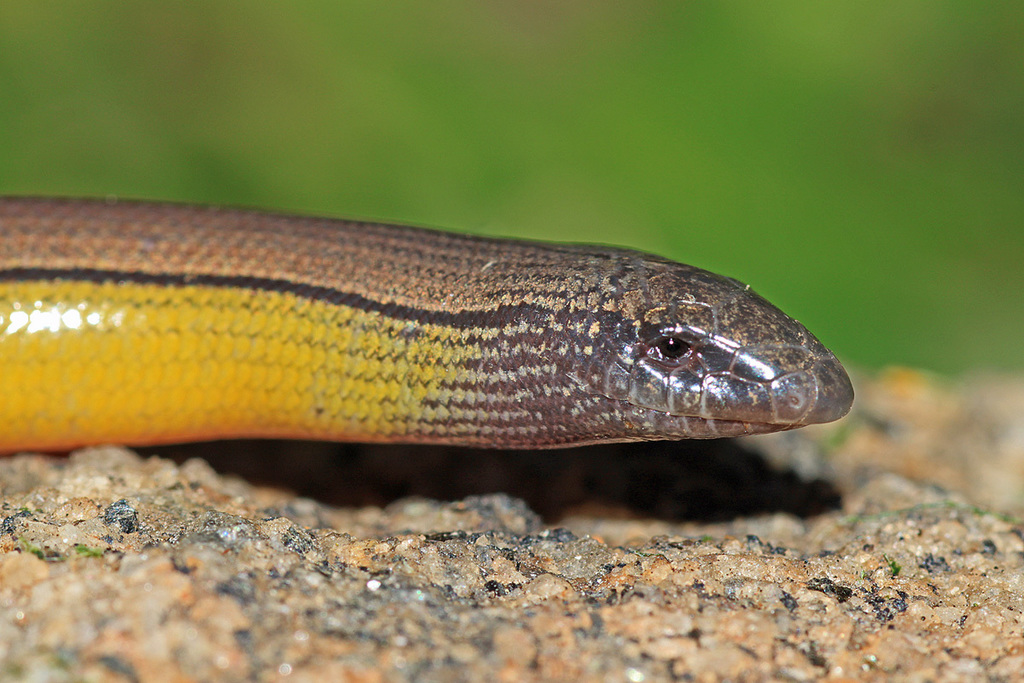
(c) Chris Brown, some rights reserved (CC BY) · licence
Family: Anniellidae · Class: Reptilia · Order: Squamata
Conservation status: G3 S3
Anniella stebbinsi (Southern California Legless Lizard) is a California animal in the Anniellidae family.
The Southern California legless lizard (Anniella stebbinsi) is a small, snake-like reptile endemic to coastal southern California and Baja California, Mexico. Adults typically measure 11 to 16 centimeters (4.3 to 6.3 inches) in snout-to-vent length, with total length including tail reaching 18 to 24 centimeters (7 to 9.4 inches). The body is cylindrical and uniform in width, covered in smooth, shiny scales that lack the overlapping pattern found in snakes. Coloration varies from silver-gray to brown or black dorsally, with a lighter yellow to white ventral surface. The species lacks external limbs entirely, though vestigial pelvic bones remain internally. The head is small and conical, with reduced eyes covered by transparent scales, and the tail is blunt and easily shed when threatened. Anniella stebbinsi occurs from Ventura County south through Los Angeles, Orange, Riverside, San Bernardino, and San Diego counties in California, extending into Baja California, Mexico. The species was formally described as distinct from Anniella pulchra in 2013 based on genetic and morphological analyses. The range encompasses coastal plains, foothills, and desert margins from sea level to approximately 1,500 meters (4,920 feet) elevation. This fossorial species inhabits areas with loose, sandy or loamy soils that facilitate burrowing. Preferred habitats include coastal sage scrub, chaparral, oak woodlands, and riparian areas with leaf litter and organic debris. The species requires soils with sufficient moisture content and often occurs beneath rocks, logs, or dense vegetation that provides cover and maintains soil humidity. Urban development has fragmented much of the suitable habitat within the species' range. Southern California legless lizards are secretive, spending most time underground in self-constructed burrows or beneath surface objects. They move through soil using lateral undulation, similar to swimming motions. The species is ovoviviparous, with females giving birth to 1 to 4 live young after a gestation period of several months. Breeding likely occurs in spring, with births in late summer or fall. The diet consists primarily of small invertebrates including beetle larvae, ant larvae, termites, and other soft-bodied insects encountered while foraging in soil and leaf litter. Activity patterns follow soil temperature and moisture cycles, with reduced activity during hot, dry periods. Currently assigned a global rank of G3 (vulnerable) and state rank of S3 (vulnerable) by NatureServe, indicating the species faces moderate risk of extinction. Primary threats include habitat loss and fragmentation from urban development, agriculture, and infrastructure projects throughout coastal southern California. Climate change poses additional risks through altered precipitation patterns and increased drought frequency, which affect soil moisture critical for the species' survival. The species is not federally or state listed, but ongoing habitat loss within its limited range warrants continued monitoring and conservation attention.
Classification
Class: Reptilia · Order: Squamata · Family: Anniellidae
Conservation status
G3 S3
Frequently asked questions
How is Anniella stebbinsi classified?
Anniella stebbinsi belongs to class Reptilia, order Squamata, family Anniellidae.
What family does Anniella stebbinsi belong to?
Anniella stebbinsi is in the Anniellidae family.
Is Anniella stebbinsi protected or of conservation concern?
Anniella stebbinsi carries the following status: G3 S3.
What is Anniella stebbinsi?
The Southern California legless lizard (Anniella stebbinsi) is a small, snake-like reptile endemic to coastal southern California and Baja California, Mexico.
Is Anniella stebbinsi found in California?
Yes. Anniella stebbinsi is recorded in California in The California Species Project's catalogue.
Related species
Other California species in the same genus, family, or bioregion.
Data from The California Species Project — 14,000+ California species with verified data from CNPS, CDFW, USFWS, and more.