Anodonta californiensis
California Floater
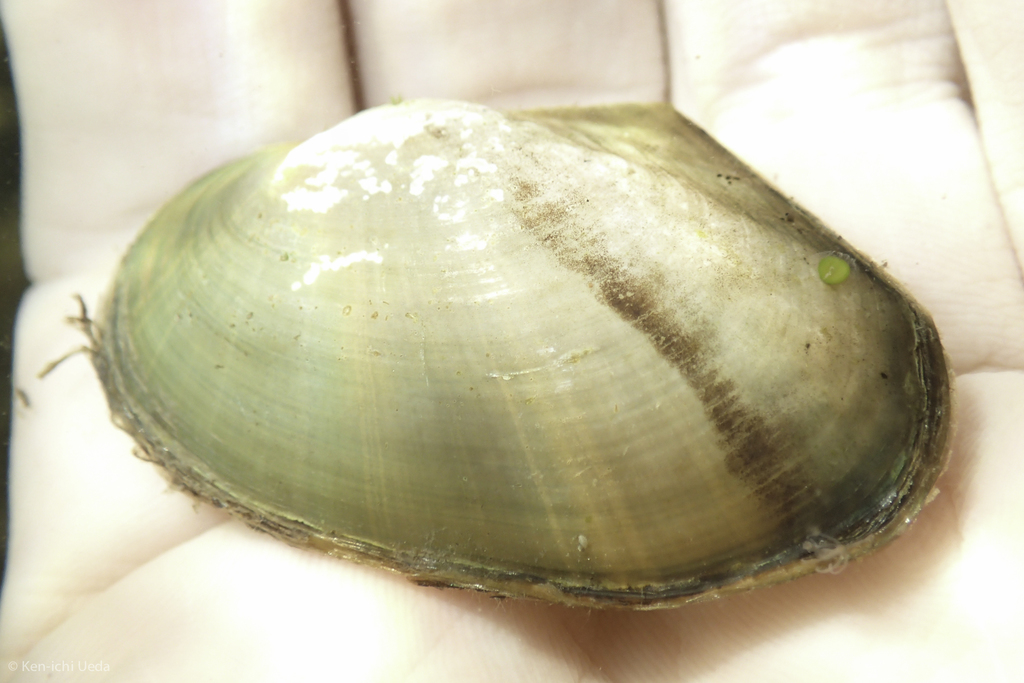
(c) Ken-ichi Ueda, some rights reserved (CC BY) · licence
Family: Unionidae · Class: Bivalvia · Order: Unionoida
Conservation status: G3 S2?
Anodonta californiensis (California Floater) is a California animal in the Unionidae family.
The California floater is a freshwater mussel that can reach up to five inches (127 mm) in length, making it one of the larger freshwater bivalves in western North America. The shell is typically thin-walled and elongated, with a smooth periostracum that ranges from yellowish-brown to dark brown or black. Like other members of the genus Anodonta, this species lacks hinge teeth, distinguishing it from many other freshwater mussels. The shell interior displays a nacreous lining that can appear white to bluish-white with iridescent qualities. Historically, the California floater occupied an extensive range across the western United States, including Arizona, California, Idaho, Nevada, Utah, Oregon, Washington, and Wyoming. Recent genetic research suggests that Anodonta californiensis and the closely related winged floater (A. nuttalliana) may actually represent a single species complex (Xerces Society). The species' current distribution is significantly reduced from its historical range, with most natural populations in California having been extirpated, particularly in southern California and the Central Valley. California floaters inhabit fine sediments in low-gradient stream reaches and still waters, including lakes, reservoirs, and stable river sections. They are most commonly found in sand and mud substrates, though individuals occasionally occur in streams with gravel bottoms (USFWS). The species typically occurs in areas with minimal water flow and can tolerate the fluctuating conditions found in some reservoir systems. Like all freshwater mussels, California floaters are filter feeders that strain microscopic organisms and organic particles from the water column. They play important ecological roles as biofilters, with each individual capable of filtering several liters of water daily. The species exhibits the complex reproductive strategy typical of unionid mussels, requiring a fish host for larval development. Female mussels release glochidia (microscopic larvae) that must attach to the gills or fins of suitable fish hosts to complete their development before dropping to the substrate as juvenile mussels. The California floater faces significant conservation challenges, with the species experiencing an estimated 33% range-wide decline (Xerces Society). The IUCN Red List categorizes the winged floater clade, which includes A. californiensis, as Vulnerable due to continuing population declines and habitat loss. In Arizona, the species is ranked S1 (Critically Imperiled), and it may be nearly extirpated from that state. Primary threats include water diversions for irrigation and municipal supply, dam construction that alters flow regimes, habitat fragmentation, and severe annual water level fluctuations in reservoirs that can decimate populations. Water quality degradation from agricultural runoff and urban development further compounds these pressures. The species receives no federal protection under the Endangered Species Act, though it is considered a candidate for protection in Washington state. Conservation efforts focus on habitat restoration, flow management, and monitoring remaining populations to prevent further losses of this ecologically important species.
Classification
Class: Bivalvia · Order: Unionoida · Family: Unionidae
Conservation status
G3 S2?
Frequently asked questions
How is Anodonta californiensis classified?
Anodonta californiensis belongs to class Bivalvia, order Unionoida, family Unionidae.
What family does Anodonta californiensis belong to?
Anodonta californiensis is in the Unionidae family.
Is Anodonta californiensis protected or of conservation concern?
Anodonta californiensis carries the following status: G3 S2?.
What is Anodonta californiensis?
The California floater is a freshwater mussel that can reach up to five inches (127 mm) in length, making it one of the larger freshwater bivalves in western North America.
Is Anodonta californiensis found in California?
Yes. Anodonta californiensis is recorded in California in The California Species Project's catalogue.
Related species
Other California species in the same genus, family, or bioregion.
Data from The California Species Project — 14,000+ California species with verified data from CNPS, CDFW, USFWS, and more.