Anolis carolinensis
Green Anole
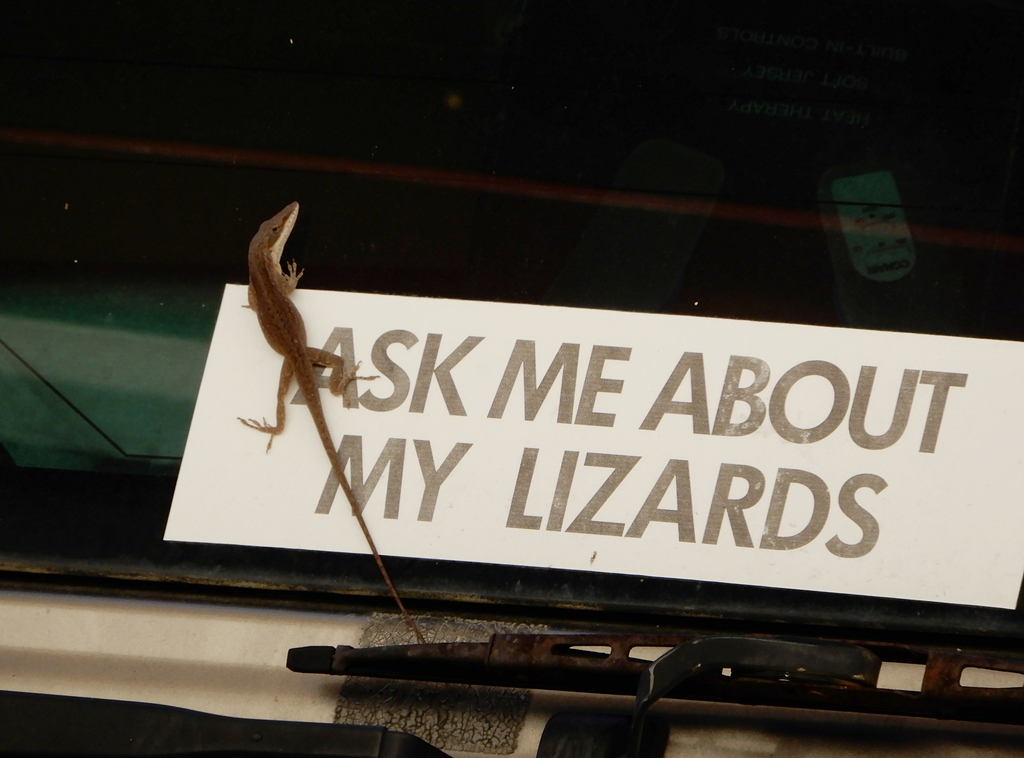
(c) Lyndsey, some rights reserved (CC BY) · licence
Family: Dactyloidae · Class: Reptilia · Order: Squamata
Anolis carolinensis (Green Anole) is a California animal in the Dactyloidae family.
The green anole is a small lizard species native to the southeastern United States, with introduced populations established in California. Adults typically measure 12.7 to 20.3 centimeters (5 to 8 inches) in total length, with males generally larger than females. Males possess a distinctive bright pink to red dewlap (throat fan) that extends when displaying, while females have a smaller, less colorful dewlap or lack one entirely. The species exhibits color-changing ability, shifting from bright green to brown or gray depending on temperature, mood, stress levels, and social interactions. The body is slender with a long, tapering tail that comprises approximately 60% of total body length. Toe pads contain specialized scales called lamellae that enable climbing on smooth surfaces. Historically absent from California, green anoles have established non-native populations through human introduction. Current populations occur primarily in Southern California, including Los Angeles, Orange, Riverside, and San Diego counties. Isolated populations have been documented in the San Francisco Bay Area. The species' native range extends from southeastern Virginia south to the Florida Keys and west to eastern Texas and southeastern Oklahoma. In California, populations are concentrated in urban and suburban environments where suitable microclimates and food sources exist. Green anoles inhabit arboreal environments, preferring areas with dense vegetation and vertical surfaces for basking and territorial displays. In California, they occupy ornamental shrubs, trees, fences, and building exteriors in residential areas. The species requires access to both sun and shade for thermoregulation, as they are ectothermic. Optimal habitat includes areas with 40-80% humidity and temperatures between 24-29°C (75-85°F). They seek shelter under bark, in tree holes, or among dense foliage during cooler periods and at night. Green anoles are primarily insectivorous, feeding on spiders, flies, beetles, moths, and other small arthropods. Males are highly territorial, performing distinctive head-bobbing displays and dewlap extensions to establish dominance and attract mates. Breeding occurs from April through August in California populations. Females lay single eggs every 10-14 days throughout the breeding season, depositing them in moist soil, leaf litter, or rotting wood. Eggs incubate for 35-60 days depending on temperature. Juveniles mature sexually at approximately one year of age. The species is diurnal, most active during morning and late afternoon hours when temperatures are moderate. As a non-native species in California, green anoles are not protected under state or federal endangered species legislation. Their establishment raises ecological concerns regarding potential impacts on native lizard species through competition for resources and habitat. According to the California Department of Fish and Wildlife, monitoring of established populations continues to assess ecological effects and distribution expansion. The species' ability to adapt to urban environments and mild California climates suggests populations may persist and potentially expand their current range. Climate change could facilitate further northward expansion as temperatures increase.
Classification
Class: Reptilia · Order: Squamata · Family: Dactyloidae
Frequently asked questions
How is Anolis carolinensis classified?
Anolis carolinensis belongs to class Reptilia, order Squamata, family Dactyloidae.
What family does Anolis carolinensis belong to?
Anolis carolinensis is in the Dactyloidae family.
What is Anolis carolinensis?
The green anole is a small lizard species native to the southeastern United States, with introduced populations established in California.
Is Anolis carolinensis found in California?
Yes. Anolis carolinensis is recorded in California in The California Species Project's catalogue.
Related species
Other California species in the same genus, family, or bioregion.
Data from The California Species Project — 14,000+ California species with verified data from CNPS, CDFW, USFWS, and more.