Anolis sagrei
Brown Anole
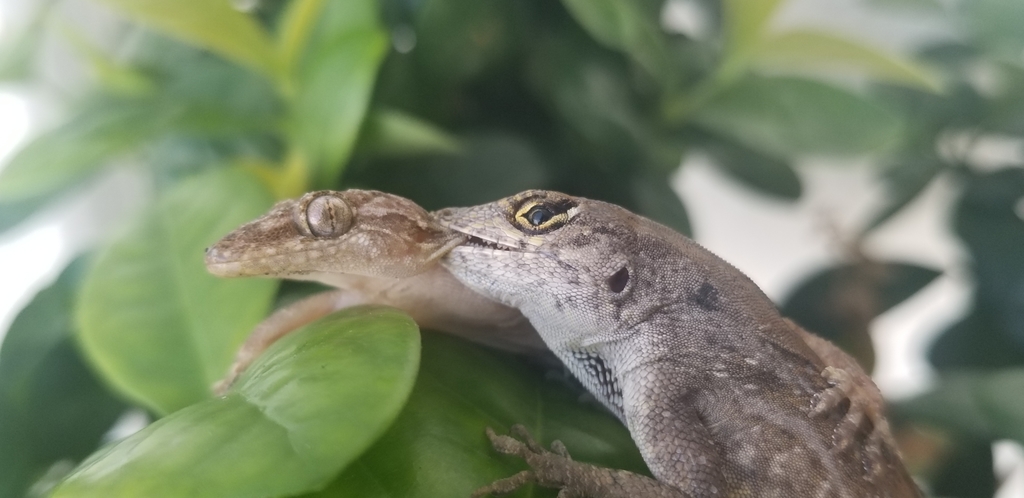
(c) chloe ⋆˚꩜。, some rights reserved (CC BY-SA) · licence
Family: Dactyloidae · Class: Reptilia · Order: Squamata
Anolis sagrei (Brown Anole) is a California animal in the Dactyloidae family.
The brown anole is a small, non-native lizard species that has established populations in California. Adult brown anoles measure 12.5 to 20.5 centimeters (5 to 8 inches) in total length, with males slightly larger than females. The dorsal coloration ranges from brown to grayish-brown, often with darker chevron or diamond patterns along the back. Males possess a bright orange-red dewlap (throat fan) with a white margin, which they extend during territorial displays and courtship. Females typically display a lighter dorsal stripe running from the head to the tail base. The species can rapidly change color from light brown to dark brown depending on temperature, stress, and social interactions. Native to Cuba and the Bahamas, brown anoles have established invasive populations across the southeastern United States and have been documented in California. In California, populations have been reported in urban areas of Los Angeles, Orange, and San Diego counties, primarily associated with nurseries, botanical gardens, and residential areas with exotic landscaping. The species likely arrived through the ornamental plant trade, as individuals often hitchhike on shipped vegetation. Brown anoles inhabit a variety of terrestrial and arboreal microhabitats, showing preference for areas with dense vegetation, shrubs, and human-modified landscapes. They commonly occupy fence lines, garden walls, patios, and structures up to 3 meters (10 feet) above ground. The species tolerates a wide range of environmental conditions and thrives in disturbed habitats, including urban parks, residential gardens, and commercial landscaping. They prefer areas with adequate cover for thermoregulation and foraging opportunities. Brown anoles are primarily insectivorous, feeding on ants, beetles, moths, spiders, and other small arthropods. Males are highly territorial, establishing home ranges averaging 9 square meters and defending these areas through aggressive displays, push-ups, and dewlap extensions. Breeding occurs throughout the warmer months, with females laying single eggs every 10 to 14 days in loose soil, leaf litter, or mulch. Incubation periods range from 30 to 45 days depending on temperature. Juveniles reach sexual maturity at 8 to 10 months of age. The species exhibits diurnal activity patterns, basking in morning sunlight and becoming less active during midday heat. Brown anoles are not protected under state or federal endangered species legislation, as they are considered an invasive species in California. Current populations appear limited and localized, but the species poses potential ecological concerns as an established non-native predator. Brown anoles may compete with native lizard species for food resources and habitat, particularly affecting smaller native reptiles and invertebrate communities. Early detection and rapid response protocols are important for preventing range expansion, as the species has demonstrated significant invasive potential in other regions. California Department of Fish and Wildlife monitors reports of brown anole sightings to track population establishment and distribution patterns.
Classification
Class: Reptilia · Order: Squamata · Family: Dactyloidae
Frequently asked questions
How is Anolis sagrei classified?
Anolis sagrei belongs to class Reptilia, order Squamata, family Dactyloidae.
What family does Anolis sagrei belong to?
Anolis sagrei is in the Dactyloidae family.
What is Anolis sagrei?
The brown anole is a small, non-native lizard species that has established populations in California.
Is Anolis sagrei found in California?
Yes. Anolis sagrei is recorded in California in The California Species Project's catalogue.
Related species
Other California species in the same genus, family, or bioregion.
Data from The California Species Project — 14,000+ California species with verified data from CNPS, CDFW, USFWS, and more.