Anser albifrons elgasi
Tule Greater White- Fronted Goose
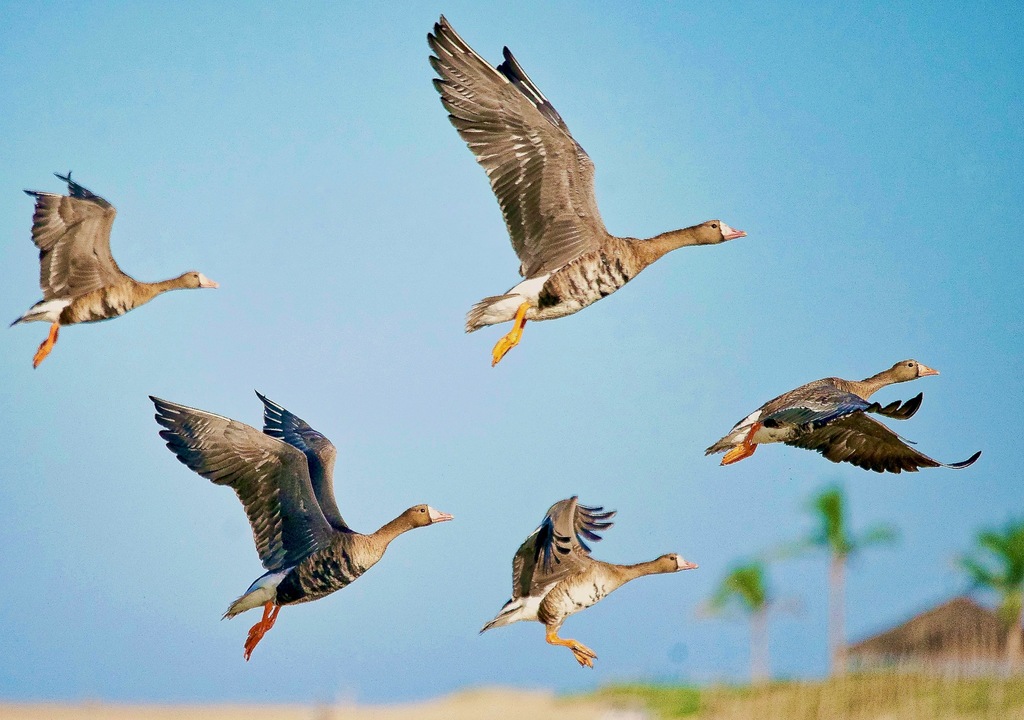
(c) Bill Levine, some rights reserved (CC BY) · licence
Family: Anatidae · Class: Aves · Order: Anseriformes
Conservation status: G5T3 S3
Anser albifrons elgasi (Tule Greater White- Fronted Goose) is a California animal in the Anatidae family.
The Tule Greater White-fronted Goose is the largest subspecies of Greater White-fronted Goose, distinguished by its darker plumage, more extensive black barring on the underparts, and bright orange legs and feet. Adults measure 70-86 cm (28-34 inches) in length with a wingspan of 130-165 cm (51-65 inches), weighing 2.3-3.2 kg (5.1-7.1 pounds). The characteristic white forehead patch develops after the first year, contrasting with the grayish-brown head and neck. The bill is pink to orange-pink, and the species displays prominent black irregular barring across the belly and breast, more extensive than in other subspecies. This subspecies has the most restricted range of all Greater White-fronted Goose populations. Tule geese breed exclusively in the Cook Inlet region of south-central Alaska, primarily in the Susitna River valley and surrounding wetlands. The wintering range is confined to California's Central Valley, particularly the Sacramento Valley and San Joaquin Valley. Sacramento National Wildlife Refuge serves as important wintering grounds, with the Willow Creek-Lurline Wildlife Management Area supporting a significant portion of the population during winter months. Breeding habitat consists of sedge-dominated wetlands, shallow ponds, and adjacent upland tundra in Alaska. During migration and winter, the subspecies utilizes flooded agricultural fields, managed wetlands, and shallow lakes. Wintering birds prefer rice fields, pastures, and wildlife refuge wetlands with water depths of 10-30 cm. The species requires both aquatic feeding areas and nearby upland roost sites. Tule geese are herbivorous, feeding primarily on sedges, grasses, and agricultural crops. During breeding season, they consume shoots and roots of sedges and pondweeds. Winter diet consists largely of waste rice, barley, and native wetland plants. The species is monogamous with permanent pair bonds, nesting in small colonies or isolated pairs. Females lay 4-6 creamy white eggs in ground nests lined with down and vegetation. Incubation lasts 27-28 days, with goslings fledging after 50-60 days. Family groups remain together through migration and into the following spring. The subspecies has a global conservation rank of G5T3, indicating it is vulnerable as a subspecies despite the species being secure overall. Population estimates range from 6,000-8,000 individuals based on recent waterfowl surveys. Primary threats include habitat loss from urban development in California's Central Valley, potential oil and gas development on Alaskan breeding grounds, and climate change impacts on wetland hydrology. The restricted breeding and wintering ranges make the population particularly vulnerable to localized threats. Conservation efforts focus on protecting and managing wetland habitats in both Alaska and California, with particular emphasis on maintaining flooded agricultural lands and refuge wetlands that support wintering concentrations.
Classification
Class: Aves · Order: Anseriformes · Family: Anatidae
Conservation status
G5T3 S3
Frequently asked questions
How is Anser albifrons elgasi classified?
Anser albifrons elgasi belongs to class Aves, order Anseriformes, family Anatidae.
What family does Anser albifrons elgasi belong to?
Anser albifrons elgasi is in the Anatidae family.
Is Anser albifrons elgasi protected or of conservation concern?
Anser albifrons elgasi carries the following status: G5T3 S3.
What is Anser albifrons elgasi?
The Tule Greater White-fronted Goose is the largest subspecies of Greater White-fronted Goose, distinguished by its darker plumage, more extensive black barring on the underparts, and bright orange legs and feet.
Is Anser albifrons elgasi found in California?
Yes. Anser albifrons elgasi is recorded in California in The California Species Project's catalogue.
Related species
Other California species in the same genus, family, or bioregion.
Data from The California Species Project — 14,000+ California species with verified data from CNPS, CDFW, USFWS, and more.