Anser canagicus
Emperor Goose
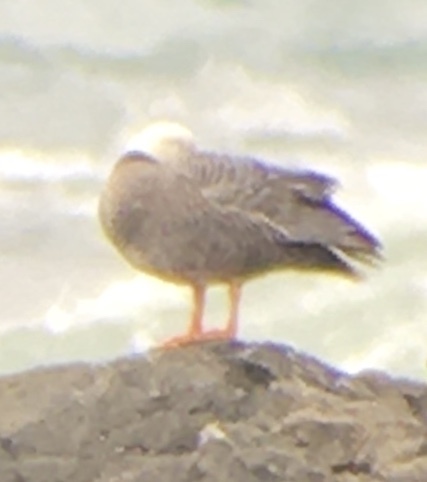
(c) Adam J. Searcy, some rights reserved (CC BY) · licence
Family: Anatidae · Class: Aves · Order: Anseriformes
Anser canagicus (Emperor Goose) is a California animal in the Anatidae family.
The Emperor Goose is a medium-sized waterfowl species measuring 66-71 cm (26-28 inches) in length with a wingspan of 142-157 cm (56-62 inches). Adults weigh between 2.4-3.2 kg (5.3-7.1 pounds). The species exhibits distinctive blue-gray plumage with black barring across the back and wings, creating a scaled appearance. The head and back of the neck are white, often stained orange-yellow from iron-rich feeding waters. A black throat patch extends from the bill to the upper chest. The bill is pink with a white nail, and the legs are orange-yellow. Juveniles display brownish-gray plumage with less distinct barring and darker head coloration. Emperor Geese breed primarily in western Alaska along the Yukon-Kuskokwim Delta and Bristol Bay regions, with smaller populations on St. Lawrence Island and the Seward Peninsula. The species winters along the Aleutian Islands chain, Alaska Peninsula, and occasionally reaches as far south as central California. In California, Emperor Geese are rare winter visitors, typically observed along the coast from November through March. Sightings have been documented in Humboldt, Mendocino, Sonoma, Marin, San Mateo, Santa Cruz, Monterey, and San Luis Obispo counties, with most records occurring north of San Francisco Bay. Breeding habitat consists of coastal tundra wetlands, including shallow ponds, marshes, and lagoons within 50 km of the coast. Nesting sites are typically located on small islands or elevated areas surrounded by water, providing protection from terrestrial predators. During winter, the species inhabits rocky shorelines, kelp beds, and nearshore marine waters where they feed in intertidal zones. Emperor Geese prefer areas with abundant marine vegetation and access to sandy or muddy substrates. Emperor Geese are primarily herbivorous, feeding on eelgrass (Zostera marina), sea lettuce (Ulva lactuca), and other marine algae during winter. On breeding grounds, they consume sedges, grasses, and aquatic invertebrates. Breeding pairs arrive at nesting areas in late May, with females laying 3-5 buff-colored eggs in ground nests lined with down and vegetation. Incubation lasts 24-25 days, with only females incubating. Young fledge after 50-55 days. The species is highly gregarious during winter, forming flocks of several hundred to over 1,000 individuals. Emperor Geese are not federally listed but are managed as a species of conservation concern. The Alaska breeding population is estimated at 60,000-80,000 individuals, representing the vast majority of the global population. Population trends appear stable, though the species faces threats from climate change impacts on Arctic breeding habitats, oil spill risks in marine wintering areas, and potential disturbance from increased shipping traffic. Subsistence hunting by Alaska Native communities is regulated through the Migratory Bird Treaty Act. In California, the species remains a rare but regular winter visitor, with approximately 5-15 individuals reported annually during Christmas Bird Count surveys.
Classification
Class: Aves · Order: Anseriformes · Family: Anatidae
Frequently asked questions
How is Anser canagicus classified?
Anser canagicus belongs to class Aves, order Anseriformes, family Anatidae.
What family does Anser canagicus belong to?
Anser canagicus is in the Anatidae family.
What is Anser canagicus?
The Emperor Goose is a medium-sized waterfowl species measuring 66-71 cm (26-28 inches) in length with a wingspan of 142-157 cm (56-62 inches).
Is Anser canagicus found in California?
Yes. Anser canagicus is recorded in California in The California Species Project's catalogue.
Related species
Other California species in the same genus, family, or bioregion.
Data from The California Species Project — 14,000+ California species with verified data from CNPS, CDFW, USFWS, and more.