Anser rossii
Ross's Goose
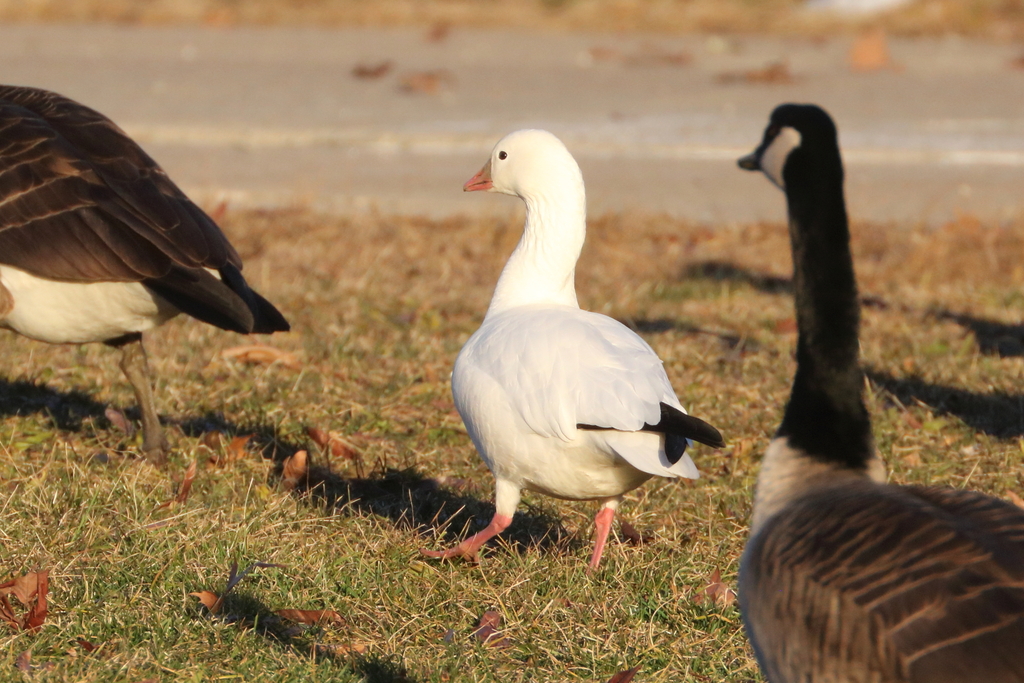
(c) Seth Wollney, some rights reserved (CC BY) · licence
Family: Anatidae · Class: Aves · Order: Anseriformes
Anser rossii (Ross's Goose) is a California animal in the Anatidae family.
Ross's Goose (Anser rossii) is a small North American waterfowl species that breeds in the Arctic and winters primarily in California's Central Valley. Adults measure 53 to 66 cm (21 to 26 inches) in length with a wingspan of 113 to 116 cm (44 to 46 inches). Body weight ranges from 1.2 to 1.6 kg (2.6 to 3.5 pounds), making it the smallest of the three North American 'white geese.' The species exhibits sexual dimorphism, with males averaging 10% larger than females. Adults display entirely white plumage except for black primary flight feathers visible during flight and when wings are extended. The bill is relatively short and triangular, ranging from pink to red with a black cutting edge and distinctive warty protuberances at the base, particularly pronounced in males during breeding season. Legs and feet are pink to red. Juveniles show grayish wash on the head, neck, and back, which molts to pure white by their first winter. Ross's Goose breeds exclusively in the Arctic regions of northern Canada, primarily in the Queen Maud Gulf area of Nunavut and the western Arctic islands. The global breeding population is estimated at approximately 2.2 million individuals according to the North American Bird Conservation Initiative. During migration and winter, the species concentrates heavily in California's Central Valley, particularly in Sacramento and San Joaquin valleys, with smaller numbers reaching Texas Gulf Coast and northwestern Mexico. Breeding habitat consists of low Arctic tundra near lakes, ponds, and coastal areas. Nests are constructed on small islands or elevated areas surrounded by water, providing protection from terrestrial predators. Winter habitat includes flooded rice fields, managed wetlands, grasslands, and grain fields. The species shows strong preference for areas with nearby roosting waters such as wildlife refuges and managed ponds. Ross's Geese are highly gregarious, forming large flocks during migration and winter that can number in the tens of thousands. Breeding occurs from late May through July, with females laying 3 to 5 white eggs in ground nests lined with down. Incubation lasts 21 to 24 days, performed solely by females while males maintain territory. Young fledge after 40 to 45 days and remain with parents through first migration. The species feeds primarily on grasses, sedges, and aquatic plants during breeding season. In winter quarters, diet shifts to include waste grains, particularly rice, and green vegetation in agricultural fields. Foraging occurs primarily during daylight hours in terrestrial habitats, with evening return flights to water roosts. Ross's Goose populations have increased dramatically since the 1950s, recovering from historical low numbers of approximately 6,000 birds in the 1940s to current estimates of 2.2 million individuals. This population growth has led to concerns about overabundance in some wintering areas, particularly impacts on Arctic breeding habitats from increased grazing pressure. The species is not federally listed and maintains stable conservation status, though hunting regulations continue to be adjusted to manage population levels and distribution patterns.
Classification
Class: Aves · Order: Anseriformes · Family: Anatidae
Frequently asked questions
How is Anser rossii classified?
Anser rossii belongs to class Aves, order Anseriformes, family Anatidae.
What family does Anser rossii belong to?
Anser rossii is in the Anatidae family.
What is Anser rossii?
Ross's Goose (Anser rossii) is a small North American waterfowl species that breeds in the Arctic and winters primarily in California's Central Valley.
Is Anser rossii found in California?
Yes. Anser rossii is recorded in California in The California Species Project's catalogue.
Related species
Other California species in the same genus, family, or bioregion.
Data from The California Species Project — 14,000+ California species with verified data from CNPS, CDFW, USFWS, and more.