Antepirrhoe semiatrata
Black-banded Carpet Moth
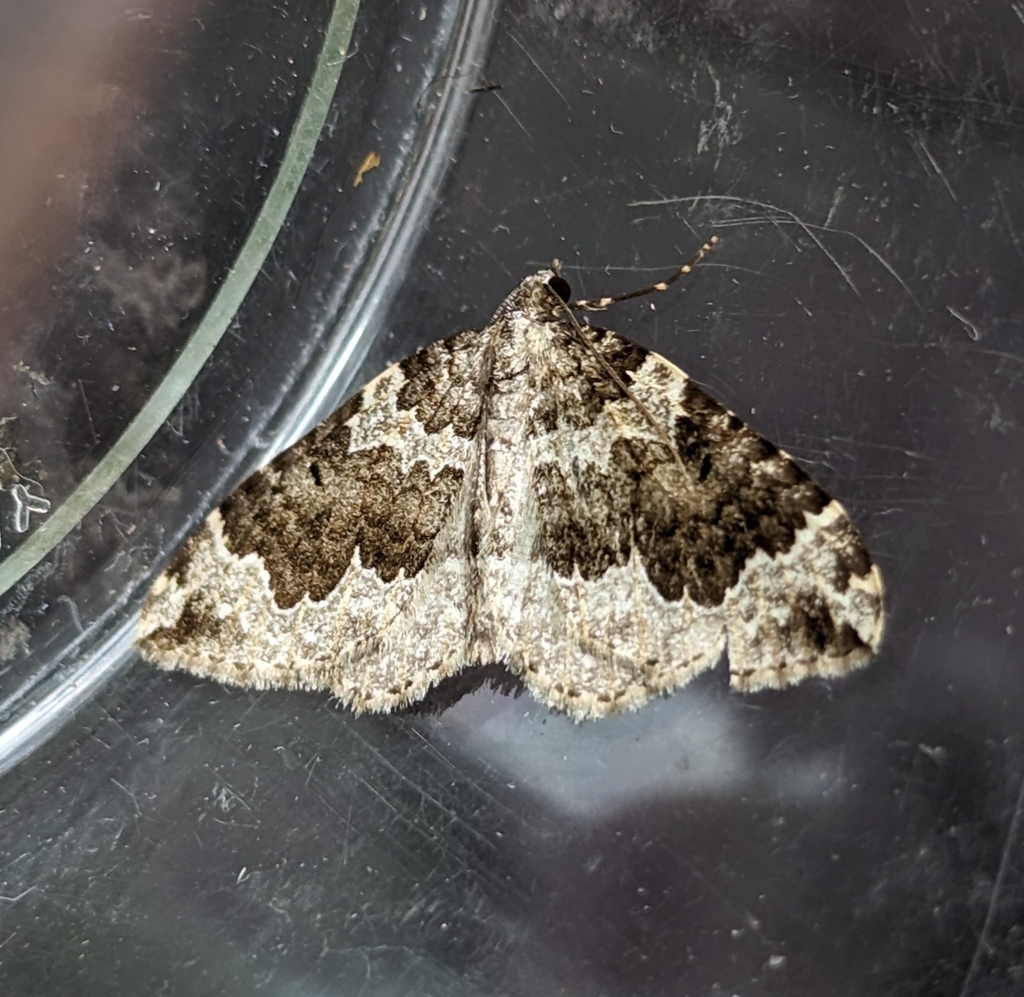
no rights reserved · CC0
Family: Geometridae · Class: Insecta · Order: Lepidoptera
Antepirrhoe semiatrata (Black-banded Carpet Moth) is a California animal in the Geometridae family.
The Black-banded Carpet Moth is a geometrid moth in the subfamily Larentiinae, distinguished by its distinctive wing pattern and coloration. Adults display forewings that are characteristically half black and half pale gray, giving rise to both the common name and the scientific epithet 'semiatrata,' which derives from Latin meaning 'half black' (BugGuide). The forewings feature prominent black bands contrasting with lighter areas, while the hindwings are typically paler. Wing span and detailed measurements have not been extensively documented in the scientific literature. This species exhibits a broad North American distribution, ranging from Alaska to Nova Scotia and extending south to southern California and South Dakota. The extensive range spans both boreal and temperate regions across the continent. According to BugGuide, the species has been documented from various states including California, though specific county-level distribution data within California remains limited in published sources. Black-banded Carpet Moths inhabit boreal forests and forest clearings where their host plants occur (BugGuide). The species shows a strong association with areas containing fireweed and related plants in the family Onagraceae. According to the Moth Photographers Group, larvae utilize host plants from both Ericaceae and Onagraceae families, with documented genera including Chamaenerion, Epilobium, and Vaccinium. Powell and Opler note that larval hosts include various herbaceous plants within these families. Adult flight periods vary considerably across the species' range, reflecting the broad latitudinal distribution. In New York, adults fly from July to September, while in British Columbia the flight season extends from April to October (BugGuide). This variation likely corresponds to different climatic conditions and growing seasons across the range. Larvae feed on leaves of fireweed (Epilobium angustifolium) and other willow-herb species in the genus Epilobium, as well as members of the heath family. The taxonomic status of this species has undergone recent revision. Historically placed in the genus Eustroma, the species was transferred to Antepirrhoe following cladistic analysis by Sei-Woong Choi in 2001, who reinstated Antepirrhoe as a valid genus based on morphological character analysis of 51 traits across 47 related species (BugGuide). This analysis distinguished the three North American Antepirrhoe species from the Eurasian Eustroma species. The species carries Hodges number 7210 in the standardized moth classification system. No federal or state conservation listings have been identified for this species. The broad continental distribution suggests relatively stable populations, though specific population trend data are not available in the literature. Climate change impacts on boreal forest habitats and host plant distributions may pose future challenges, particularly at the southern extent of the range. The species' dependence on specific host plant families makes habitat conservation important for maintaining viable populations across its range.
Classification
Class: Insecta · Order: Lepidoptera · Family: Geometridae
Frequently asked questions
How is Antepirrhoe semiatrata classified?
Antepirrhoe semiatrata belongs to class Insecta, order Lepidoptera, family Geometridae.
What family does Antepirrhoe semiatrata belong to?
Antepirrhoe semiatrata is in the Geometridae family.
What is Antepirrhoe semiatrata?
The Black-banded Carpet Moth is a geometrid moth in the subfamily Larentiinae, distinguished by its distinctive wing pattern and coloration.
Is Antepirrhoe semiatrata found in California?
Yes. Antepirrhoe semiatrata is recorded in California in The California Species Project's catalogue.
Related species
Other California species in the same genus, family, or bioregion.
Data from The California Species Project — 14,000+ California species with verified data from CNPS, CDFW, USFWS, and more.