Antheraea polyphemus
Polyphemus moth
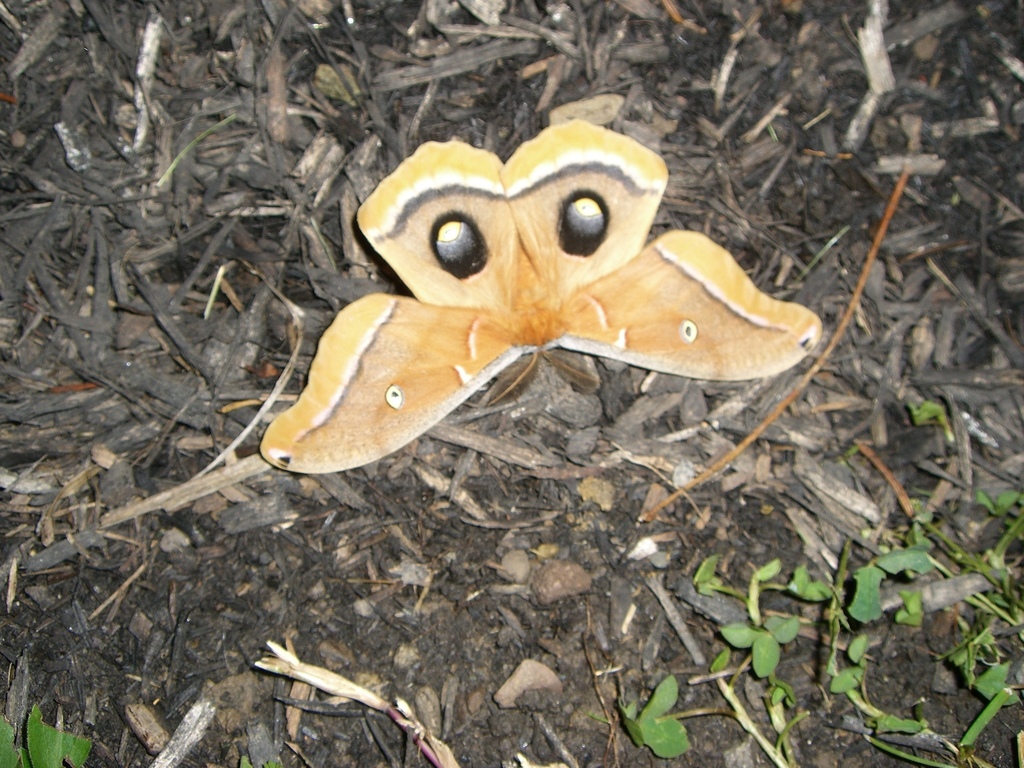
no rights reserved · CC0
Family: Saturniidae · Class: Insecta · Order: Lepidoptera
Antheraea polyphemus (Polyphemus moth) is a California animal in the Saturniidae family.
The Polyphemus moth is North America's largest native silk moth, with females reaching wingspans of 100 to 150 mm (4 to 6 inches) and males typically measuring 75 to 100 mm (3 to 4 inches). The forewings are reddish-brown to tan with distinctive eye-spots, while the hindwings display prominent eyespots resembling those of the mythological giant Polyphemus, measuring approximately 20 mm in diameter. These eyespots consist of concentric circles of yellow, blue, black, and white, serving as a primary defense mechanism against predators. Males possess broader, more feathery antennae compared to females, enabling them to detect female pheromones from distances exceeding 1.6 kilometers (1 mile). The species maintains a broad distribution across North America, occurring in every Canadian province except Newfoundland and Prince Edward Island, and in every U.S. state except Arizona and Nevada. The range extends south into Mexico. In California, populations occur primarily in the northern and central regions where suitable host plants are abundant. The species demonstrates considerable adaptability across diverse climatic zones from sea level to elevations of approximately 2,000 meters (6,560 feet). Polyphemus moths inhabit deciduous and mixed forests, woodlands, parks, and suburban areas where host trees occur. The species utilizes a wide variety of trees and shrubs including oak (Quercus), willow (Salix), maple (Acer), and birch (Betula). Additional documented hosts include cherry (Prunus), elm (Ulmus), basswood (Tilia), and hickory (Carya). Larvae show particular preference for oak species in western populations. The species tolerates various habitat types from dense forests to fragmented suburban landscapes. Adult moths emerge from pupae in late spring through early summer, typically from May through July depending on latitude and elevation. Adults do not feed, relying entirely on energy reserves accumulated during the larval stage. Mating occurs at night, with males using their sensitive antennae to locate females releasing sex pheromones. Females deposit 200 to 300 eggs singly on host plant leaves. Larvae undergo five instars over 6 to 8 weeks, reaching lengths of 75 to 100 mm before pupating. The species typically produces one generation per year in northern regions and two generations in southern areas. Larvae construct brown, papery cocoons attached to branches or leaf litter, where they overwinter as pupae. The Polyphemus moth currently maintains stable populations throughout most of its range and carries no federal or state conservation listing. However, localized declines have been documented in urbanized areas due to habitat fragmentation and light pollution, which disrupts mating behaviors. Pesticide applications targeting forest pests can impact larval populations. Climate change may affect the species' northern range limits and alter synchronization between emergence timing and host plant phenology. The moth's broad host plant range and adaptability to various habitats contribute to its overall population stability.
Classification
Class: Insecta · Order: Lepidoptera · Family: Saturniidae
Frequently asked questions
How is Antheraea polyphemus classified?
Antheraea polyphemus belongs to class Insecta, order Lepidoptera, family Saturniidae.
What family does Antheraea polyphemus belong to?
Antheraea polyphemus is in the Saturniidae family.
What is Antheraea polyphemus?
The Polyphemus moth is North America's largest native silk moth, with females reaching wingspans of 100 to 150 mm (4 to 6 inches) and males typically measuring 75 to 100 mm (3 to 4 inches).
Is Antheraea polyphemus found in California?
Yes. Antheraea polyphemus is recorded in California in The California Species Project's catalogue.
Related species
Other California species in the same genus, family, or bioregion.
Data from The California Species Project — 14,000+ California species with verified data from CNPS, CDFW, USFWS, and more.