Anthidium maculosum
Spotted Woolcarder
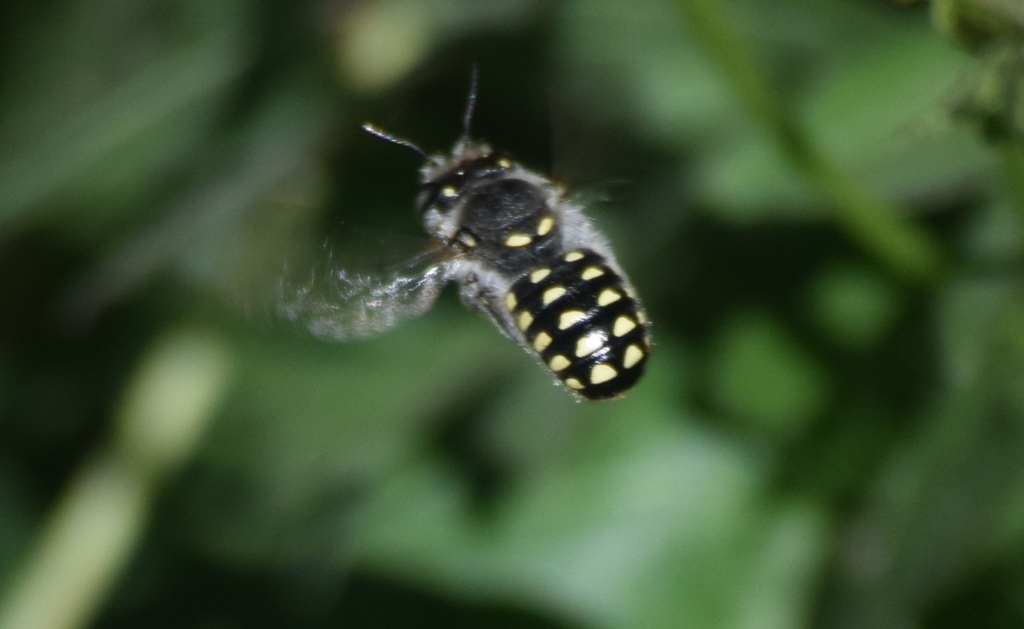
(c) William Harmon, some rights reserved (CC BY) · licence
Family: Megachilidae · Class: Insecta · Order: Hymenoptera
Anthidium maculosum (Spotted Woolcarder) is a California animal in the Megachilidae family.
The Spotted Woolcarder (Anthidium maculosum) is a medium-sized solitary bee in the family Megachilidae, measuring approximately 8-12 mm in length. Like other woolcarder bees, this species exhibits distinct sexual dimorphism, with males typically larger and more boldly patterned than females. The common name derives from the female's distinctive behavior of collecting plant fibers, or "wool," to construct nest cells. The species displays the characteristic robust build of megachilid bees, with females possessing specialized scopae (pollen-collecting hairs) on the ventral surface of the abdomen rather than on the legs. Anthidium maculosum occurs across much of North America, with populations documented from southern Canada through the United States into Mexico. In California, the species has been recorded from various counties, though specific distribution data within the state requires further documentation. The species appears to have a relatively broad geographic range compared to some other Anthidium species, which often show more restricted distributions. The Spotted Woolcarder inhabits diverse habitats where suitable host plants and nesting sites occur. Like other woolcarder bees, this species requires access to plants with dense, woolly or downy leaf surfaces from which females can collect nesting material. The species shows particular association with plants in the mint family (Lamiaceae) and other fuzzy-leaved vegetation. Nesting sites typically include hollow stems, crevices in wood or rock, or other pre-existing cavities that females can partition into individual cells using collected plant fibers. Females exhibit the characteristic woolcarder behavior of scraping plant hairs and fibers from leaf surfaces using their mandibles, then carrying this material back to nest sites. The collected plant wool is used to construct waterproof cell walls within cavities, creating individual chambers for eggs and provisions. Each cell is stocked with a mixture of pollen and nectar before a single egg is deposited. Males are often territorial, defending patches of preferred flowering plants and attempting to mate with visiting females. The species is active during warmer months, with peak activity typically occurring in summer when preferred host plants are in bloom. According to NatureServe Explorer, Anthidium maculosum is considered widespread and common across its range, with populations known from many localities and no apparent declining trend. The species does not currently hold federal or state conservation listing status in California or elsewhere within its range. However, like many native bee species, populations may face localized pressures from habitat loss, pesticide use, and competition from introduced species such as the European woolcarder bee (Anthidium manicatum). The maintenance of diverse native plant communities, particularly those with woolly-leaved species, supports continued population stability. Further research into the species' specific ecological requirements and distribution patterns in California would enhance understanding of its conservation needs.
Classification
Class: Insecta · Order: Hymenoptera · Family: Megachilidae
Frequently asked questions
How is Anthidium maculosum classified?
Anthidium maculosum belongs to class Insecta, order Hymenoptera, family Megachilidae.
What family does Anthidium maculosum belong to?
Anthidium maculosum is in the Megachilidae family.
What is Anthidium maculosum?
The Spotted Woolcarder (Anthidium maculosum) is a medium-sized solitary bee in the family Megachilidae, measuring approximately 8-12 mm in length.
Is Anthidium maculosum found in California?
Yes. Anthidium maculosum is recorded in California in The California Species Project's catalogue.
Related species
Other California species in the same genus, family, or bioregion.
Data from The California Species Project — 14,000+ California species with verified data from CNPS, CDFW, USFWS, and more.