Anthidium manicatum
European Woolcarder Bee
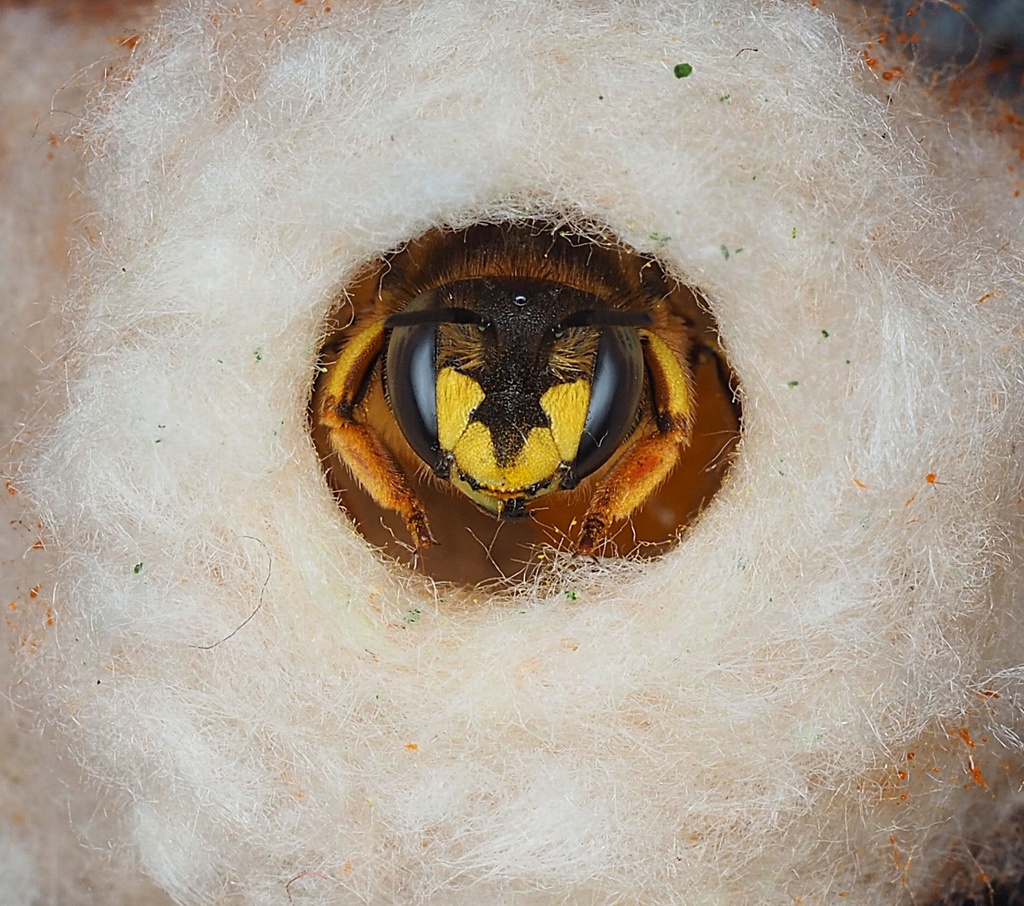
(c) Tom, some rights reserved (CC BY) · licence
Family: Megachilidae · Class: Insecta · Order: Hymenoptera
Anthidium manicatum (European Woolcarder Bee) is a California animal in the Megachilidae family.
The European Woolcarder Bee is a non-native bee species measuring 8-12 mm in length, belonging to the family Megachilidae. Females are robust with black and yellow coloration, while males are typically larger and more aggressive in behavior. The species exhibits sexual dimorphism, with males possessing distinctive terminal abdominal spines used for territorial defense. Both sexes have dense hair collections on the underside of their abdomens, which females use to transport plant fibers for nest construction. Originally native to Europe, Anthidium manicatum was first documented in North America before 1963 and has since established populations across much of the United States and southern Canada (BugGuide). The species occurs throughout California, where it has become widely distributed in urban and suburban environments. Its range continues to expand as suitable habitat and host plants become available in new areas. European Woolcarder Bees inhabit gardens, parks, disturbed areas, and urban landscapes where their preferred host plants grow. The species shows a strong association with plants in the mint family (Lamiaceae), particularly lamb's ears (Stachys byzantina), from which females collect the characteristic woolly hairs that give the species its common name. They also utilize other fuzzy-leaved plants for fiber collection and visit various flowers for nectar. Females are solitary nesters, constructing brood cells in pre-existing cavities such as hollow stems, beetle borings, or artificial nest sites. They line these cells with plant fibers collected from woolly-leaved plants, creating distinctive white, cotton-like nest chambers. Each cell is provisioned with a pollen ball before an egg is deposited. Males exhibit highly territorial behavior, establishing patrol routes around patches of host plants where they aggressively chase away other insects, including much larger species, and even occasionally confront humans. This aggressive territorial defense is unusual among bee species and helps ensure male access to emerging females. The species is multivoltine, producing multiple generations per year in favorable climates. Adults are active from spring through fall, with peak activity during summer months. Females demonstrate strong fidelity to specific plant species for fiber collection, though they are generalist foragers for nectar, visiting a wide variety of flowering plants. As a non-native species, Anthidium manicatum is not protected under federal or state conservation legislation. NatureServe ranks the species globally secure (G5), reflecting its stable populations and continued range expansion (NatureServe Explorer). The species poses potential ecological concerns as an introduced pollinator that may compete with native bee species for nesting sites and floral resources. However, its ecological impact on native pollinator communities in California has not been thoroughly studied. The European Woolcarder Bee's establishment demonstrates the ongoing changes to North American pollinator communities through species introductions, highlighting the need for continued monitoring of both native and non-native bee populations to understand ecosystem-level effects of biological invasions.
Classification
Class: Insecta · Order: Hymenoptera · Family: Megachilidae
Frequently asked questions
How is Anthidium manicatum classified?
Anthidium manicatum belongs to class Insecta, order Hymenoptera, family Megachilidae.
What family does Anthidium manicatum belong to?
Anthidium manicatum is in the Megachilidae family.
What is Anthidium manicatum?
The European Woolcarder Bee is a non-native bee species measuring 8-12 mm in length, belonging to the family Megachilidae.
Is Anthidium manicatum found in California?
Yes. Anthidium manicatum is recorded in California in The California Species Project's catalogue.
Related species
Other California species in the same genus, family, or bioregion.
Data from The California Species Project — 14,000+ California species with verified data from CNPS, CDFW, USFWS, and more.