Anthocharis cethura
Desert Orangetip
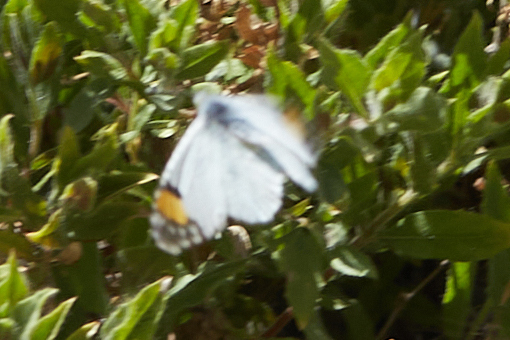
(c) Ken-ichi Ueda, some rights reserved (CC BY) · licence
Family: Pieridae · Class: Insecta · Order: Lepidoptera
Anthocharis cethura (Desert Orangetip) is a California animal in the Pieridae family.
The Desert Orangetip is a small to medium-sized butterfly in the white and sulfur family Pieridae. Males display distinctive bright orange patches on the forewings, particularly near the wing tips, which give the species its common name. The orange coloration is bordered by black markings and contrasts sharply with the predominantly white or cream-colored wing base. Females typically lack the orange patches and appear more mottled with grayish-brown and white markings, providing camouflage when at rest on host plants. The underwings of both sexes show intricate patterns of green and white marbling that resemble lichen or moss. The wingspan ranges from 32 to 44 millimeters (1.3 to 1.7 inches). The antennae are clubbed and checkered black and white, typical of the Pieridae family. Desert Orangetips occur across a broad range extending from northwestern Nevada south through southeastern California and western Arizona to northern Mexico. Within California, populations are documented from the Mojave Desert, Colorado Desert, and adjacent mountain ranges. The species inhabits areas where suitable host plants are present, typically at elevations below 1,500 meters (4,900 feet). Their distribution closely follows that of their mustard family host plants throughout the arid Southwest. This species occupies desert washes, rocky slopes, and canyon bottoms where mustard family plants grow. Preferred habitats include creosote bush scrub, desert chaparral, and pinyon-juniper woodland at lower elevations. Desert Orangetips are closely associated with areas that receive periodic moisture, such as ephemeral drainages and spring seeps, where their host plants are most abundant. The species appears to favor disturbed areas and edges where mustard plants colonize following winter rains. Desert Orangetips utilize tansy-mustard, jewelflower, tumble mustard, and probably other plants in the mustard family (Brassicaceae) as larval host plants. Adults are active primarily in spring, typically from February through May, coinciding with the blooming period of desert wildflowers. Males patrol territories and engage in courtship flights, often aggregating around patches of host plants. Females lay eggs singly on flower buds and young seed pods of mustard plants. The larvae feed on developing seeds and flowers, completing development in approximately four to six weeks. The species likely has one generation per year, with adults emerging after adequate winter precipitation triggers host plant growth. The Desert Orangetip is not currently listed under federal or state endangered species acts and appears to maintain stable populations across most of its range. However, populations may fluctuate significantly based on annual precipitation patterns that affect host plant abundance. Primary threats include habitat loss from urban development, off-road vehicle use, and invasive plant species that displace native mustards. Climate change may alter precipitation patterns and shift the distribution of suitable habitat. The species benefits from habitat protection in desert parks and wilderness areas throughout its range.
Classification
Class: Insecta · Order: Lepidoptera · Family: Pieridae
Frequently asked questions
How is Anthocharis cethura classified?
Anthocharis cethura belongs to class Insecta, order Lepidoptera, family Pieridae.
What family does Anthocharis cethura belong to?
Anthocharis cethura is in the Pieridae family.
What is Anthocharis cethura?
The Desert Orangetip is a small to medium-sized butterfly in the white and sulfur family Pieridae.
Is Anthocharis cethura found in California?
Yes. Anthocharis cethura is recorded in California in The California Species Project's catalogue.
Related species
Other California species in the same genus, family, or bioregion.
Data from The California Species Project — 14,000+ California species with verified data from CNPS, CDFW, USFWS, and more.