Anthocharis sara
Sara Orangetip
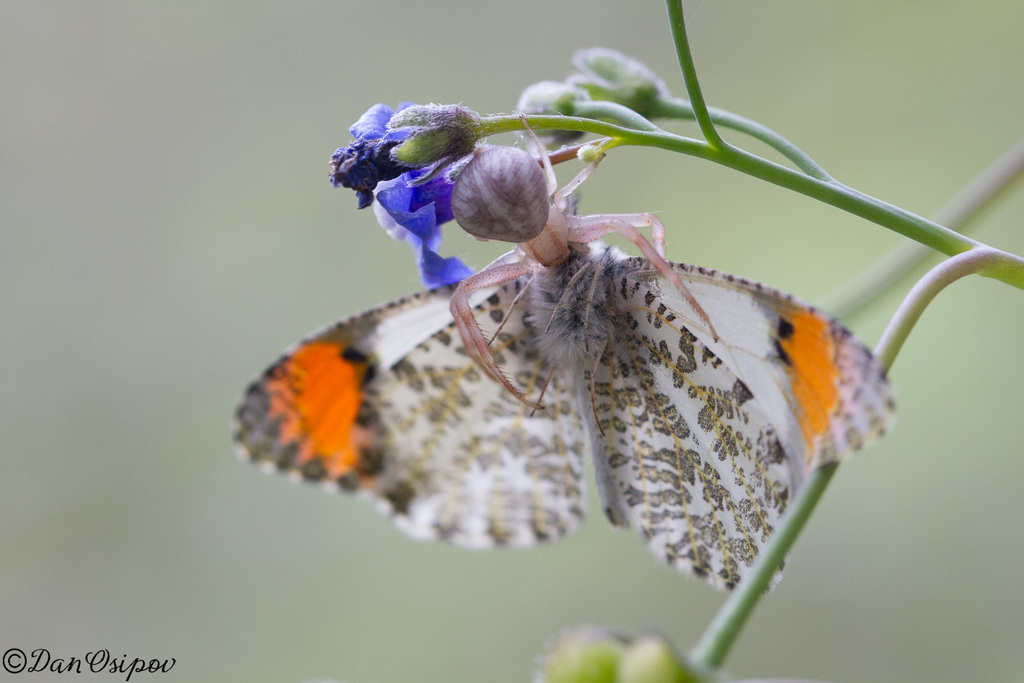
(c) Dan Osipov, some rights reserved (CC BY) · licence
Family: Pieridae · Class: Insecta · Order: Lepidoptera
Anthocharis sara (Sara Orangetip) is a California animal in the Pieridae family.
The Sara orangetip is a medium-sized butterfly in the white and sulphur family (Pieridae). Adults have a wingspan of 32 to 45 mm (1.3 to 1.8 inches). Males display bright white forewings with distinctive orange patches at the wing tips, bordered by black markings. The orange coloration is absent in females, which show white forewings with black wing tips and subtle gray markings. Both sexes exhibit marbled green and white patterns on the undersides of their hindwings, providing effective camouflage when at rest. The body is white to pale yellow with dark scaling along the thorax. Sara orangetips range from the Alaska coast south to Baja California, occurring mainly west of the Pacific divide. In California, populations are found throughout the coastal ranges, Sierra Nevada foothills, and Cascade Range, typically at elevations from sea level to 2,400 meters (7,900 feet). The species exhibits considerable regional variation in size, coloration, and flight timing across this extensive range. This species inhabits diverse environments including chaparral, oak woodlands, mixed coniferous forests, riparian corridors, and disturbed areas such as roadsides and clearcuts. Adults are commonly observed in areas where their host plants grow abundantly, particularly in sunny openings and edges of forested habitats. They show a preference for slopes and hillsides with good sun exposure and adequate moisture. Sara orangetips are specialized herbivores that feed exclusively on plants in the mustard family (Brassicaceae), particularly rock cresses such as tower mustard (Arabis glabra). Larvae consume flower buds, seed pods, and occasionally leaves of their host plants. In California, the presence of late-flowering mustard species (Brassica species) allows for extended larval feeding periods and enables a partial second flight in some populations. Adults feed on nectar from various flowers including their host plants, as well as other spring-blooming species. The species typically produces one generation per year, with adults emerging from March through July depending on elevation and latitude. Earlier flights occur at lower elevations and southern latitudes. Females lay single eggs on flower buds or young seed pods of host plants. Larvae develop through five instars over 3 to 4 weeks, pupating in a chrysalis that overwinters. Males exhibit territorial behavior and engage in hilltopping, where they patrol elevated areas to locate females. Sara orangetips are not federally or state listed and appear to maintain stable populations across most of their range. Their adaptability to disturbed habitats and use of common, weedy mustard species as hosts contributes to their persistence. However, localized populations may face pressure from habitat loss due to urban development and intensive agriculture. The species benefits from forest management practices that maintain open areas and edge habitats where host plants can establish.
Classification
Class: Insecta · Order: Lepidoptera · Family: Pieridae
Frequently asked questions
How is Anthocharis sara classified?
Anthocharis sara belongs to class Insecta, order Lepidoptera, family Pieridae.
What family does Anthocharis sara belong to?
Anthocharis sara is in the Pieridae family.
What is Anthocharis sara?
The Sara orangetip is a medium-sized butterfly in the white and sulphur family (Pieridae).
Is Anthocharis sara found in California?
Yes. Anthocharis sara is recorded in California in The California Species Project's catalogue.
Related species
Other California species in the same genus, family, or bioregion.
Data from The California Species Project — 14,000+ California species with verified data from CNPS, CDFW, USFWS, and more.