Anthocharis stella
Stella Orangetip
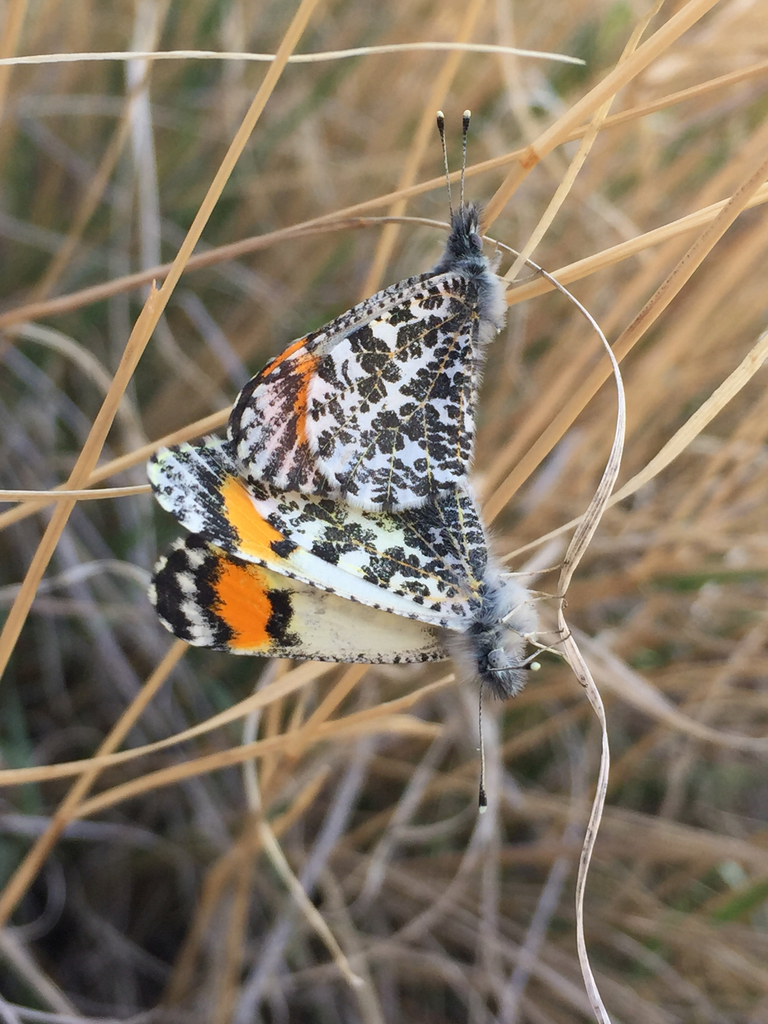
no rights reserved · CC0
Family: Pieridae · Class: Insecta · Order: Lepidoptera
Anthocharis stella (Stella Orangetip) is a California animal in the Pieridae family.
The Stella Orangetip is a small to medium-sized butterfly in the white and sulphur family (Pieridae). Males display bright white wings with distinctive orange patches on the forewings' tips, bordered by black markings. The orange coloration is typically confined to the apex of the forewings and serves as the species' most recognizable feature. Females lack the orange patches and appear predominantly white with black markings along wing margins and forewings tips. Both sexes have gray-green mottling on the undersides of their hindwings, providing camouflage when at rest. The wingspan ranges from 35 to 50 mm (1.4 to 2.0 inches). The Stella Orangetip exhibits one of the broadest distributions among North American orangetip butterflies, ranging from the Alaska coast south to Baja California and extending eastward to North Dakota, New Mexico, and extreme western Texas. In California, populations occur throughout much of the state, from coastal areas to interior valleys and mountain foothills. The species demonstrates adaptability across diverse climatic zones, from maritime coastal environments to arid interior regions. This butterfly inhabits a variety of open habitats including grasslands, chaparral, oak woodlands, desert washes, and disturbed areas such as roadsides and field margins. Elevation ranges from sea level to approximately 2,500 meters (8,200 feet) in mountainous regions. The species shows preference for areas with abundant mustard family plants and typically avoids dense forest environments. Adults are most commonly observed in areas with scattered shrubs and open ground where host plants flourish. Stella Orangetips are univoltine, producing one generation per year with flight periods typically occurring from March through June, depending on elevation and latitude. Males engage in patrolling behavior, flying low over suitable habitat in search of females. Mating occurs in spring when adults emerge following winter pupation. Females lay single eggs on flower buds or young leaves of mustard family plants including tansy-mustard (Descurainia), hedge mustard (Sisymbrium), and rock cresses (Arabis species). Larvae feed on developing seeds, flowers, and young fruits of these host plants. The caterpillars are typically green with pale stripes and complete development within 4-6 weeks. Pupation occurs in a chrysalis attached to the host plant or nearby vegetation, with individuals overwintering in this stage. The Stella Orangetip currently holds no special conservation status at federal or state levels. The species appears to maintain stable populations across much of its range, likely benefiting from its broad habitat tolerance and diverse host plant associations. However, localized populations may face pressures from habitat conversion, particularly in rapidly developing areas of California. Urban expansion and agricultural intensification can reduce available habitat and host plant diversity. The species' reliance on annual mustard plants, some of which are considered weeds, may provide some resilience against habitat modification compared to butterflies dependent on more specialized native plant communities.
Classification
Class: Insecta · Order: Lepidoptera · Family: Pieridae
Frequently asked questions
How is Anthocharis stella classified?
Anthocharis stella belongs to class Insecta, order Lepidoptera, family Pieridae.
What family does Anthocharis stella belong to?
Anthocharis stella is in the Pieridae family.
What is Anthocharis stella?
The Stella Orangetip is a small to medium-sized butterfly in the white and sulphur family (Pieridae).
Is Anthocharis stella found in California?
Yes. Anthocharis stella is recorded in California in The California Species Project's catalogue.
Related species
Other California species in the same genus, family, or bioregion.
Data from The California Species Project — 14,000+ California species with verified data from CNPS, CDFW, USFWS, and more.