Anthocharis thoosa
Southwestern Orangetip
no rights reserved · CC0
Family: Pieridae · Class: Insecta · Order: Lepidoptera
Anthocharis thoosa (Southwestern Orangetip) is a California animal in the Pieridae family.
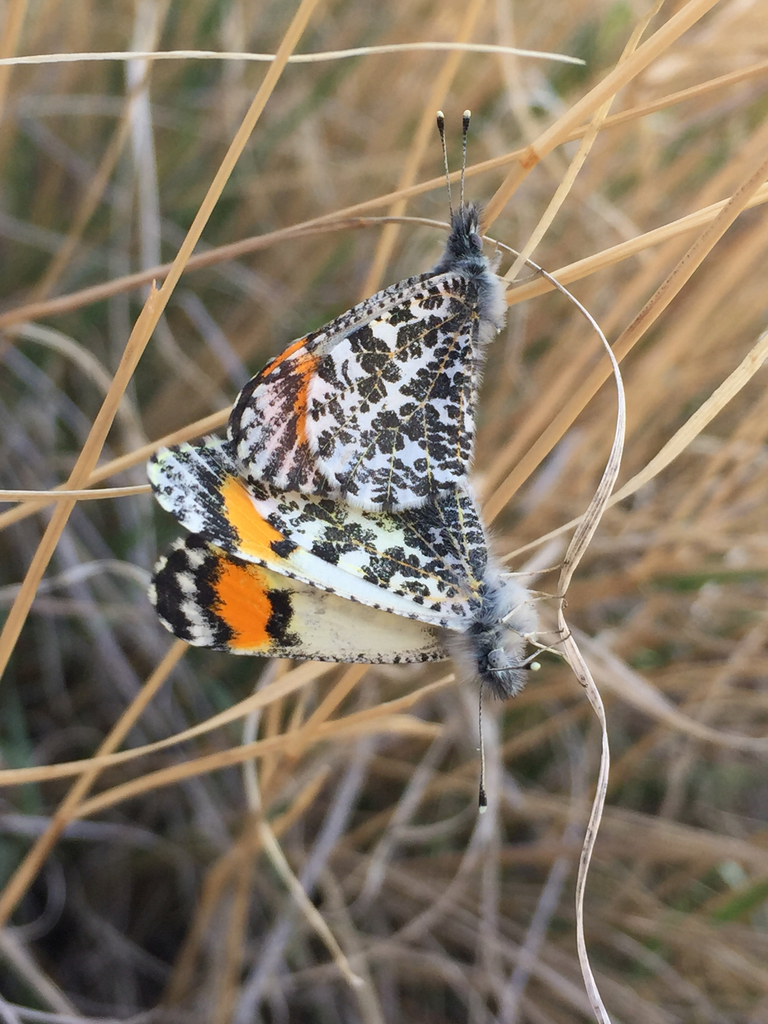
The Southwestern Orangetip is a small butterfly in the white and sulphur family Pieridae, measuring 38-48 mm (1.5-1.9 inches) in wingspan. Males display bright white forewings with distinctive orange patches at the wing tips, bordered by black markings. The orange coloration is absent in females, which exhibit white forewings with black wing tips and subtle gray marbling. Both sexes possess white hindwings with intricate green and yellow mottled patterns that provide effective camouflage when at rest. The underwings show pronounced veining with greenish-white marbling that distinguishes this species from other regional whites. The Southwestern Orangetip ranges across the arid intermountain West from northern Nevada, Utah, and western Colorado south to western Texas, New Mexico, Arizona, and southeastern California. In California, populations occur primarily in the Mojave Desert region and extend into the southern Sierra Nevada foothills. The species occupies desert mountain ranges, canyon systems, and elevated plateaus throughout its range. Historical records indicate populations were more widespread, but current distribution appears fragmented across suitable habitat patches. This species inhabits arid and semi-arid environments characterized by desert scrub, pinyon-juniper woodland, and chaparral communities. Populations typically occur at elevations ranging from 900 to 2,100 meters (3,000 to 7,000 feet), though they may be found slightly lower in northern portions of the range. Adults require areas with abundant nectar sources and presence of host plants in the mustard family (Brassicaceae). Suitable habitat includes rocky slopes, desert washes, and mountain canyons where moisture supports diverse flowering plants. Southwestern Orangetips are univoltine, producing a single generation per year. Adults emerge in early spring, typically March through May, coinciding with peak wildflower blooms in desert environments. Flight period varies with elevation and local climate conditions, with lower elevation populations emerging earlier. Females deposit eggs singly on flower buds and young leaves of cruciferous host plants, including species of Streptanthus, Caulanthus, and Descurainia. Larvae develop through five instars, feeding on flowers, fruits, and young leaves. The species overwinters as a chrysalis, remaining in diapause through the hot, dry summer months and cold winter period. Males exhibit territorial behavior, patrolling hillsides and canyon bottoms in search of females. Both sexes nectar on various spring wildflowers, including lupines, phacelia, and desert marigolds. Adults are strong fliers capable of covering considerable distances between habitat patches. The Southwestern Orangetip lacks formal conservation status designation but faces ongoing pressures from habitat loss due to urban development, recreational activities, and climate change effects on desert ecosystems. Drought conditions and shifting precipitation patterns may affect host plant availability and timing of emergence. Population trends remain poorly documented across much of the species' range, highlighting the need for systematic monitoring of this desert specialist.
Classification
Class: Insecta · Order: Lepidoptera · Family: Pieridae
Frequently asked questions
How is Anthocharis thoosa classified?
Anthocharis thoosa belongs to class Insecta, order Lepidoptera, family Pieridae.
What family does Anthocharis thoosa belong to?
Anthocharis thoosa is in the Pieridae family.
What is Anthocharis thoosa?
The Southwestern Orangetip is a small butterfly in the white and sulphur family Pieridae, measuring 38-48 mm (1.5-1.9 inches) in wingspan.
Is Anthocharis thoosa found in California?
Yes. Anthocharis thoosa is recorded in California in The California Species Project's catalogue.
Related species
Other California species in the same genus, family, or bioregion.
Data from The California Species Project — 14,000+ California species with verified data from CNPS, CDFW, USFWS, and more.