Anthrax irroratus
Spotted Bee Fly
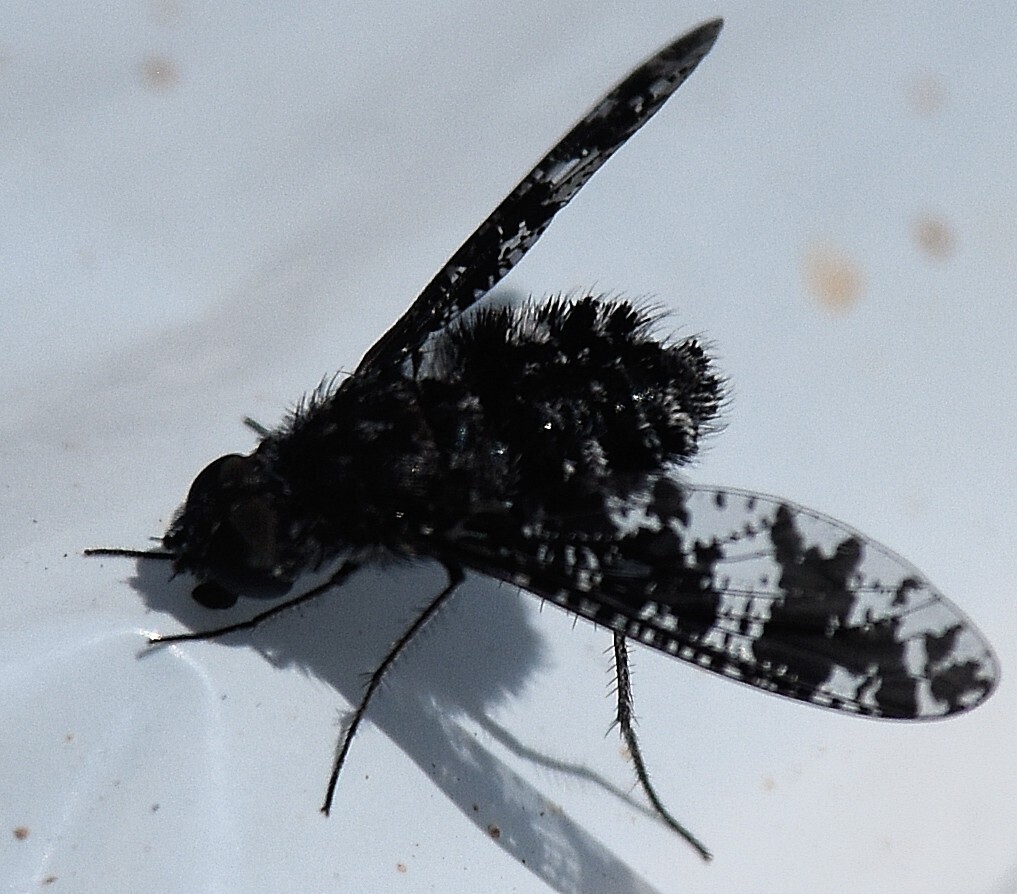
(c) Jimmy Dee, some rights reserved (CC BY-SA) · licence
Family: Bombyliidae · Class: Insecta · Order: Diptera
Anthrax irroratus (Spotted Bee Fly) is a California animal in the Bombyliidae family.
The spotted bee fly (Anthrax irroratus) is a medium-sized dipteran insect belonging to the family Bombyliidae. Adults typically measure 8-12 mm in body length and are characterized by their robust, densely hairy bodies and distinctive spotted wing patterns. The wings display irregular dark spots and patches against a translucent background, giving the species its common name. The body is covered in dense, often golden or yellowish setae, with darker markings on the thorax and abdomen. Like other bee flies, this species has a prominent proboscis used for nectar feeding. Anthrax irroratus has a broad distribution across North America, occurring from southern Canada to Mexico. In California, the species is found throughout much of the state, from coastal regions to inland valleys and mountain areas. According to NatureServe, the species maintains a stable global conservation status of G5, indicating it is secure across its range (NatureServe 2025). The distribution extends across multiple ecological regions, suggesting considerable habitat flexibility. This species inhabits a variety of open and semi-open environments including grasslands, chaparral, oak woodlands, and desert scrub communities. Adults are commonly observed in areas with abundant flowering plants, particularly during spring and early summer months. Elevation ranges from near sea level in coastal areas to moderate elevations in mountainous regions. The species shows preference for sunny, exposed areas where host plants and nectar sources are available. Adults are active diurnal insects, typically observed from March through August, with peak activity during warm, sunny days. Like other Anthrax species, spotted bee flies are nectar feeders as adults, visiting a variety of flowering plants including members of the Asteraceae, Fabaceae, and other families. The hovering flight behavior characteristic of bee flies allows them to feed while remaining airborne. Larvae are parasitoids, developing within the nests or bodies of other insects, particularly ground-nesting bees and wasps. Females use their specialized ovipositor to deposit eggs near or in host nests, where larvae subsequently locate and parasitize developing hosts. Mating typically occurs in late spring and early summer, with males often establishing territories around flowering plants or potential host nesting sites. The species exhibits typical bombyliid reproductive behavior, with elaborate courtship flights and territorial displays. Currently, Anthrax irroratus faces no immediate conservation concerns and is not listed under federal or state endangered species legislation. The species appears to maintain stable populations across its range, benefiting from its broad habitat tolerance and diverse host relationships. However, like many native pollinators, populations may face localized pressures from habitat conversion, pesticide use, and climate change effects on flowering plant communities and host insect populations. The species' role as both pollinator and natural pest control agent through its parasitoid larval stage makes it ecologically valuable in agricultural and natural ecosystems.
Classification
Class: Insecta · Order: Diptera · Family: Bombyliidae
Frequently asked questions
How is Anthrax irroratus classified?
Anthrax irroratus belongs to class Insecta, order Diptera, family Bombyliidae.
What family does Anthrax irroratus belong to?
Anthrax irroratus is in the Bombyliidae family.
What is Anthrax irroratus?
The spotted bee fly (Anthrax irroratus) is a medium-sized dipteran insect belonging to the family Bombyliidae.
Is Anthrax irroratus found in California?
Yes. Anthrax irroratus is recorded in California in The California Species Project's catalogue.
Related species
Other California species in the same genus, family, or bioregion.
Data from The California Species Project — 14,000+ California species with verified data from CNPS, CDFW, USFWS, and more.