Anthrenus coloratus
Asian Carpet Beetle
no rights reserved · CC0
Family: Dermestidae · Class: Insecta · Order: Coleoptera
Anthrenus coloratus (Asian Carpet Beetle) is a California animal in the Dermestidae family.
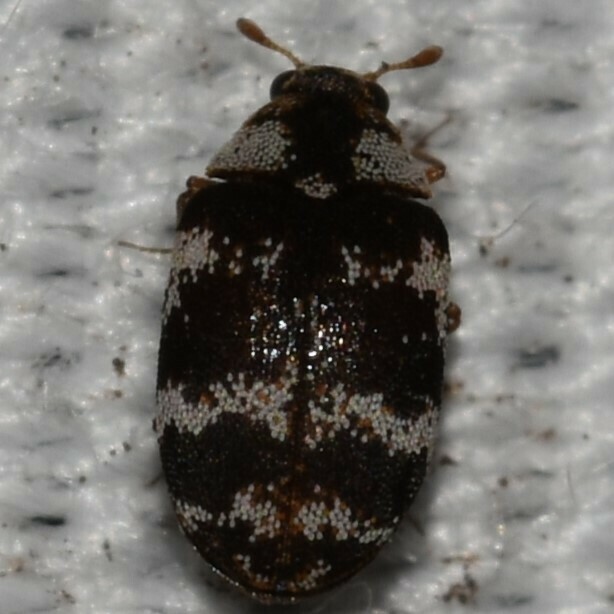
The Asian carpet beetle (Anthrenus coloratus) is a small dermestid beetle belonging to the family Dermestidae, commonly known as carpet beetles. Adult beetles typically measure 2-4 mm in length and display a mottled coloration pattern with scales that create varied brown, black, and sometimes reddish hues across the elytra. The body is oval-shaped and compact, characteristic of the Anthrenus genus. Larvae are elongated and covered with dense bristles, earning them the common name "woolly bears." This species is native to the Old World, including regions of Asia, but has been introduced to North America as a recent addition to the continent's non-native arthropod fauna (BugGuide). The Asian carpet beetle has established populations across various regions of the United States, though specific distribution patterns in California require further documentation. The species' presence represents part of the broader pattern of dermestid introductions to North America, following other established carpet beetle species such as the varied carpet beetle and furniture carpet beetle. Asian carpet beetles inhabit both indoor and outdoor environments, demonstrating considerable habitat flexibility. Indoors, they are commonly found in homes, museums, warehouses, and other structures where they have access to organic materials. Outdoor populations establish in areas with accumulated organic debris, including bird nests, animal burrows, and beneath loose bark. The species shows preference for dry environments with stable temperatures, making heated buildings particularly suitable for year-round reproduction. As with other dermestid beetles, Asian carpet beetles exhibit complete metamorphosis with distinct larval and adult feeding behaviors. Adults primarily feed on pollen and nectar from flowers, particularly favoring plants in the family Asteraceae. However, larvae are the life stage of greatest economic concern, as they consume a wide variety of organic materials including wool, silk, leather, dried insects, animal specimens, and stored food products. Females deposit eggs in areas with suitable larval food sources, with development time varying based on temperature and food availability. The species typically produces one to two generations per year in temperate climates. Currently, Anthrenus coloratus lacks formal conservation status designations, as it is considered an introduced species rather than a conservation concern. However, its establishment in North America represents an ongoing biological invasion that may have ecological and economic implications. The species' ability to damage natural history collections, textiles, and stored products makes it a pest of concern for museums, libraries, and households. Management strategies focus on exclusion, sanitation, and targeted treatments rather than conservation. Continued monitoring of its distribution and impacts remains important for understanding the full scope of this introduction. Research into the species' specific ecological requirements and potential impacts on native arthropod communities would enhance management approaches and invasion biology understanding.
Classification
Class: Insecta · Order: Coleoptera · Family: Dermestidae
Frequently asked questions
How is Anthrenus coloratus classified?
Anthrenus coloratus belongs to class Insecta, order Coleoptera, family Dermestidae.
What family does Anthrenus coloratus belong to?
Anthrenus coloratus is in the Dermestidae family.
What is Anthrenus coloratus?
The Asian carpet beetle (Anthrenus coloratus) is a small dermestid beetle belonging to the family Dermestidae, commonly known as carpet beetles.
Is Anthrenus coloratus found in California?
Yes. Anthrenus coloratus is recorded in California in The California Species Project's catalogue.
Related species
Other California species in the same genus, family, or bioregion.
Data from The California Species Project — 14,000+ California species with verified data from CNPS, CDFW, USFWS, and more.