Anthus cervinus
Red-throated Pipit
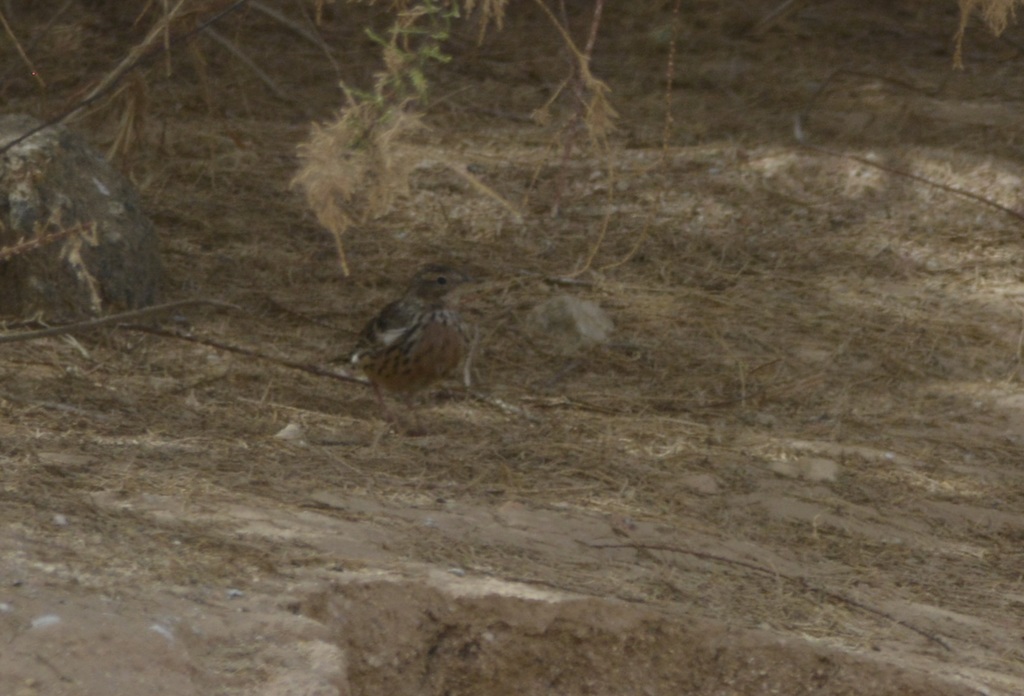
(c) Karim Haddad, some rights reserved (CC BY) · licence
Family: Motacillidae · Class: Aves · Order: Passeriformes
Anthus cervinus (Red-throated Pipit) is a California animal in the Motacillidae family.
The Red-throated Pipit (Anthus cervinus) is a small passerine bird in the family Motacillidae, comprising the pipits and wagtails. Adults measure 14 to 15 centimeters (5.5 to 5.9 inches) in length with a wingspan of 22 to 25 centimeters (8.7 to 9.8 inches). During breeding season, males develop distinctive rufous-red coloration on the throat and upper breast, while females show more subdued reddish-buff tones. Non-breeding adults and juveniles lack the red throat markings, displaying streaked brown upperparts with buff-colored underparts marked by fine dark streaking. The species exhibits a relatively short, thin bill adapted for insectivory and prominent pale eyebrow stripes. The legs and feet are pinkish-brown to yellowish. The Red-throated Pipit breeds across the Arctic and subarctic regions of northern Europe and Asia, from Scandinavia eastward through Siberia to Chukotka and Alaska. In North America, the breeding range extends from northern and western Alaska south to the Alaska Peninsula. The species migrates vast distances, wintering primarily in tropical Africa, southern and southeastern Asia, and occasionally reaching the Philippines and Indonesia. In California, Red-throated Pipits occur as rare but regular migrants, primarily along the coast during fall migration from September through November. Peak migration typically occurs from mid-October to early November, with most records documented in coastal counties. Spring records are exceptionally rare, with fewer than ten documented occurrences statewide. Breeding habitat consists of wet tundra, marshy areas, and sedge meadows in Arctic and subarctic regions. The species shows preference for areas with scattered shrubs, particularly dwarf birch and willow, at elevations typically below 500 meters. During migration and winter, Red-throated Pipits utilize open grasslands, agricultural fields, mudflats, and coastal marshes. In California, migrants are typically observed in short-grass habitats, plowed fields, coastal dunes, and wetland edges, often associating with American Pipits. Favored stopover sites include Point Reyes National Seashore, Pescadero Marsh, and Elkhorn Slough, where birds often remain for several days to weeks before continuing migration. Red-throated Pipits are ground-foraging insectivores, feeding on flies, beetles, moths, caterpillars, and other small arthropods. During breeding season, they also consume seeds and berries. The species constructs cup-shaped nests on the ground, typically concealed under vegetation or in slight depressions. Females lay 4 to 6 eggs, with incubation lasting 11 to 15 days. Both parents participate in feeding nestlings, which fledge after 11 to 15 days. The species is known for its distinctive flight call, described as a thin 'psii' or 'tseep,' which aids in identification during migration. This call is often the first indication of the species' presence in mixed pipit flocks. The Red-throated Pipit is not federally listed in the United States and holds no special conservation status in California. The International Union for Conservation of Nature classifies the species as Least Concern globally, with stable population trends across most of its range. However, climate change poses potential long-term threats to Arctic breeding habitats through altered precipitation patterns and warming temperatures. In California, the species remains a prized observation for birders due to its relative rarity and brief migration windows, with the California Bird Records Committee documenting approximately 150 accepted records since 1960, primarily from coastal locations between Marin and Monterey counties.
Classification
Class: Aves · Order: Passeriformes · Family: Motacillidae
Frequently asked questions
How is Anthus cervinus classified?
Anthus cervinus belongs to class Aves, order Passeriformes, family Motacillidae.
What family does Anthus cervinus belong to?
Anthus cervinus is in the Motacillidae family.
What is Anthus cervinus?
The Red-throated Pipit (Anthus cervinus) is a small passerine bird in the family Motacillidae, comprising the pipits and wagtails.
Is Anthus cervinus found in California?
Yes. Anthus cervinus is recorded in California in The California Species Project's catalogue.
Related species
Other California species in the same genus, family, or bioregion.
Data from The California Species Project — 14,000+ California species with verified data from CNPS, CDFW, USFWS, and more.