Anthus rubescens
American Pipit
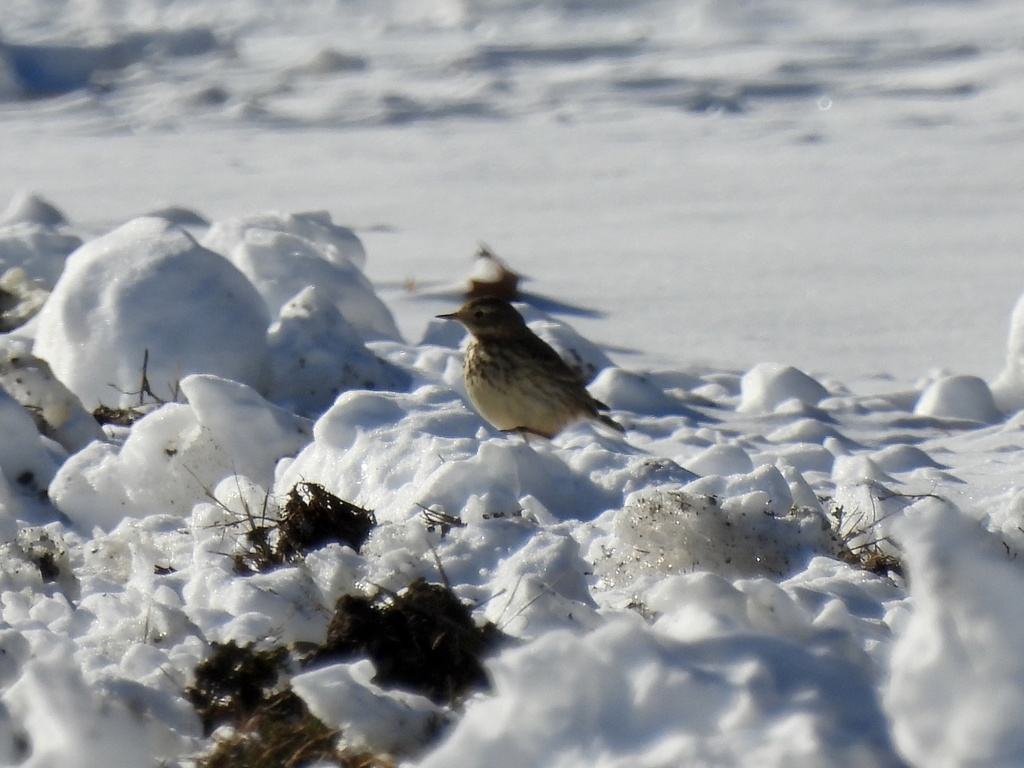
(c) Caroline Quinn, some rights reserved (CC BY) · licence
Family: Motacillidae · Class: Aves · Order: Passeriformes
Anthus rubescens (American Pipit) is a California animal in the Motacillidae family.
The American Pipit is a small, slender songbird measuring 15-17 cm (5.9-6.7 inches) in length with a wingspan of 22-25 cm (8.7-9.8 inches). Adults weigh 19-25 grams. The species displays seasonal plumage variation: breeding adults have grayish-brown upperparts with darker streaking, buff-colored underparts with fine dark streaks on the breast, and a distinct white outer tail feathers pattern visible in flight. Non-breeding birds appear more subdued with heavier streaking on buff-white underparts. The bill is thin and pointed, adapted for capturing small invertebrates, and the legs are dark colored. A pale eyering and supercilium provide subtle facial markings. The American Pipit breeds across Alaska, northern Canada, and high-elevation areas of the western United States, including the Sierra Nevada, Cascade Range, and Rocky Mountains. In California, breeding populations occur primarily in alpine and subalpine zones above 2,400 meters (7,900 feet) elevation in the Sierra Nevada and southern Cascade ranges. During winter months, the species migrates to lower elevations and more southern latitudes, occurring throughout California's Central Valley, coastal areas, and desert regions. Winter distribution extends from southern Canada through Central America. Breeding habitat consists of alpine tundra, high-elevation meadows, and areas above treeline characterized by short grass, sedge communities, and sparse vegetation. These environments typically feature rocky substrates, seasonal snow patches, and proximity to water sources such as alpine lakes or streams. During winter and migration, American Pipits utilize agricultural fields, mudflats, beaches, short grasslands, and plowed fields. The species shows preference for open areas with minimal vegetation height, facilitating ground foraging and predator detection. American Pipits are ground-dwelling birds that forage by walking slowly and picking invertebrates from soil and vegetation surfaces. Their diet consists primarily of insects including flies, beetles, moths, and their larvae, supplemented by spiders, small crustaceans, and occasionally seeds. Breeding occurs from May through August in high-elevation habitats. Females construct cup-shaped nests on the ground, often in slight depressions sheltered by rocks or vegetation clumps. Clutch size ranges from 3-7 eggs, typically 4-5, with an incubation period of 13-15 days. Young fledge after 13-14 days but remain dependent on parents for an additional 14-21 days. The species exhibits strong site fidelity to both breeding and wintering areas. The American Pipit is not federally listed and maintains stable global populations, though some local breeding areas face pressure from climate change effects on alpine ecosystems. Rising temperatures may force breeding habitat to higher elevations or reduce available suitable terrain. Winter habitat loss through agricultural intensification and urban development presents regional concerns. The species' dependence on high-elevation breeding areas makes it particularly vulnerable to warming trends that alter alpine plant communities and snowpack duration. Conservation priorities include protecting alpine habitats and maintaining winter foraging areas through sustainable agricultural practices.
Classification
Class: Aves · Order: Passeriformes · Family: Motacillidae
Frequently asked questions
How is Anthus rubescens classified?
Anthus rubescens belongs to class Aves, order Passeriformes, family Motacillidae.
What family does Anthus rubescens belong to?
Anthus rubescens is in the Motacillidae family.
What is Anthus rubescens?
The American Pipit is a small, slender songbird measuring 15-17 cm (5.9-6.7 inches) in length with a wingspan of 22-25 cm (8.7-9.8 inches).
Is Anthus rubescens found in California?
Yes. Anthus rubescens is recorded in California in The California Species Project's catalogue.
Related species
Other California species in the same genus, family, or bioregion.
Data from The California Species Project — 14,000+ California species with verified data from CNPS, CDFW, USFWS, and more.