Antigone canadensis tabida
Greater Sandhill Crane
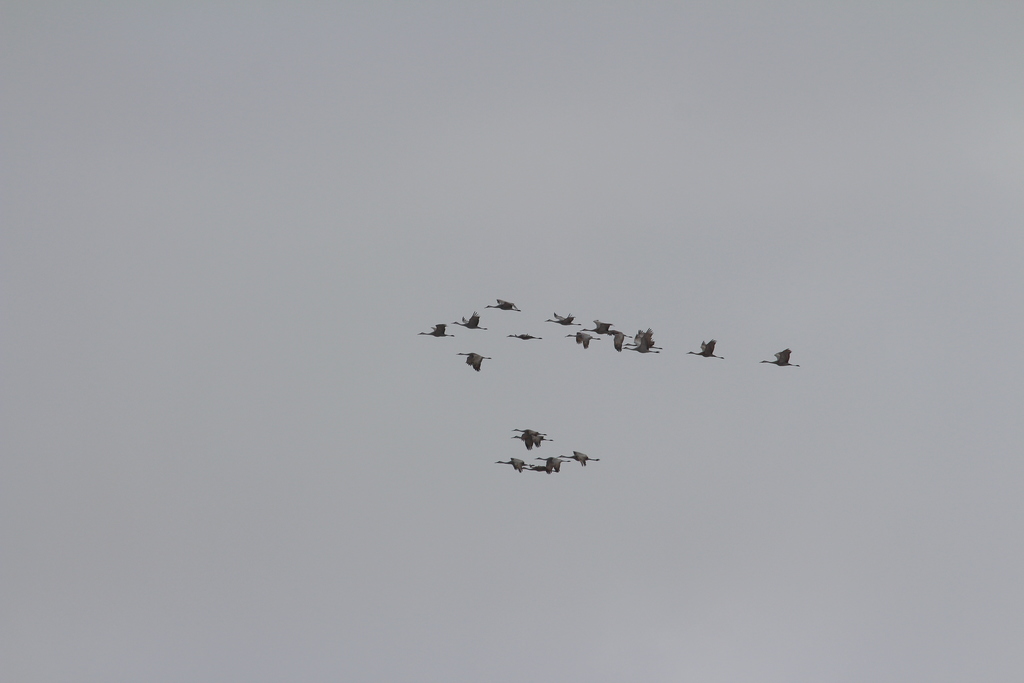
no rights reserved · CC0
Family: Gruidae · Class: Aves · Order: Gruiformes
Conservation status: G5T5 S2
Antigone canadensis tabida (Greater Sandhill Crane) is a California animal in the Gruidae family.
The Greater Sandhill Crane (Antigone canadensis tabida) is the largest subspecies of sandhill crane, standing 1.0 to 1.2 meters tall with a wingspan of 1.8 to 2.0 meters (Birds of the World). Adults display uniform gray plumage with a distinctive red crown patch of bare skin extending from the bill to the back of the head. The subspecies is distinguished from smaller sandhill crane subspecies by its larger size, longer bill, and darker plumage coloration. Historically, the Greater Sandhill Crane bred across a broad range including southern British Columbia, central and southern Alberta, Saskatchewan, northern Manitoba, southwestern Ontario, and Michigan (NatureServe Explorer). The subspecies has experienced significant range contraction, particularly in the United States, where breeding populations have been largely extirpated from many historic areas. Current breeding populations persist primarily in the Canadian prairies and Great Lakes region. Breeding habitat consists of open freshwater wetlands and shallow marshes, including bogs, sedge meadows, and prairie potholes (Birds of the World). These cranes require large territories with suitable nesting sites near water and adjacent upland areas for foraging. During migration and winter, they utilize agricultural fields, particularly corn and wheat stubble, as well as shallow wetlands and roosting sites in open water areas. Greater Sandhill Cranes are omnivorous with seasonal dietary shifts. During the breeding season, they consume primarily plant material including roots, tubers, and seeds, supplemented with invertebrates, small vertebrates, and occasionally eggs of other birds (Birds of the World). Breeding pairs establish territories in late spring, with males frequently initiating nest construction though females typically select the final nest site. Females usually lay two eggs in ground nests constructed of vegetation in shallow water or on islands. The species exhibits delayed maturity, with first breeding occurring at 2-7 years of age, and low annual productivity, resulting in naturally slow population growth rates. In California, the Greater Sandhill Crane is listed as threatened under the California Endangered Species Act. The subspecies has a global rank of G5T5, indicating it is secure globally but vulnerable in California with a state rank of S2. Canada lists A. c. tabida as "Not at Risk," though the Canadian population has not been formally assessed since 1979 (Birds of the World). Primary threats include habitat loss through wetland drainage and conversion of grasslands to agriculture, human disturbance at roosting and nesting sites, and collisions with power lines. Climate change poses additional challenges through altered precipitation patterns affecting wetland availability. Conservation efforts focus on habitat protection and restoration, particularly of breeding wetlands and migration stopover sites, along with reducing anthropogenic mortality sources during migration.
Classification
Class: Aves · Order: Gruiformes · Family: Gruidae
Conservation status
G5T5 S2
Frequently asked questions
How is Antigone canadensis tabida classified?
Antigone canadensis tabida belongs to class Aves, order Gruiformes, family Gruidae.
What family does Antigone canadensis tabida belong to?
Antigone canadensis tabida is in the Gruidae family.
Is Antigone canadensis tabida protected or of conservation concern?
Antigone canadensis tabida carries the following status: G5T5 S2.
What is Antigone canadensis tabida?
The Greater Sandhill Crane (Antigone canadensis tabida) is the largest subspecies of sandhill crane, standing 1.0 to 1.2 meters tall with a wingspan of 1.8 to 2.0 meters (Birds of the World).
Is Antigone canadensis tabida found in California?
Yes. Antigone canadensis tabida is recorded in California in The California Species Project's catalogue.
Related species
Other California species in the same genus, family, or bioregion.
Data from The California Species Project — 14,000+ California species with verified data from CNPS, CDFW, USFWS, and more.