Antilocapra americana
Pronghorn
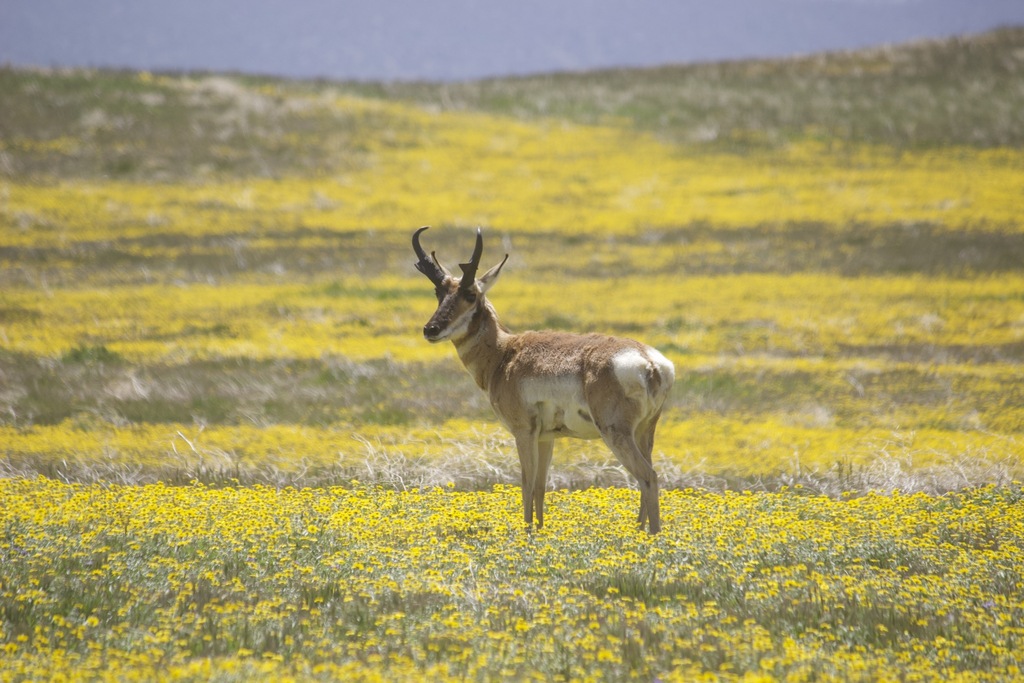
no rights reserved · CC0
Family: Antilocapridae · Class: Mammalia · Order: Artiodactyla
Conservation status: G5 S3
Antilocapra americana (Pronghorn) is a California animal in the Antilocapridae family.
The pronghorn is North America's fastest land animal and the sole surviving member of the family Antilocapridae. Adults stand 81 to 104 cm (32 to 41 inches) at the shoulder and weigh 36 to 70 kg (79 to 154 pounds), with males typically larger than females. The species displays tan to reddish-brown upperparts with distinctive white markings on the rump, sides, belly, and throat. Males possess black, pronged horns that reach 25 to 43 cm (10 to 17 inches) in length, while females have smaller, unbranched horns or are hornless. Both sexes shed the outer horn sheaths annually, a unique trait among horned mammals. Historically, pronghorn ranged across western North America from southern Canada to northern Mexico. In California, populations once inhabited the Central Valley, Mojave Desert, and northeastern counties. Current California range is severely restricted to the Modoc Plateau in Modoc and Lassen counties, representing the remnant of what was once a much more extensive distribution. The species has been extirpated from most of its historical California range due to habitat conversion and overhunting in the late 1800s and early 1900s. Pronghorn inhabit open grasslands, shrublands, and desert plains, typically avoiding areas with dense vegetation or steep terrain. In California, they occur in sagebrush-grassland communities at elevations ranging from 1,200 to 2,100 meters (3,900 to 6,900 feet). The species requires large, uninterrupted landscapes for seasonal migrations and depends on diverse plant communities that provide forage throughout the year. Water sources are essential, particularly during summer months. Pronghorn are highly social, forming mixed-sex herds during winter and segregating by sex during summer. Males establish territories during the September to October breeding season, gathering harems of females for mating. Gestation lasts approximately 8.5 months, with females typically giving birth to twins in May or June after seeking secluded birthing sites. Newborns remain hidden for their first week before joining the herd. The species is primarily a browser, feeding on forbs, shrubs, and grasses, with sagebrush comprising a significant portion of the winter diet. Pronghorn can reach speeds of 88 km/h (55 mph) and maintain 72 km/h (45 mph) for extended distances. While pronghorn maintain stable populations across much of their range, California populations face significant conservation challenges. The state's G5 S3 ranking indicates global security but state-level vulnerability. Current California population estimates suggest fewer than 300 individuals remain, concentrated primarily on the Modoc Plateau. Primary threats include habitat fragmentation from fencing and development, competition with livestock, vehicle strikes, and climate change impacts on forage availability. The California Department of Fish and Wildlife monitors populations through annual aerial surveys and collaborates with private landowners to maintain migration corridors and reduce fence-related mortality.
Classification
Class: Mammalia · Order: Artiodactyla · Family: Antilocapridae
Conservation status
G5 S3
Frequently asked questions
How is Antilocapra americana classified?
Antilocapra americana belongs to class Mammalia, order Artiodactyla, family Antilocapridae.
What family does Antilocapra americana belong to?
Antilocapra americana is in the Antilocapridae family.
Is Antilocapra americana protected or of conservation concern?
Antilocapra americana carries the following status: G5 S3.
What is Antilocapra americana?
The pronghorn is North America's fastest land animal and the sole surviving member of the family Antilocapridae.
Is Antilocapra americana found in California?
Yes. Antilocapra americana is recorded in California in The California Species Project's catalogue.
Related species
Other California species in the same genus, family, or bioregion.
Data from The California Species Project — 14,000+ California species with verified data from CNPS, CDFW, USFWS, and more.