Antrostomus ridgwayi
Buff-collared Nightjar
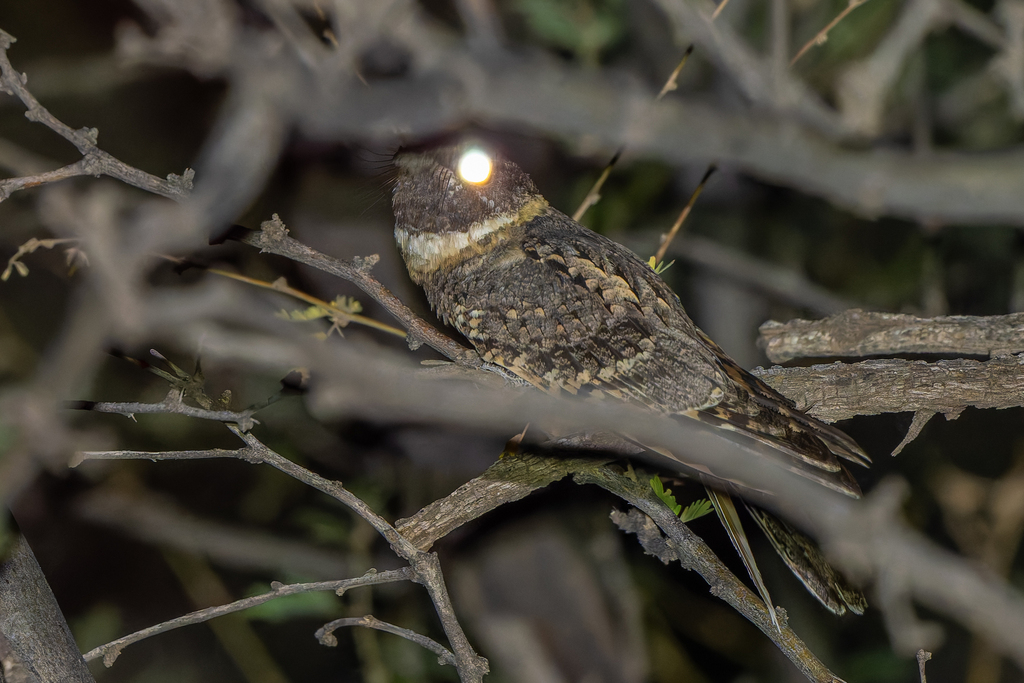
no rights reserved · CC0
Family: Caprimulgidae · Class: Aves · Order: Caprimulgiformes
Antrostomus ridgwayi (Buff-collared Nightjar) is a California animal in the Caprimulgidae family.
The Buff-collared Nightjar is a medium-sized nocturnal bird in the family Caprimulgidae, measuring approximately 20 to 23 cm (8 to 9 inches) in length with a wingspan of 46 to 51 cm (18 to 20 inches). The species exhibits cryptic plumation with mottled brown, gray, and black coloration that provides camouflage against tree bark and leaf litter. The distinctive buff-colored collar across the nape gives the species its common name. Males display white patches on the outer tail feathers and white throat patches, while females lack these white markings and show more subdued coloration overall. The bill is small and black with a wide gape adapted for capturing insects in flight. Historically, the Buff-collared Nightjar's range extended from extreme southeastern Arizona through western Mexico to Honduras. In the United States, the species was documented in Arizona's Madrean sky islands, including the Huachuca, Santa Rita, and Chiricahua Mountains. However, the last confirmed breeding record in Arizona occurred in 1977 in the Huachuca Mountains. The species has not been reliably detected in California, though vagrant individuals could potentially occur in suitable habitat along the Colorado River corridor or in southeastern desert mountains. The species inhabits oak-pine woodlands and pine-oak forests at elevations between 1,200 and 2,400 meters (3,900 to 7,900 feet). Preferred habitat includes areas with moderate canopy cover and open understory that facilitate foraging flights. The nightjar selects daytime roosts on horizontal tree branches or on the ground among leaf litter, where its cryptic plumage provides concealment. Breeding habitat requires suitable nesting sites on bare ground or minimal vegetation cover. Buff-collared Nightjars are crepuscular and nocturnal, becoming active at dusk to hunt flying insects including moths, beetles, flying ants, and other arthropods. The species employs a sit-and-wait foraging strategy, making short flights from perches to capture prey. Breeding occurs from May through August, with females laying one to two eggs directly on bare ground without constructing a nest. Incubation lasts approximately 18 to 20 days, and young fledge after 20 to 21 days. The species' distinctive call is a repetitive 'cuk-cuk-cuk-cuk' or 'chuck-will's-widow-like' vocalization delivered primarily during breeding season. The International Union for Conservation of Nature classifies the Buff-collared Nightjar as Near Threatened globally. In North America, the species has experienced significant range contraction, with apparent extirpation from Arizona since the 1970s. Population declines are attributed to habitat loss from fire suppression altering forest structure, livestock grazing impacts, and climate change affecting prey availability. The species receives no federal protection under the Endangered Species Act, though it is considered a bird of conservation concern by the U.S. Fish and Wildlife Service. Conservation efforts focus on habitat restoration in historical range areas and monitoring for potential recolonization.
Classification
Class: Aves · Order: Caprimulgiformes · Family: Caprimulgidae
Frequently asked questions
How is Antrostomus ridgwayi classified?
Antrostomus ridgwayi belongs to class Aves, order Caprimulgiformes, family Caprimulgidae.
What family does Antrostomus ridgwayi belong to?
Antrostomus ridgwayi is in the Caprimulgidae family.
What is Antrostomus ridgwayi?
The Buff-collared Nightjar is a medium-sized nocturnal bird in the family Caprimulgidae, measuring approximately 20 to 23 cm (8 to 9 inches) in length with a wingspan of 46 to 51 cm (18 to 20 inches).
Is Antrostomus ridgwayi found in California?
Yes. Antrostomus ridgwayi is recorded in California in The California Species Project's catalogue.
Related species
Other California species in the same genus, family, or bioregion.
Data from The California Species Project — 14,000+ California species with verified data from CNPS, CDFW, USFWS, and more.