Apalone spinifera
Spiny Softshell
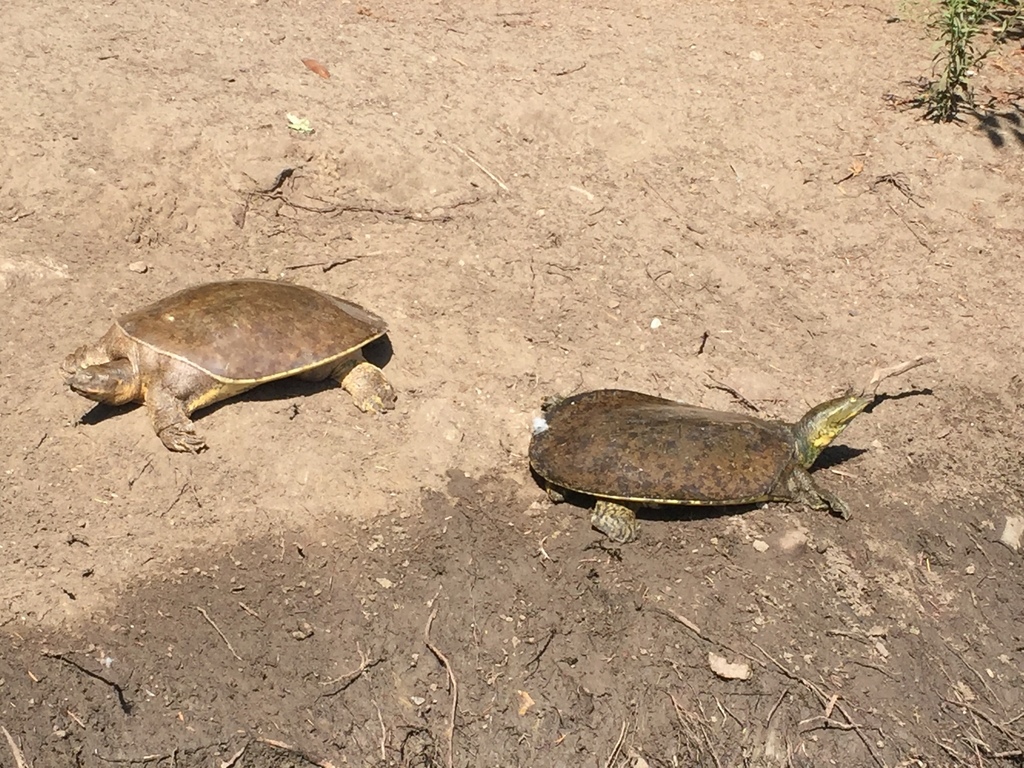
no rights reserved · CC0
Family: Trionychidae · Class: Chelonia · Order: Testudines
Apalone spinifera (Spiny Softshell) is a California animal in the Trionychidae family.
The spiny softshell (Apalone spinifera) is a large, distinctive freshwater turtle characterized by its leathery, flexible shell lacking the hard scutes typical of other turtles. Adult females reach 43 centimeters (17 inches) in carapace length, while males remain smaller at approximately 23 centimeters (9 inches). The carapace is olive to brown with darker spots or blotches, and the plastron is white to cream-colored. The species is named for small, conical spines projecting from the anterior edge of the carapace, though these are more prominent in juveniles and may wear down with age. The elongated snout bears tubular nostrils that function as a snorkel, allowing the turtle to breathe while mostly submerged. Historically, spiny softshells ranged throughout much of the central and western United States, from the Great Lakes region south to Mexico and west to Colorado and New Mexico. In California, the species was native to the Colorado River system along the state's southeastern border, including areas near Blythe, Needles, and the lower Colorado River. However, the species has been extirpated from California waters, with the last confirmed native population documented in the early 20th century. Current populations exist in the Colorado River system in Arizona, Nevada, and other southwestern states. Spiny softshells inhabit rivers, streams, ponds, and lakes with sandy or muddy bottoms and minimal vegetation. They prefer areas with slow to moderate current and require soft substrates for burying themselves. Water temperatures between 20 to 30 degrees Celsius (68 to 86 degrees Fahrenheit) are optimal for activity. The species tolerates a range of water qualities but requires adequate dissolved oxygen levels and minimal siltation. These highly aquatic turtles are excellent swimmers and rarely venture far from water. They are primarily carnivorous, feeding on fish, crayfish, aquatic insects, mollusks, and amphibians. Spiny softshells are ambush predators, burying themselves in substrate with only their snout exposed. Mating occurs in spring, typically from April through June. Females nest on sandy banks or bars, digging nests 10 to 25 centimeters (4 to 10 inches) deep. Clutch sizes range from 4 to 39 eggs, with larger females producing more eggs. Incubation lasts 60 to 80 days, depending on temperature. While not federally listed, spiny softshells face significant conservation challenges throughout their range. In California, habitat modification, water diversions, and dam construction contributed to their extirpation from the Colorado River system. River channelization, reduced water flows, and introduced species continue to threaten remaining populations in adjacent states. The species' dependence on free-flowing rivers with natural flood cycles makes it particularly vulnerable to water management practices. Some southwestern populations have declined substantially, though the species maintains stable numbers in portions of its core range in the Great Plains and Mississippi River basin.
Classification
Class: Chelonia · Order: Testudines · Family: Trionychidae
Frequently asked questions
How is Apalone spinifera classified?
Apalone spinifera belongs to class Chelonia, order Testudines, family Trionychidae.
What family does Apalone spinifera belong to?
Apalone spinifera is in the Trionychidae family.
What is Apalone spinifera?
The spiny softshell (Apalone spinifera) is a large, distinctive freshwater turtle characterized by its leathery, flexible shell lacking the hard scutes typical of other turtles.
Is Apalone spinifera found in California?
Yes. Apalone spinifera is recorded in California in The California Species Project's catalogue.
More California species
This species has no close relatives in our California data — here are other species to explore.
Data from The California Species Project — 14,000+ California species with verified data from CNPS, CDFW, USFWS, and more.