Apamea devastator
Glassy Cutworm
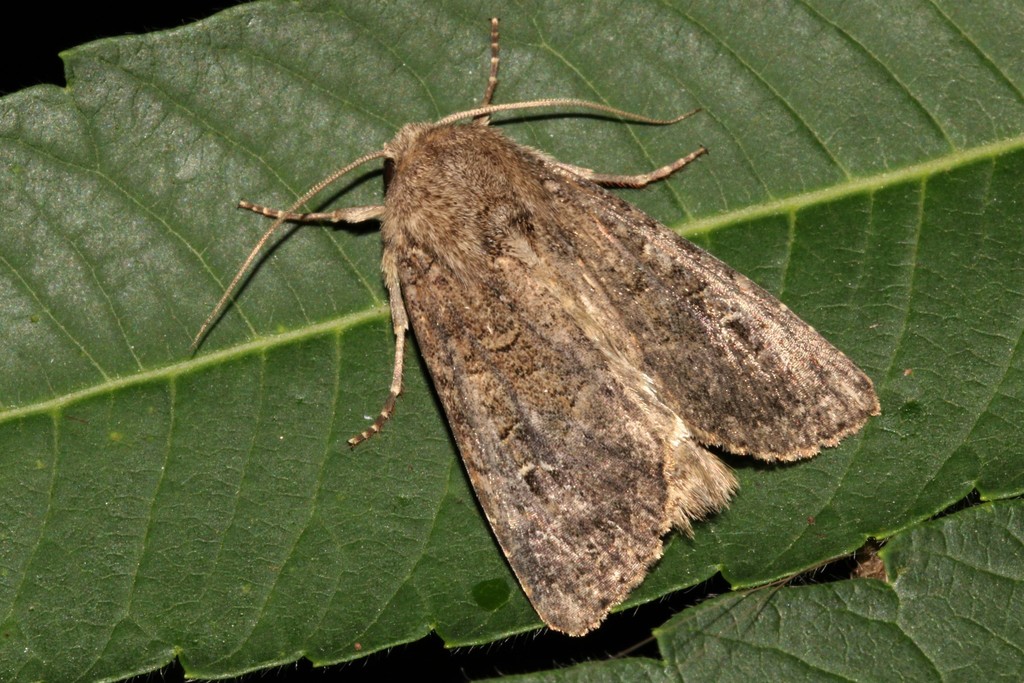
(c) Dan Riley, some rights reserved (CC BY) · licence
Family: Noctuidae · Class: Insecta · Order: Lepidoptera
Apamea devastator (Glassy Cutworm) is a California animal in the Noctuidae family.
The glassy cutworm (Apamea devastator) is a moth species in the family Noctuidae, characterized by its distinctive larval stage that causes significant agricultural damage. Adult moths have a wingspan of approximately 32-38 mm (1.3-1.5 inches), with forewings that are typically pale gray to brownish-gray with darker markings and a distinctive kidney-shaped reniform spot. The hindwings are lighter, often whitish or pale gray with darker marginal borders. Moths exhibit sexual dimorphism, with males having more feathered antennae compared to females. The species occurs across much of North America, with its range extending from southern Canada through the United States into northern Mexico. In California, glassy cutworms are found throughout agricultural regions of the Central Valley, coastal areas, and foothills, particularly where host crops are cultivated. The species has expanded its range with agricultural development and irrigation. Glassy cutworm larvae inhabit agricultural fields, gardens, and disturbed areas where their host plants occur. They prefer areas with loose, well-drained soils that facilitate their subterranean lifestyle. The species thrives in irrigated croplands and is commonly associated with corn, wheat, barley, oats, and various grasses. Larvae are subterranean, spending daylight hours in soil burrows 2-5 cm below the surface, emerging at night to feed. The species exhibits a univoltine life cycle in most regions, producing one generation per year. Adults emerge in late summer and early fall, typically from August through October. Females lay eggs in soil near host plants, with each female capable of depositing 500-1,000 eggs. Eggs overwinter and hatch the following spring when soil temperatures reach approximately 10°C (50°F). Larvae develop through six instars over 8-10 weeks, reaching lengths of 30-40 mm (1.2-1.6 inches) when mature. Pupation occurs in earthen cells 5-15 cm below the soil surface. Larvae are polyphagous feeders, consuming roots, stems, and crowns of grasses and cereal crops. They cut plants at or below the soil surface, earning their common name. Major host plants include corn, wheat, barley, oats, rye, and various native and introduced grasses. Feeding damage is most severe during the third through sixth larval instars, when larvae can consume entire seedlings. The glassy cutworm is not listed under federal or state endangered species legislation and is not considered a conservation concern. Population levels fluctuate annually based on weather conditions, with wet springs generally favoring larval survival and development. The species is primarily managed as an agricultural pest rather than a conservation target. Climate change may affect its distribution and phenology, potentially expanding its range northward and altering emergence timing. Integrated pest management strategies in agriculture help control populations while maintaining ecosystem balance.
Classification
Class: Insecta · Order: Lepidoptera · Family: Noctuidae
Frequently asked questions
How is Apamea devastator classified?
Apamea devastator belongs to class Insecta, order Lepidoptera, family Noctuidae.
What family does Apamea devastator belong to?
Apamea devastator is in the Noctuidae family.
What is Apamea devastator?
The glassy cutworm (Apamea devastator) is a moth species in the family Noctuidae, characterized by its distinctive larval stage that causes significant agricultural damage.
Is Apamea devastator found in California?
Yes. Apamea devastator is recorded in California in The California Species Project's catalogue.
Related species
Other California species in the same genus, family, or bioregion.
Data from The California Species Project — 14,000+ California species with verified data from CNPS, CDFW, USFWS, and more.