Aphaenogaster occidentalis
Western Collared Ant
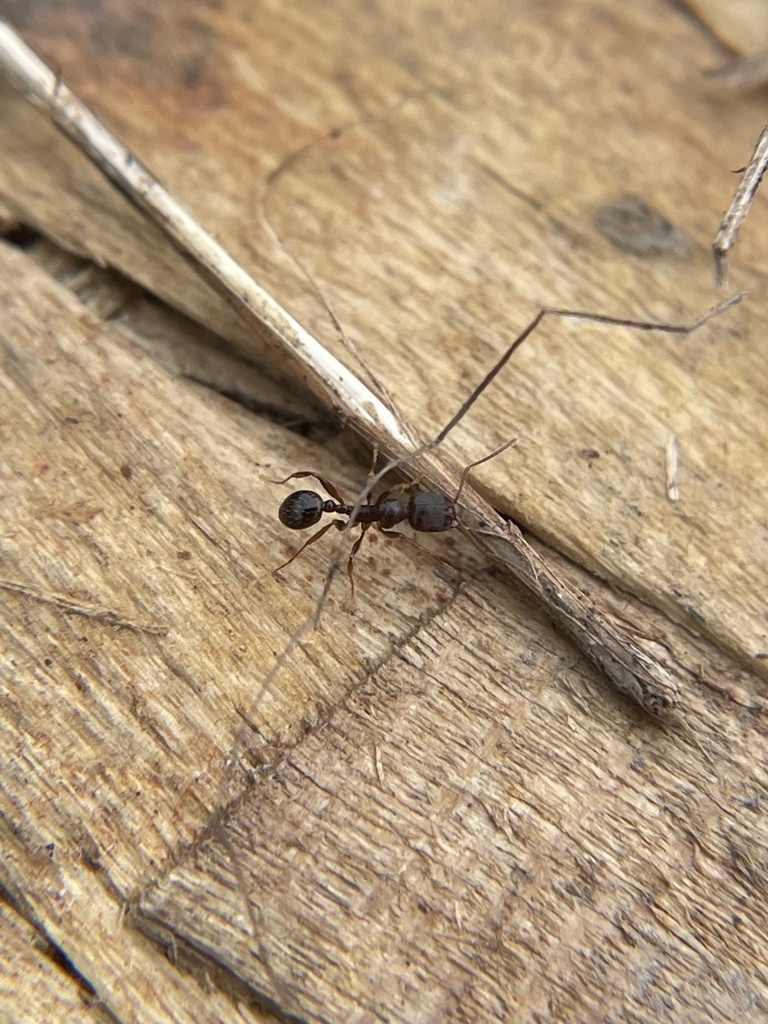
(c) Amelia Tauber, some rights reserved (CC BY) · licence
Family: Formicidae · Class: Insecta · Order: Hymenoptera
Aphaenogaster occidentalis (Western Collared Ant) is a California animal in the Formicidae family.
The Western Collared Ant (Aphaenogaster occidentalis) is a member of the spine-waisted ant genus Aphaenogaster within the family Formicidae. This species belongs to a diverse group of ants characterized by their distinctive wasp-like constriction between the thorax and abdomen, which gives the genus its common name of spine-waisted ants. As with other Aphaenogaster species, the Western Collared Ant likely exhibits the typical morphological features of the genus, including a well-defined petiole and postpetiole, giving workers a distinctly segmented appearance. Workers in this genus typically measure 4-8 mm in length, though specific measurements for A. occidentalis have not been well documented in available literature. The geographic distribution of the Western Collared Ant appears to be restricted to western North America, as suggested by its scientific name occidentalis, meaning "western." However, detailed range maps and specific locality records for this species are not readily available in current taxonomic databases. The distribution likely overlaps with other western Aphaenogaster species, potentially including areas of California, though precise boundaries remain undocumented. Habitat preferences for A. occidentalis have not been specifically studied, but members of the genus Aphaenogaster typically inhabit forested areas, woodlands, and shrublands where they nest in soil, under stones, or in rotting wood. These ants are generally found in areas with well-developed leaf litter and organic soil layers, which provide both nesting sites and foraging opportunities. Ecologically, Aphaenogaster ants serve important roles as seed dispersers and soil aerators. Most species in the genus are omnivorous, feeding on a combination of seeds, small arthropods, and sugary substances from plant and insect sources. They are known for their seed-collecting behavior, with workers often observed carrying seeds back to the nest. Colonies typically contain a single queen and range from hundreds to several thousand workers, depending on the species and environmental conditions. The conservation status of the Western Collared Ant is not well established. The species does not appear on federal or state endangered species lists as of December 2025, and its population trends remain unknown due to limited scientific study. Like many ant species, A. occidentalis may face threats from habitat loss, urban development, and climate change, though specific impacts have not been assessed. Scientific documentation for this species remains extremely limited. The information presented here is based on general knowledge of the Aphaenogaster genus and taxonomic databases that confirm the species' existence. Detailed ecological studies, distribution surveys, and morphological descriptions are needed to better understand this western North American ant species.
Classification
Class: Insecta · Order: Hymenoptera · Family: Formicidae
Frequently asked questions
How is Aphaenogaster occidentalis classified?
Aphaenogaster occidentalis belongs to class Insecta, order Hymenoptera, family Formicidae.
What family does Aphaenogaster occidentalis belong to?
Aphaenogaster occidentalis is in the Formicidae family.
What is Aphaenogaster occidentalis?
The Western Collared Ant (Aphaenogaster occidentalis) is a member of the spine-waisted ant genus Aphaenogaster within the family Formicidae.
Is Aphaenogaster occidentalis found in California?
Yes. Aphaenogaster occidentalis is recorded in California in The California Species Project's catalogue.
Related species
Other California species in the same genus, family, or bioregion.
Data from The California Species Project — 14,000+ California species with verified data from CNPS, CDFW, USFWS, and more.