Aphelocoma californica
Western Scrub-Jay
no rights reserved · CC0
Family: Corvidae · Class: Aves · Order: Passeriformes
Aphelocoma californica (Western Scrub-Jay) is a California animal in the Corvidae family.
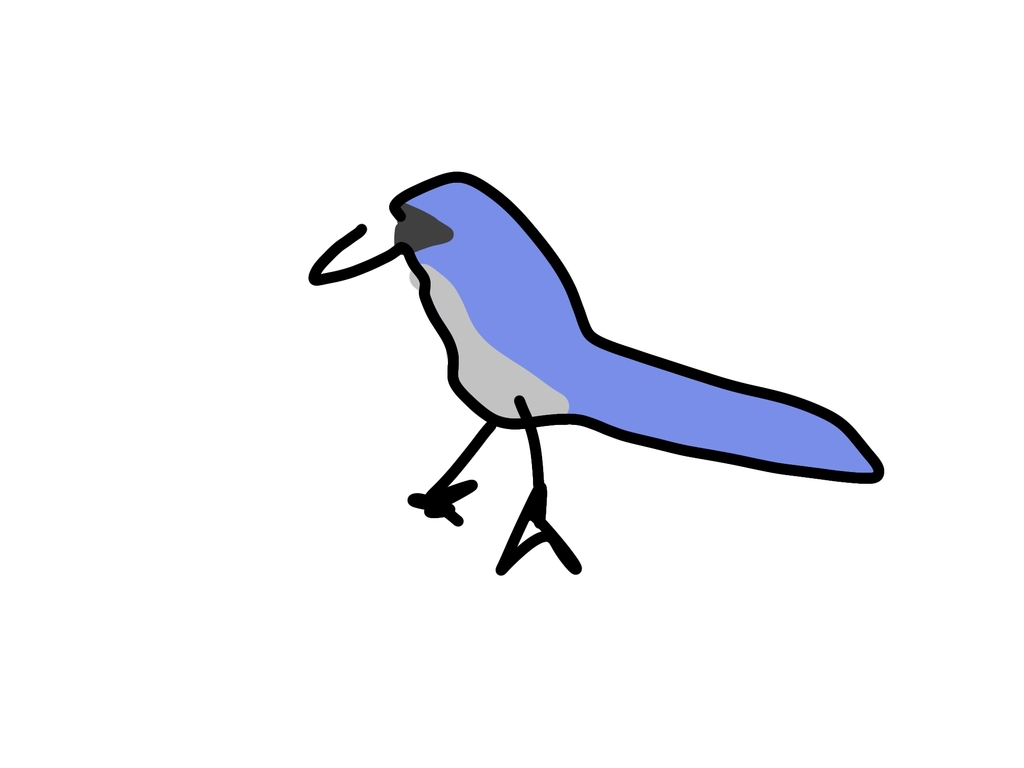
The Western Scrub-Jay (Aphelocoma californica), also known as the California Scrub-Jay, is a medium-sized corvid measuring 28-30 cm (11-12 inches) in length with a wingspan of 39 cm (15 inches). Adults weigh between 80-100 grams. The species exhibits sexual size dimorphism, with males typically larger than females. The dorsal surfaces are bright blue, including the wings, tail, and back of the head. The underparts are grayish-white, with a distinctive blue necklace across the upper breast. A white supercilium extends above each eye, contrasting with darker blue cheeks. The bill is black and relatively straight, adapted for their omnivorous diet. Western Scrub-Jays are endemic to western North America, with their range extending from southern Washington through California and into Baja California, Mexico. In California, the species occurs throughout most of the state except for high-elevation montane forests and the Central Valley floor. They inhabit all coastal counties and are common in foothill and lower montane regions of the Sierra Nevada, Cascade Range, and Transverse Ranges. The species reaches elevations up to 1,800 meters (5,900 feet) but is most abundant below 1,200 meters (3,900 feet). The species primarily inhabits oak woodlands, chaparral, pinyon-juniper woodlands, and riparian forests. They show strong association with oak trees, particularly coast live oak (Quercus agrifolia), interior live oak (Q. wislizeni), and blue oak (Q. douglasii). Western Scrub-Jays also occupy suburban areas with mature trees and shrubs, parks, and oak-studded grasslands. They require a mosaic of dense shrub cover for nesting and more open areas for foraging. Western Scrub-Jays are highly social and intelligent birds known for their complex behaviors. They are primarily granivorous, with acorns comprising up to 50% of their annual diet. The species exhibits extensive caching behavior, burying thousands of acorns each fall and remembering cache locations months later. They also consume insects, small reptiles, eggs, nestlings of other birds, and fruits. Breeding occurs from March through July, with peak nesting in April and May. Females construct cup-shaped nests 1-3 meters above ground in dense shrubs or small trees. Clutch size ranges from 3-6 eggs, with an average of 4. Incubation lasts 16-19 days, performed solely by females. Both parents feed nestlings, which fledge after 17-19 days. The Western Scrub-Jay is not federally or state listed and maintains stable populations throughout most of its range. According to the North American Breeding Bird Survey, populations have remained relatively stable from 1966-2019, with slight increases in some regions. However, localized declines have occurred due to habitat loss from urban development and oak woodland conversion. Fire suppression has altered natural habitat structure in some areas, potentially affecting population dynamics. Climate change poses long-term threats through altered precipitation patterns affecting oak production and distribution shifts in suitable habitat.
Classification
Class: Aves · Order: Passeriformes · Family: Corvidae
Frequently asked questions
How is Aphelocoma californica classified?
Aphelocoma californica belongs to class Aves, order Passeriformes, family Corvidae.
What family does Aphelocoma californica belong to?
Aphelocoma californica is in the Corvidae family.
What is Aphelocoma californica?
The Western Scrub-Jay (Aphelocoma californica), also known as the California Scrub-Jay, is a medium-sized corvid measuring 28-30 cm (11-12 inches) in length with a wingspan of 39 cm (15 inches).
Is Aphelocoma californica found in California?
Yes. Aphelocoma californica is recorded in California in The California Species Project's catalogue.
Related species
Other California species in the same genus, family, or bioregion.
Data from The California Species Project — 14,000+ California species with verified data from CNPS, CDFW, USFWS, and more.