Aphelocoma insularis
Island Scrub-jay
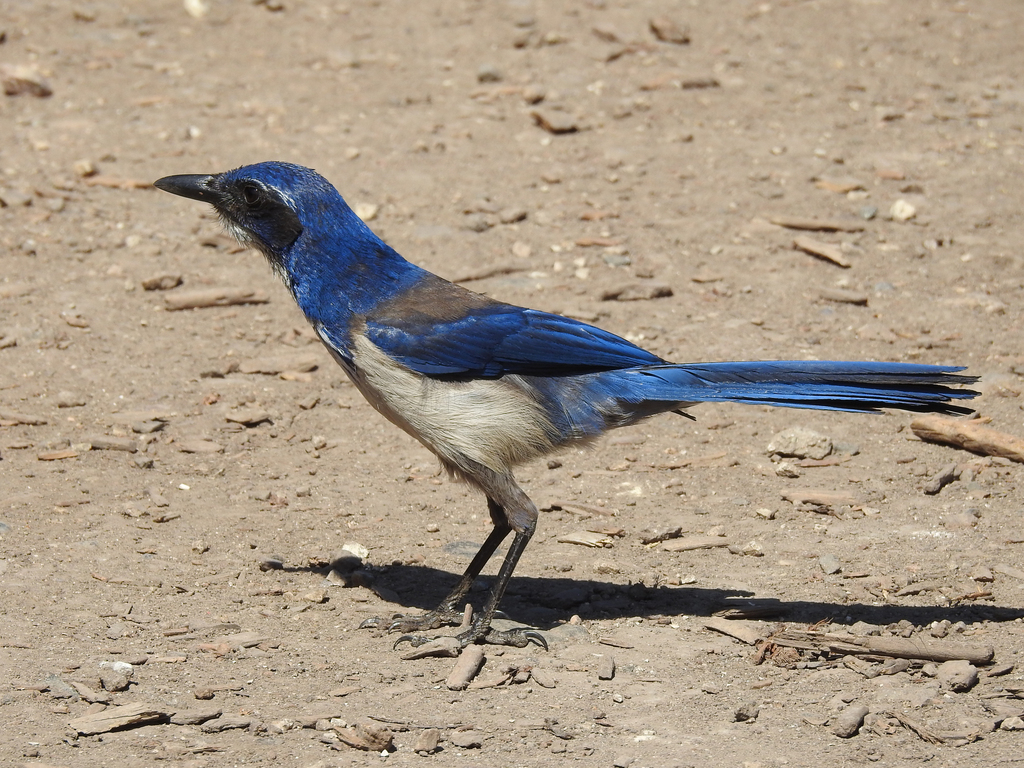
(c) rainbowkitten, some rights reserved (CC BY) · licence
Family: Corvidae · Class: Aves · Order: Passeriformes
Conservation status: G1 S1
Aphelocoma insularis (Island Scrub-jay) is a California animal in the Corvidae family.
The Island Scrub-jay is a medium-sized corvid endemic to Santa Cruz Island, California. Adults measure 28 to 33 cm (11 to 13 inches) in length with a wingspan of approximately 39 cm (15.4 inches). The species is notably larger and more robust than its mainland relative, the California Scrub-jay, weighing 115 to 140 grams compared to 80 to 100 grams for mainland populations. The head, wings, and tail are bright blue, while the back displays a brownish-blue coloration. The underparts are pale gray to whitish, with a distinct blue breast band. The bill is large and heavy, adapted for cracking hard nuts and seeds. Both sexes appear similar, though males average slightly larger than females. The Island Scrub-jay occurs exclusively on Santa Cruz Island, the largest of California's Channel Islands, located approximately 40 km (25 miles) off the coast of Santa Barbara County. The species' range encompasses the entire 249 square kilometers (96 square miles) of the island, making it one of the most geographically restricted bird species in North America. Fossil evidence suggests the species evolved in isolation on the island for at least 100,000 years following separation from mainland scrub-jay populations. Island Scrub-jays inhabit oak woodlands and chaparral communities from sea level to the island's highest elevations at 753 meters (2,470 feet). The species shows particular association with island oak (Quercus tomentella) groves, coastal sage scrub, and mixed chaparral containing manzanita, ceanothus, and island cherry. Oak woodland areas provide critical nesting habitat and acorn resources, while chaparral offers year-round foraging opportunities and cover. The species is omnivorous, with diet varying seasonally based on resource availability. Acorns from island oak comprise a major food source, supplemented by insects, other arthropods, small reptiles including island fence lizards, birds' eggs and nestlings, and occasionally carrion. Island Scrub-jays are known to cache acorns for winter consumption, burying them in scattered locations throughout their territory. Breeding occurs from March through July, with pairs constructing stick nests in oak trees or tall shrubs 1 to 4 meters above ground. Clutch size ranges from 3 to 5 eggs, with incubation lasting approximately 18 days. Young fledge after 18 to 20 days but remain dependent on parents for several weeks. The Island Scrub-jay is classified as G1 S1, indicating it is critically imperiled both globally and within California. The total population is estimated at approximately 1,200 to 1,800 individuals based on recent surveys. Primary threats include habitat degradation from introduced herbivores, particularly feral sheep and pigs that were removed from the island in the 1980s and 2000s respectively. Fire represents another significant threat, as the species' limited range makes it vulnerable to catastrophic wildfire events. West Nile virus, detected on the island in 2009, poses an emerging disease threat. Climate change may affect food resource availability and increase fire frequency. Conservation efforts focus on habitat restoration, monitoring of population trends, and disease surveillance through collaborative programs involving The Nature Conservancy, the National Park Service, and academic researchers.
Classification
Class: Aves · Order: Passeriformes · Family: Corvidae
Conservation status
G1 S1
Frequently asked questions
How is Aphelocoma insularis classified?
Aphelocoma insularis belongs to class Aves, order Passeriformes, family Corvidae.
What family does Aphelocoma insularis belong to?
Aphelocoma insularis is in the Corvidae family.
Is Aphelocoma insularis protected or of conservation concern?
Aphelocoma insularis carries the following status: G1 S1.
What is Aphelocoma insularis?
The Island Scrub-jay is a medium-sized corvid endemic to Santa Cruz Island, California.
Is Aphelocoma insularis found in California?
Yes. Aphelocoma insularis is recorded in California in The California Species Project's catalogue.
Related species
Other California species in the same genus, family, or bioregion.
Data from The California Species Project — 14,000+ California species with verified data from CNPS, CDFW, USFWS, and more.