Aphelocoma woodhouseii
Woodhouse's Scrub-Jay
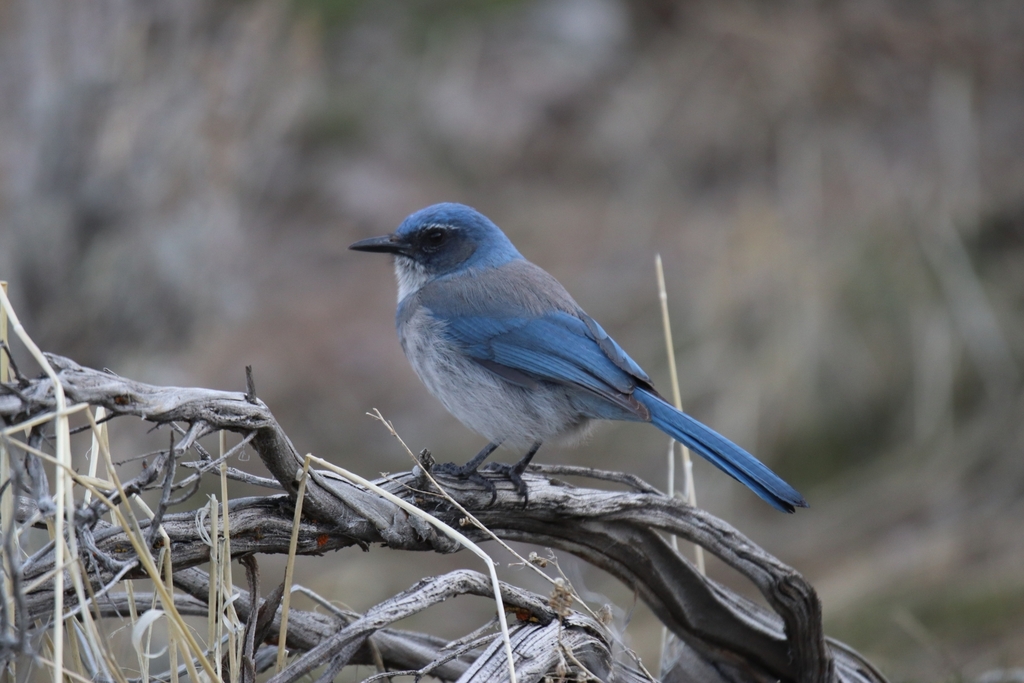
(c) Roland Godon, some rights reserved (CC BY) · licence
Family: Corvidae · Class: Aves · Order: Passeriformes
Aphelocoma woodhouseii (Woodhouse's Scrub-Jay) is a California animal in the Corvidae family.
The Woodhouse's Scrub-Jay is a medium-sized jay measuring approximately 28-30 cm (11-12 inches) in length with a wingspan of 39-43 cm (15-17 inches). This species displays duller blue upperparts compared to its California counterpart, with grayer underparts and a less distinct breast-band. The head, wings, and tail are blue, while the back shows a brownish-gray coloration. The underparts are pale gray to whitish, with a faint grayish breast-band across the chest. The bill is black and relatively heavy, adapted for its omnivorous diet. Woodhouse's Scrub-Jay occurs throughout much of the American Southwest, ranging from the Great Basin south through the Colorado Plateau and into mainland Mexico. In California, the species is found primarily in the eastern portions of the state, including the eastern Sierra Nevada, Mojave Desert ranges, and areas where its range contacts with the California Scrub-Jay in western Nevada and east-central California. The species also occurs in Arizona, Colorado, Utah, Nevada, New Mexico, Idaho, Wyoming, and western Texas (NatureServe 2016). This species inhabits dry scrub and woodland habitats, showing a strong preference for pinyon-juniper (Pinus-Juniperus) woodlands in foothills and lower mountain slopes. Unlike the California Scrub-Jay, which frequents oak woodlands and residential areas, Woodhouse's Scrub-Jay typically avoids human-modified landscapes and remains in more natural habitats. The species occurs at elevations ranging from desert valleys to montane zones, generally between 1,200 and 2,400 meters (4,000-8,000 feet) elevation. Woodhouse's Scrub-Jay exhibits a reclusive nature, being more inconspicuous and sparsely distributed compared to other scrub-jay species. The species is omnivorous, feeding on insects, small vertebrates, eggs, nestlings, and various seeds and nuts, particularly pine nuts from pinyon pines. Breeding typically occurs from April through July, with pairs constructing stick nests in dense shrubs or small trees. Females lay 3-6 eggs, with incubation lasting approximately 16-18 days. Unlike some other jay species, Woodhouse's Scrub-Jays do not exhibit cooperative breeding behavior. The Woodhouse's Scrub-Jay resulted from a taxonomic split of the Western Scrub-Jay complex, gaining recognition as a separate species in 2016 based on differences in ecology, morphology, genetics, and vocalizations (AOU 2016). The U.S. Fish and Wildlife Service designated this species as a Bird of Conservation Concern in 2021, specifically the subspecies A. w. woodhouseii (USFWS 2021). NatureServe ranks the species as G5 (globally secure) as of 2016, though state-level rankings vary, with Wyoming listing it as S1 (critically imperiled) and Idaho and New Mexico as S3 (vulnerable). The species faces potential threats from habitat loss due to development, altered fire regimes, and climate change impacts on pinyon-juniper ecosystems. While the species maintains stable populations across much of its range, monitoring continues to assess long-term population trends and habitat requirements.
Classification
Class: Aves · Order: Passeriformes · Family: Corvidae
Frequently asked questions
How is Aphelocoma woodhouseii classified?
Aphelocoma woodhouseii belongs to class Aves, order Passeriformes, family Corvidae.
What family does Aphelocoma woodhouseii belong to?
Aphelocoma woodhouseii is in the Corvidae family.
What is Aphelocoma woodhouseii?
The Woodhouse's Scrub-Jay is a medium-sized jay measuring approximately 28-30 cm (11-12 inches) in length with a wingspan of 39-43 cm (15-17 inches).
Is Aphelocoma woodhouseii found in California?
Yes. Aphelocoma woodhouseii is recorded in California in The California Species Project's catalogue.
Related species
Other California species in the same genus, family, or bioregion.
Data from The California Species Project — 14,000+ California species with verified data from CNPS, CDFW, USFWS, and more.