Aphonopelma iodius
Desert Tarantula
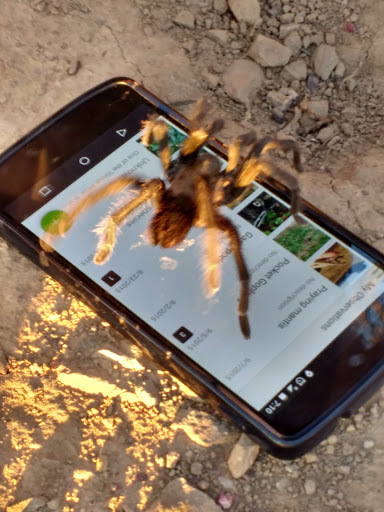
(c) 115527224325819725585, some rights reserved (CC BY) · licence
Family: Theraphosidae · Class: Arachnida · Order: Araneae
Aphonopelma iodius (Desert Tarantula) is a California animal in the Theraphosidae family.
The desert tarantula is a large, robust spider found throughout California's arid regions. Adult females reach 4 to 5 inches (10 to 13 cm) in leg span, while males are typically smaller at 3 to 4 inches (7.6 to 10 cm). The species displays a characteristic dark triangular pattern on the carapace surrounding the eye tubercle area, distinguishing it from other California Aphonopelma species (BugGuide). The body is typically dark brown to black with a dense covering of urticating hairs. Males develop distinctive tibial hooks on their first pair of legs and palpal bulbs when they reach sexual maturity. According to USFWS records, Aphonopelma iodius occurs across seven California counties: Imperial, Los Angeles, Orange, Riverside, San Bernardino, San Diego, and Ventura. The species has also been documented in San Benito County and extends into Nevada and Utah (BugGuide). This represents one of the most widespread tarantula distributions in the western United States. The species' range encompasses both coastal and inland desert regions, from sea level to moderate elevations. Desert tarantulas inhabit a variety of arid and semi-arid environments including desert scrub, chaparral, oak woodlands, and grasslands. They construct silk-lined burrows in sandy or rocky soils, often on hillsides or in washes. Burrows typically extend 12 to 24 inches (30 to 61 cm) deep with a diameter slightly larger than the spider's body. The entrance is often camouflaged with a thin layer of silk and debris. Urban populations have adapted to developed areas, utilizing landscaped gardens and vacant lots. Females remain primarily sedentary, rarely venturing far from their burrows except during prey capture or extreme weather events. Males become active wanderers during mating season, typically from September through November, when they search for receptive females. The species is nocturnal, emerging after sunset to hunt for insects, other spiders, and small arthropods. Prey is ambushed near the burrow entrance and subdued with venom before being dragged underground for consumption. Mating occurs when males locate females' burrows and perform courtship displays involving leg tapping and body positioning. After successful mating, females may consume the male. Egg sacs containing 100 to 400 eggs are produced the following spring, with spiderlings emerging after 6 to 8 weeks. Females can live 20 to 30 years, while males typically die within a year of reaching maturity. As of December 2025, USFWS has proposed listing two distinct population segments of Aphonopelma iodius as threatened under the Endangered Species Act. The northern and southern distinct population segments face threats from habitat loss due to urban development, renewable energy projects, and off-road vehicle use. Climate change poses additional challenges through altered precipitation patterns and increased temperature extremes. Despite these pressures, the species maintains relatively stable populations across much of its range, though long-term monitoring is needed to assess population trends accurately.
Classification
Class: Arachnida · Order: Araneae · Family: Theraphosidae
Frequently asked questions
How is Aphonopelma iodius classified?
Aphonopelma iodius belongs to class Arachnida, order Araneae, family Theraphosidae.
What family does Aphonopelma iodius belong to?
Aphonopelma iodius is in the Theraphosidae family.
What is Aphonopelma iodius?
The desert tarantula is a large, robust spider found throughout California's arid regions.
Is Aphonopelma iodius found in California?
Yes. Aphonopelma iodius is recorded in California in The California Species Project's catalogue.
More California species
This species has no close relatives in our California data — here are other species to explore.
Data from The California Species Project — 14,000+ California species with verified data from CNPS, CDFW, USFWS, and more.