Aplidium californicum
Pacific Sea Pork
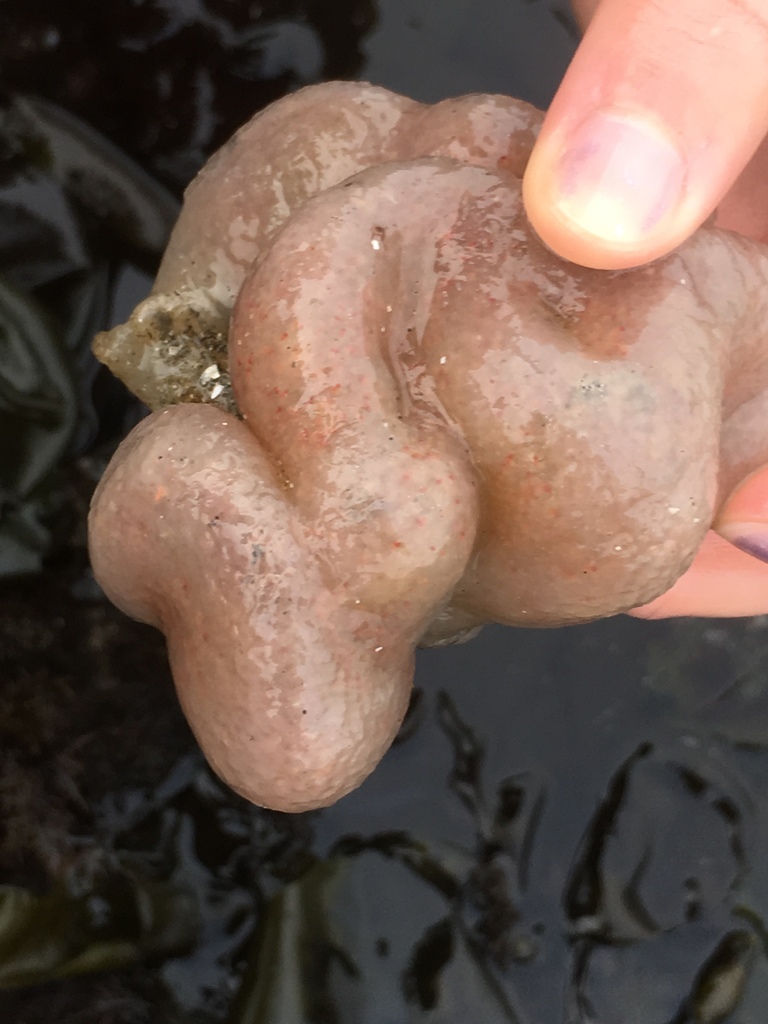
(c) Rebecca Johnson, some rights reserved (CC BY) · licence
Family: Polyclinidae · Class: Ascidiacea · Order: Aplousobranchiata
Aplidium californicum (Pacific Sea Pork) is a California animal in the Polyclinidae family.
The Pacific Sea Pork (Aplidium californicum) is a colonial tunicate that forms lumpy, encrusting masses on marine substrates. Individual colonies typically measure 1-3 cm thick, though they can reach up to 3 cm in thickness and extend 30 cm across in irregular patterns. The texture is gelatinous to fleshy, usually lacking embedded sand particles, though surface encrustations may occur. Coloration varies considerably, ranging from tan, yellowish, and gray to opalescent white, orange, transparent, or orange-brown hues. This species exhibits the characteristic colonial organization of compound tunicates. Individual zooids are arranged in systems where each possesses its own oral (buccal) siphon opening at the colony surface, while atrial siphons connect to internal canal networks. These canals terminate at shared atrial openings scattered across the colony surface. The pharyngeal basket contains 7-15 rows of stigmata, typically 8-12, distinguishing it from the closely related Aplidium solidum, which has 12-16 rows and forms thicker slabs up to 5 cm thick. Pacific Sea Pork ranges from Alaska to Baja California, Mexico, with populations also documented in the Galápagos Islands. The species occurs from intertidal zones to depths of 85 meters, making it one of the most widely distributed compound tunicates along the Pacific coast. This tunicate colonizes various solid and semi-solid substrates including dock pilings, tubeworm tubes, crab carapaces, mollusk shells, and surge channels. It typically inhabits areas protected from direct surf action, thriving in semi-protected marine environments where it ranks among the most common compound tunicates. Reproduction occurs through both sexual and asexual mechanisms. The species broods eggs in small numbers within the atrial cavity dorsal to the pharynx. Fertilized eggs develop into tadpole larvae that disperse through atrial apertures. Asexual reproduction involves the postabdomen detaching and constricting into linear bud series, each developing into a complete zooid. Colonies may undergo seasonal degeneration during winter months. Pacific Sea Pork serves as prey for several seastar species, including Dermasterias imbricata, Asterina miniata, Mediaster aequalis, and Pteraster tesselatus. The colonies host symbiotic relationships with the amphipod Polycheria osborni, which inhabits grooves on colony surfaces, and may harbor the parasitic copepod Pholeterides furtiva. Each zooid displays typical tunicate anatomy with three distinct body regions: the thorax containing the pharyngeal basket and atrial aperture, the abdomen housing the coiled digestive system, and the postabdomen containing reproductive organs including yellow ovaries, white testes, and the heart. Currently, no specific conservation concerns have been documented for Pacific Sea Pork. The species appears stable throughout its range and maintains healthy populations in suitable marine habitats along the Pacific coast.
Classification
Class: Ascidiacea · Order: Aplousobranchiata · Family: Polyclinidae
Frequently asked questions
How is Aplidium californicum classified?
Aplidium californicum belongs to class Ascidiacea, order Aplousobranchiata, family Polyclinidae.
What family does Aplidium californicum belong to?
Aplidium californicum is in the Polyclinidae family.
What is Aplidium californicum?
The Pacific Sea Pork (Aplidium californicum) is a colonial tunicate that forms lumpy, encrusting masses on marine substrates.
Is Aplidium californicum found in California?
Yes. Aplidium californicum is recorded in California in The California Species Project's catalogue.
More California species
This species has no close relatives in our California data — here are other species to explore.
Data from The California Species Project — 14,000+ California species with verified data from CNPS, CDFW, USFWS, and more.