Apodemia palmeri
Palmer's Metalmark
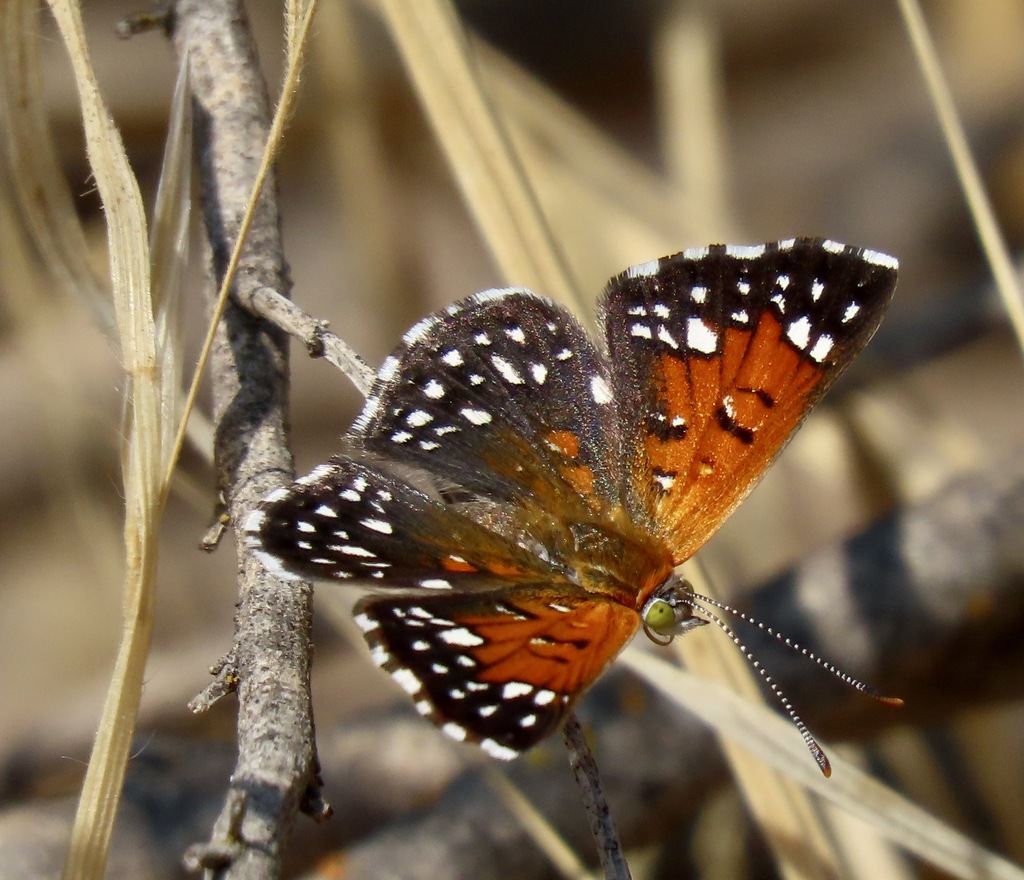
(c) John Hibbard, some rights reserved (CC BY) · licence
Family: Riodinidae · Class: Insecta · Order: Lepidoptera
Apodemia palmeri (Palmer's Metalmark) is a California animal in the Riodinidae family.
Palmer's Metalmark is a small butterfly in the family Riodinidae, distinguished by its metallic orange-brown wings with distinctive white and black markings. Adults have a wingspan of approximately 25-32 mm (1.0-1.3 inches). The dorsal wing surfaces display bright orange-red coloration with black borders and white spotting, while the ventral surfaces show more subdued orange-brown tones with prominent metallic silver spots that give the species its common name. Males and females are similar in appearance, though males may display slightly more vibrant coloration. This species occurs across a broad range spanning West Texas, New Mexico, Arizona, southern Utah, southern Nevada, and southern California, extending south through central Mexico and Baja California. In California, Palmer's Metalmark is found primarily in the southeastern desert regions, including the Sonoran and Mojave Desert areas. The species reaches its northwestern range limit in Inyo County and extends south through Imperial County. Palmer's Metalmark inhabits desert washes, riparian corridors, and areas with mesquite woodlands, typically at elevations below 1,200 meters (3,940 feet). The species is closely associated with its host plants, screwbean mesquite (Prosopis pubescens) and honey mesquite (P. glandulosa var. torreyana). These mesquite-dominated habitats provide both larval food sources and adult nectar resources. The butterfly is most commonly found in areas where mesquite trees form dense thickets along seasonal watercourses and in desert flats. Adults are active primarily during spring and fall months, with peak flight periods occurring from March through May and September through October, avoiding the extreme summer heat. Males exhibit territorial behavior, perching on mesquite branches and engaging in aerial pursuit of other males and potential mates. Females deposit eggs singly on young mesquite foliage, typically on new growth shoots. Larvae feed exclusively on mesquite leaves, developing through five instars before pupating. The species appears to have multiple broods per year in favorable conditions, with development synchronized to mesquite leaf production cycles. Palmer's Metalmark currently has no federal or state conservation listing status, though populations face localized threats from habitat loss due to urban development, water diversions affecting riparian mesquite stands, and invasive plant species that alter desert wash ecosystems. The species' dependence on specific mesquite habitats makes it vulnerable to changes in water availability and land use practices. Climate change may affect the species through altered precipitation patterns that impact mesquite tree health and distribution. In California, habitat conversion for agriculture and residential development in desert valleys has reduced available habitat, though the species maintains stable populations in protected areas including Joshua Tree National Park and Mojave National Preserve.
Classification
Class: Insecta · Order: Lepidoptera · Family: Riodinidae
Frequently asked questions
How is Apodemia palmeri classified?
Apodemia palmeri belongs to class Insecta, order Lepidoptera, family Riodinidae.
What family does Apodemia palmeri belong to?
Apodemia palmeri is in the Riodinidae family.
What is Apodemia palmeri?
Palmer's Metalmark is a small butterfly in the family Riodinidae, distinguished by its metallic orange-brown wings with distinctive white and black markings.
Is Apodemia palmeri found in California?
Yes. Apodemia palmeri is recorded in California in The California Species Project's catalogue.
Related species
Other California species in the same genus, family, or bioregion.
Data from The California Species Project — 14,000+ California species with verified data from CNPS, CDFW, USFWS, and more.