Apodemia virgulti
Behr's Metalmark
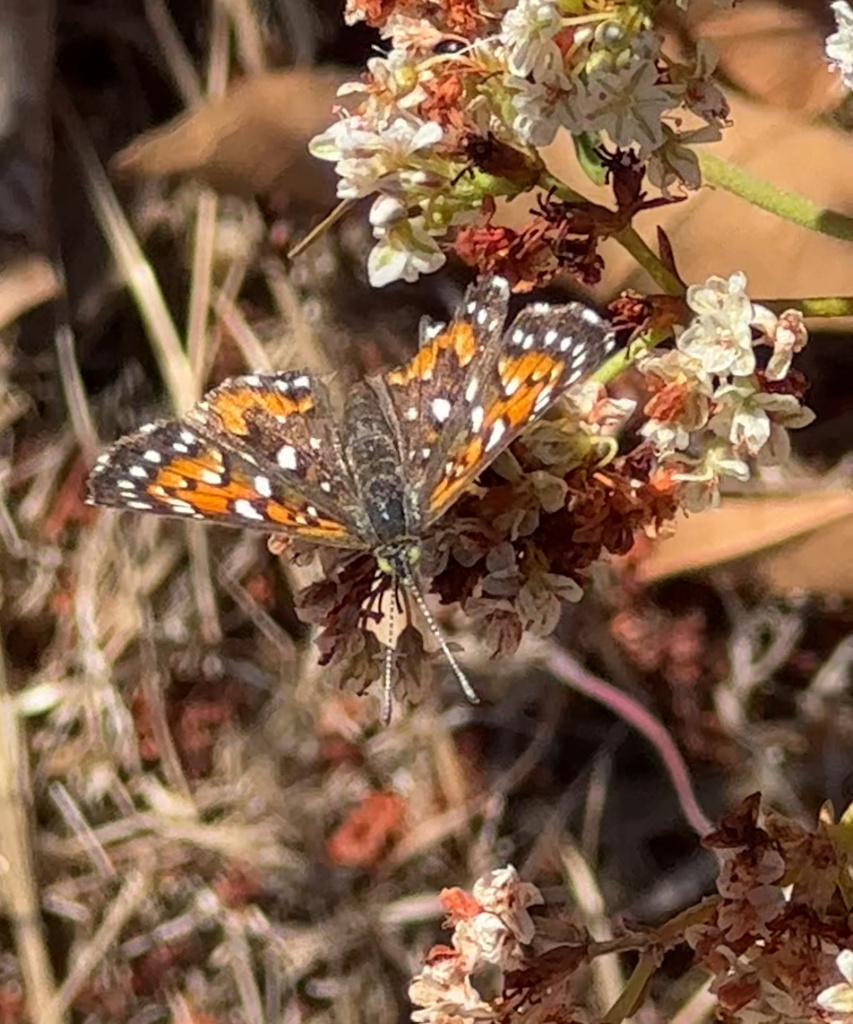
(c) Rachel Lee Harper, some rights reserved (CC BY) · licence
Family: Riodinidae · Class: Insecta · Order: Lepidoptera
Apodemia virgulti (Behr's Metalmark) is a California animal in the Riodinidae family.
Behr's Metalmark (Apodemia virgulti) is a small butterfly belonging to the family Riodinidae, known as metalmarks due to the metallic markings on their wings. Adults have a wingspan typically ranging from 19 to 25 mm (0.75 to 1.0 inches). The dorsal wing surfaces are orange-brown with distinctive black markings and metallic spots that give the species its common name. The ventral surfaces display a lighter coloration with prominent white and metallic silver spots arranged in regular patterns. Males and females show similar coloration patterns, though females tend to be slightly larger. Behr's Metalmark ranges from central California south to central Baja California, Mexico. In California, the species occurs primarily in the Coast Ranges, Transverse Ranges, and Peninsular Ranges. Documented populations exist in counties including San Luis Obispo, Santa Barbara, Ventura, Los Angeles, Orange, Riverside, San Bernardino, and San Diego. The distribution extends through suitable habitat in chaparral and coastal sage scrub communities throughout this range. The species inhabits chaparral, coastal sage scrub, and oak woodland communities, typically at elevations from sea level to approximately 1,500 meters (4,900 feet). Behr's Metalmark shows strong habitat association with its host plants, most commonly fasciculate buckwheat (Eriogonum fasciculatum). However, subspecies dialeuca and dialeucoides utilize Wright's buckwheat (Eriogonum wrightii) as their primary host plant. Adults are typically found in areas with scattered shrubs and open spaces that provide nectar sources and basking sites. Behr's Metalmark exhibits multiple broods per year in favorable conditions, with flight periods varying by location and elevation. Adults are active from March through October, with peak activity occurring during spring and early summer months. Males engage in territorial behavior, perching on prominent vegetation or rocks to await passing females. Mating occurs after brief courtship flights. Females deposit eggs singly on the leaves or stems of host buckwheat plants. Larvae feed exclusively on buckwheat species, developing through five instars before pupating. The species overwinters in the pupal stage, though some populations may have extended development periods. Currently, Behr's Metalmark does not hold federal or state listing status in California, though local populations face pressures from habitat loss and fragmentation. Urban development, agriculture, and fire management practices have reduced available habitat in portions of the species' range. The butterfly's dependence on specific buckwheat species makes it vulnerable to changes in plant community composition. Climate change may affect the timing of life cycle events and the distribution of suitable habitat. Conservation efforts focus on protecting chaparral and coastal sage scrub habitats and maintaining native buckwheat populations. The species benefits from habitat restoration projects that include native Eriogonum species and from fire management practices that maintain the mosaic structure of shrubland communities.
Classification
Class: Insecta · Order: Lepidoptera · Family: Riodinidae
Frequently asked questions
How is Apodemia virgulti classified?
Apodemia virgulti belongs to class Insecta, order Lepidoptera, family Riodinidae.
What family does Apodemia virgulti belong to?
Apodemia virgulti is in the Riodinidae family.
What is Apodemia virgulti?
Behr's Metalmark (Apodemia virgulti) is a small butterfly belonging to the family Riodinidae, known as metalmarks due to the metallic markings on their wings.
Is Apodemia virgulti found in California?
Yes. Apodemia virgulti is recorded in California in The California Species Project's catalogue.
Related species
Other California species in the same genus, family, or bioregion.
Data from The California Species Project — 14,000+ California species with verified data from CNPS, CDFW, USFWS, and more.