Aquila chrysaetos
Golden eagle
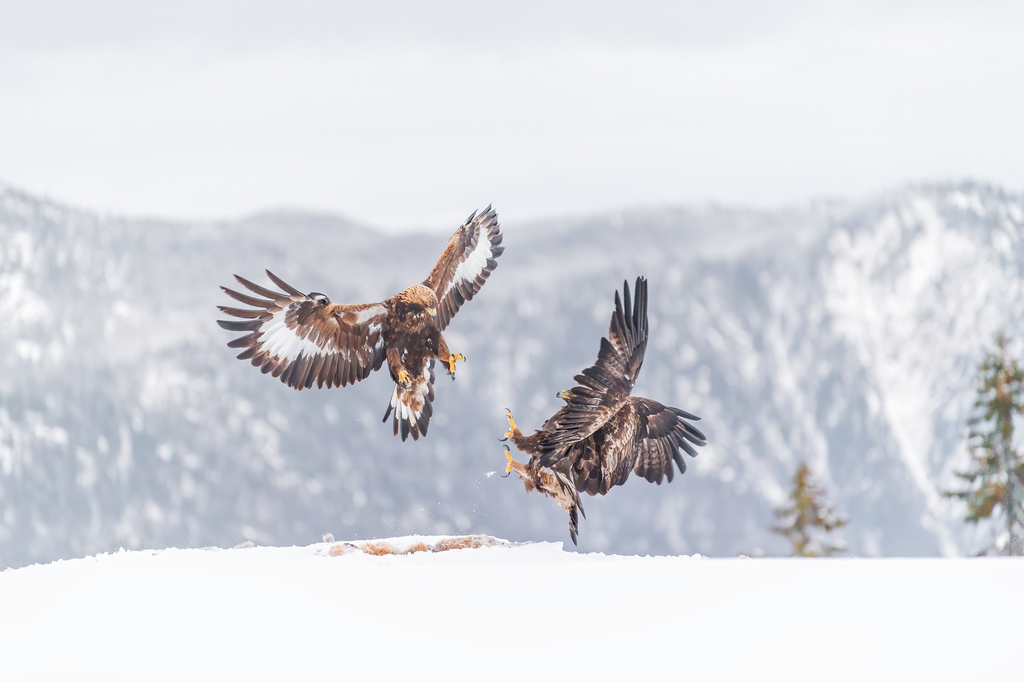
(c) Morten Ross, some rights reserved (CC BY) · licence
Family: Accipitridae · Class: Aves · Order: Accipitriformes
Conservation status: FP · G5 S3
Aquila chrysaetos (Golden eagle) is a California animal in the Accipitridae family.
The golden eagle is a large raptor with a wingspan ranging from 1.8 to 2.3 meters (6 to 7.5 feet) and body length of 66 to 102 centimeters (26 to 40 inches). Adults weigh 2.5 to 7 kilograms (5.5 to 15.4 pounds), with females typically 25% larger than males. The species displays dark brown plumage overall, with distinctive golden-buff feathers on the head and nape that give the bird its common name. Juveniles show white patches at the base of the flight feathers and white tail bands that fade as birds mature over four to five years. The powerful bill is dark with a yellow cere, and the feathered legs extend to yellow talons. In California, golden eagles occur throughout mountainous and foothill regions, from the Cascade Range and Sierra Nevada to coastal ranges and desert mountains. The species inhabits elevations from sea level to over 3,000 meters (10,000 feet). According to CDFW surveys, breeding pairs are distributed across 52 of California's 58 counties, with highest densities in the Coast Ranges, Sierra Nevada foothills, and Transverse Ranges. The statewide population is estimated at 1,500 to 2,000 breeding pairs. Golden eagles prefer open and semi-open habitats including grasslands, shrublands, oak woodlands, and coniferous forests with adjacent clearings. Nesting sites are typically located on cliff faces, in large trees, or on transmission towers, with territories averaging 20 to 200 square kilometers (8 to 77 square miles) depending on prey density. The species requires large foraging areas with minimal human disturbance and adequate prey populations. Nest sites are often reused annually, with some documented use spanning decades. Golden eagles are opportunistic predators feeding primarily on medium-sized mammals including ground squirrels, rabbits, marmots, and young ungulates. Birds, reptiles, and carrion supplement the diet seasonally. Breeding occurs from January through August, with peak egg laying from March to May. Pairs construct stick nests measuring 1.5 to 3 meters (5 to 10 feet) in diameter, often reusing sites for multiple years. Females lay one to four eggs, typically two, with an incubation period of 43 to 45 days. Young fledge after 66 to 75 days but may remain dependent on adults for several additional months. Pair bonds are typically maintained across multiple breeding seasons. The golden eagle is designated as a California Fully Protected species under Fish and Game Code Section 3511, prohibiting take, possession, or destruction without special authorization. The species receives additional protection under the federal Bald and Golden Eagle Protection Act and Migratory Bird Treaty Act. Primary threats include habitat loss from development, collision mortality at wind energy facilities, electrocution on power lines, and human disturbance at nest sites. Lead poisoning from ammunition in carrion poses a significant mortality risk. Climate change may affect prey availability and breeding success through altered precipitation patterns and habitat shifts.
Classification
Class: Aves · Order: Accipitriformes · Family: Accipitridae
Conservation status
FP · G5 S3
Frequently asked questions
How is Aquila chrysaetos classified?
Aquila chrysaetos belongs to class Aves, order Accipitriformes, family Accipitridae.
What family does Aquila chrysaetos belong to?
Aquila chrysaetos is in the Accipitridae family.
Is Aquila chrysaetos protected or of conservation concern?
Aquila chrysaetos carries the following status: FP · G5 S3.
What is Aquila chrysaetos?
The golden eagle is a large raptor with a wingspan ranging from 1.8 to 2.3 meters (6 to 7.5 feet) and body length of 66 to 102 centimeters (26 to 40 inches).
Is Aquila chrysaetos found in California?
Yes. Aquila chrysaetos is recorded in California in The California Species Project's catalogue.
Related species
Other California species in the same genus, family, or bioregion.
Data from The California Species Project — 14,000+ California species with verified data from CNPS, CDFW, USFWS, and more.