Araneus andrewsi
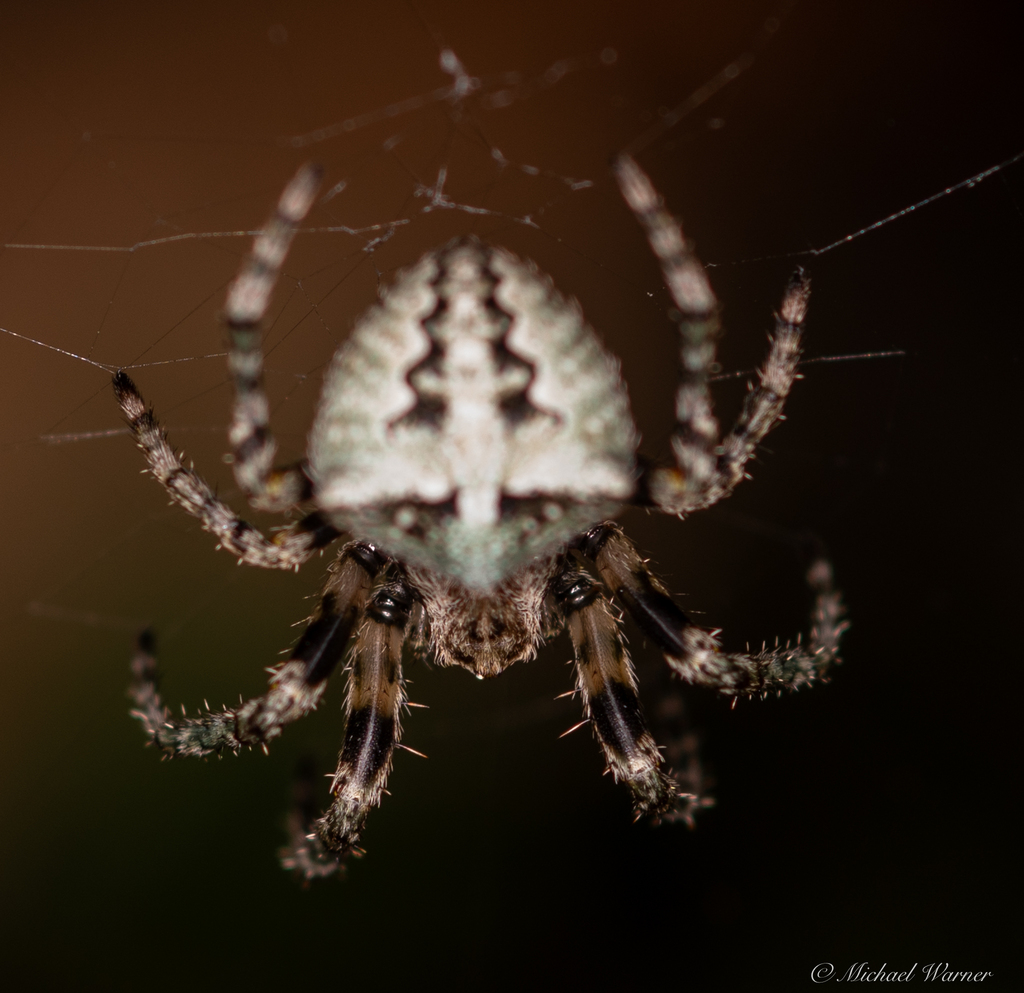
(c) Michael Warner, some rights reserved (CC BY) · licence
Family: Araneidae · Class: Arachnida · Order: Araneae
Araneus andrewsi is a California animal in the Araneidae family.
Araneus andrewsi is an orb weaver spider in the family Araneidae, part of the true spiders (Araneomorphae). This species belongs to a large genus of orb weavers that construct characteristic circular webs to capture prey. The spider displays a mottled brown abdomen pattern that distinguishes it from closely related species (BugGuide). Unlike Araneus gemma, A. andrewsi typically lacks the medial brown stripe running down the center of the abdomen that characterizes its relative. The overall coloration provides effective camouflage among bark and dried vegetation where the species commonly resides. Detailed morphological descriptions and size measurements for this species have not been comprehensively documented in available literature. Araneus andrewsi occurs in western North America, with its range extending from western Montana west to British Columbia and south to California (Dondale & Redner 1978). Within California, the species' specific distribution patterns and county-level occurrences require further documentation. The species appears to have a relatively broad latitudinal range across the western mountain and coastal regions. The habitat preferences of A. andrewsi center around areas that support web construction, though specific microhabitat requirements have not been thoroughly studied. Based on the genus' typical ecology, this species likely inhabits locations with suitable anchor points for orb web construction, including shrubland edges, forest openings, and areas with mixed vegetation structure. Elevation ranges and specific vegetation associations within California remain poorly documented. As an orb weaver, A. andrewsi constructs circular webs to capture flying insects and other small arthropods. The species likely follows the typical orb weaver behavioral pattern of rebuilding webs regularly, often consuming the old web silk before constructing a new one. Prey capture involves detecting vibrations in the web strands when insects become entangled, followed by rapid movement to subdue and wrap the prey. Reproductive timing, egg-laying behavior, and seasonal activity patterns have not been specifically documented for this species. Like other Araneus species, it likely has an annual life cycle with overwintering occurring in the egg stage. Araneus andrewsi does not appear on federal or state endangered species lists, and no specific conservation status has been assigned to this species. The lack of detailed population studies makes it difficult to assess current population trends or potential threats. As with many spider species, habitat modification and pesticide use could pose potential risks, though specific impacts on A. andrewsi populations have not been evaluated. The species' apparent broad geographic range suggests it may be relatively stable, though targeted surveys would be needed to confirm population status. Scientific documentation for this species remains limited compared to more extensively studied orb weavers. Additional research on habitat requirements, population distribution, and ecological interactions would enhance understanding of this species' biology and conservation needs within California's diverse arachnid fauna.
Classification
Class: Arachnida · Order: Araneae · Family: Araneidae
Frequently asked questions
How is Araneus andrewsi classified?
Araneus andrewsi belongs to class Arachnida, order Araneae, family Araneidae.
What family does Araneus andrewsi belong to?
Araneus andrewsi is in the Araneidae family.
What is Araneus andrewsi?
Araneus andrewsi is an orb weaver spider in the family Araneidae, part of the true spiders (Araneomorphae).
Is Araneus andrewsi found in California?
Yes. Araneus andrewsi is recorded in California in The California Species Project's catalogue.
Related species
Other California species in the same genus, family, or bioregion.
Data from The California Species Project — 14,000+ California species with verified data from CNPS, CDFW, USFWS, and more.