Araneus gemmoides
Cat-faced Orbweaver
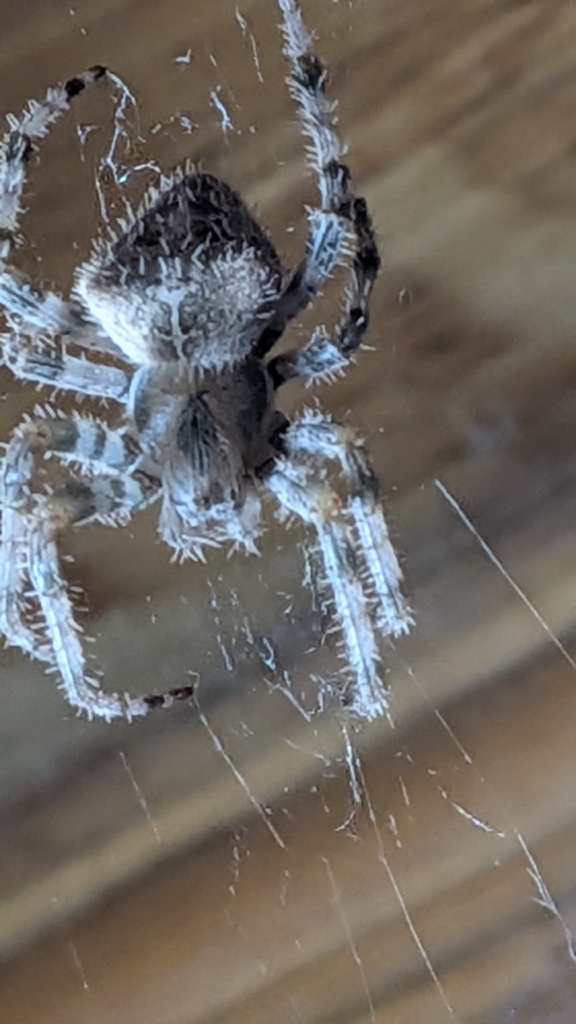
(c) Jake Armstrong, some rights reserved (CC BY) · licence
Family: Araneidae · Class: Arachnida · Order: Araneae
Araneus gemmoides (Cat-faced Orbweaver) is a California animal in the Araneidae family.
Araneus gemmoides, commonly known as the cat-faced orbweaver or jewel spider, is a medium to large orb-weaver spider in the family Araneidae. Adults typically measure 13-19 mm (0.5-0.75 inches) in body length, with females considerably larger than males. The species exhibits significant color variation, ranging from light yellow to dark brown or reddish-brown, often with distinctive markings that can resemble a cat's face when viewed from above. The abdomen features two prominent humps or tubercles that create the characteristic "cat-faced" appearance, along with various patterns of spots, stripes, or mottled coloration. The cat-faced orbweaver has an extensive range across western North America, occurring from British Columbia south through the western United States to Arizona and California (BugGuide). In California, the species is found throughout much of the state, with populations documented from coastal areas to mountainous regions. The eastern extent of its range reaches into Texas, with some reports extending as far east as Michigan and Florida, though these peripheral records require verification. This species inhabits a variety of habitats including forests, woodlands, chaparral, gardens, and urban areas. Cat-faced orbweavers commonly build their webs on trees, shrubs, buildings, and other structures, showing considerable adaptability to human-modified environments. They prefer locations with adequate support structures for their large, circular webs and sufficient prey availability. The species occurs from sea level to moderate elevations in mountainous areas. Cat-faced orbweavers are primarily nocturnal hunters that construct classic orb webs measuring 30-60 cm (12-24 inches) in diameter. These semi-permanent webs feature the typical radial and spiral thread pattern characteristic of orb-weavers, with sticky capture spirals to ensnare flying insects. The spiders typically position themselves at the web center or retreat to a nearby shelter during daylight hours. Their diet consists primarily of flying insects including moths, flies, beetles, and other arthropods caught in their webs. Mating occurs in late summer to early fall, with females producing egg sacs that overwinter. Females may live for more than one year, while males typically die after mating. Juveniles disperse through ballooning, using silk threads to catch air currents. Araneus gemmoides has a conservation status of G5 (globally secure) according to NatureServe, indicating stable populations throughout its range. The species shows no apparent conservation concerns and appears well-adapted to both natural and anthropogenic habitats. Its wide distribution, habitat flexibility, and stable populations suggest the cat-faced orbweaver faces no significant threats at present. The species plays an important ecological role as both predator of pest insects and prey for birds and other arthropod predators.
Classification
Class: Arachnida · Order: Araneae · Family: Araneidae
Frequently asked questions
How is Araneus gemmoides classified?
Araneus gemmoides belongs to class Arachnida, order Araneae, family Araneidae.
What family does Araneus gemmoides belong to?
Araneus gemmoides is in the Araneidae family.
What is Araneus gemmoides?
Araneus gemmoides, commonly known as the cat-faced orbweaver or jewel spider, is a medium to large orb-weaver spider in the family Araneidae.
Is Araneus gemmoides found in California?
Yes. Araneus gemmoides is recorded in California in The California Species Project's catalogue.
Related species
Other California species in the same genus, family, or bioregion.
Data from The California Species Project — 14,000+ California species with verified data from CNPS, CDFW, USFWS, and more.