Araneus pegnia
Butterfly Orbweaver
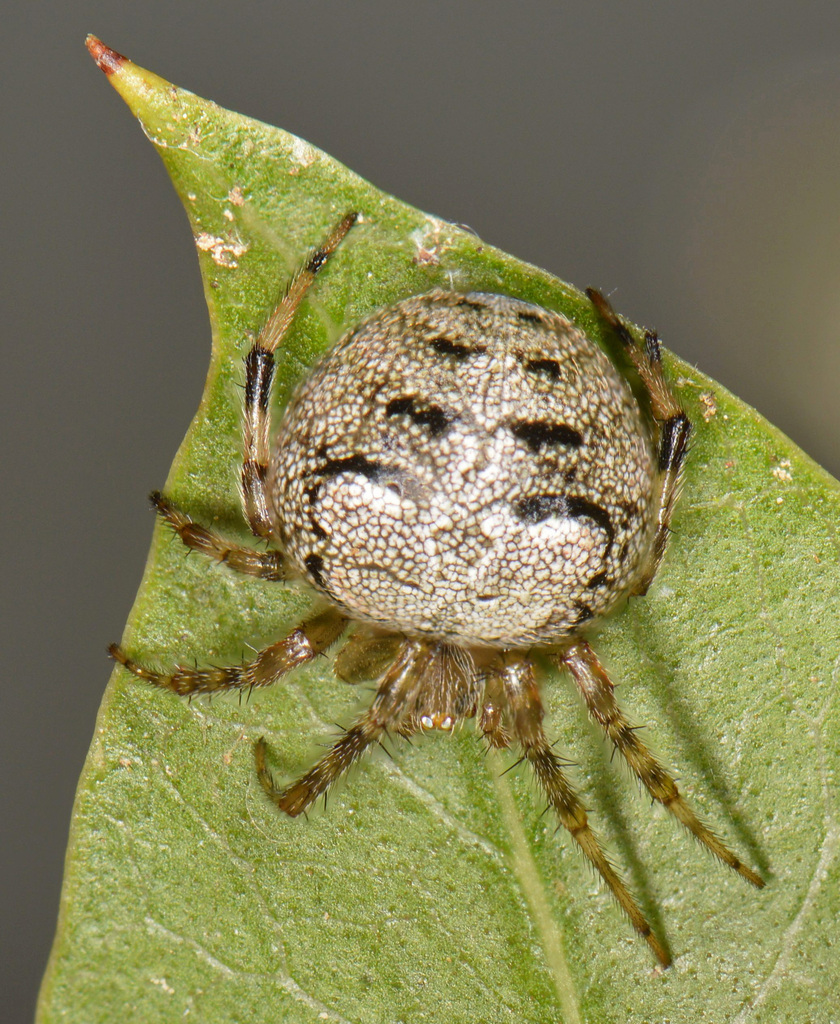
(c) Celeste Ray, some rights reserved (CC BY) · licence
Family: Araneidae · Class: Arachnida · Order: Araneae
Araneus pegnia (Butterfly Orbweaver) is a California animal in the Araneidae family.
Araneus pegnia, known as the butterfly orbweaver, is a member of the Araneidae family of orb-weaver spiders. This species belongs to a diverse group of spiders known for constructing circular, wheel-shaped webs to capture flying prey. Adult females typically measure 8 to 12 mm in body length, while males are considerably smaller at 4 to 6 mm. The species displays sexual dimorphism common among orb-weavers, with females showing more robust abdomens and pronounced coloration patterns. The butterfly orbweaver occurs across western North America, with documented populations throughout California. According to NatureServe Explorer, the species has a global conservation rank of G5, indicating it is secure and widespread across its range. Within California, A. pegnia has been documented in various counties, though specific distribution data remains limited in published literature. This species inhabits diverse terrestrial environments including grasslands, chaparral, oak woodlands, and riparian areas. Butterfly orbweavers construct their webs in vegetation ranging from low shrubs to tree branches, typically positioning webs 0.5 to 3 meters above ground level. The spiders show preference for areas with moderate vegetation density that provide adequate anchor points for web construction while maintaining open flight paths for potential prey. They are commonly found in edge habitats where different vegetation types meet, creating optimal hunting grounds. Araneus pegnia exhibits typical orb-weaver behavior, constructing geometric webs with radial threads and a spiral capture zone coated with sticky silk. Females rebuild their webs daily, usually during evening hours, consuming the previous day's web to recycle silk proteins. The species is primarily nocturnal, remaining hidden in retreat sites during daylight hours and becoming active at dusk. Mating occurs during late summer and fall, with males approaching female webs and engaging in complex courtship behaviors involving web vibrations and chemical signals. Females produce egg sacs containing 100 to 300 eggs, which they guard until environmental conditions trigger hatching in spring. Diet consists primarily of flying insects including flies, mosquitoes, moths, beetles, and small wasps. The sticky spiral threads of their webs are particularly effective at capturing small to medium-sized flying prey. Spiderlings disperse through ballooning, releasing silk threads that catch air currents to transport them to new territories. Currently, A. pegnia faces no specific conservation threats and maintains stable populations throughout its range. The species' adaptability to various habitat types and its ability to coexist with human-modified landscapes contribute to its secure conservation status. However, like many arthropods, populations may be affected by habitat loss, pesticide use, and climate change, though these impacts have not been quantitatively assessed for this species. No special management or protection measures are currently implemented for the butterfly orbweaver.
Classification
Class: Arachnida · Order: Araneae · Family: Araneidae
Frequently asked questions
How is Araneus pegnia classified?
Araneus pegnia belongs to class Arachnida, order Araneae, family Araneidae.
What family does Araneus pegnia belong to?
Araneus pegnia is in the Araneidae family.
What is Araneus pegnia?
Araneus pegnia, known as the butterfly orbweaver, is a member of the Araneidae family of orb-weaver spiders.
Is Araneus pegnia found in California?
Yes. Araneus pegnia is recorded in California in The California Species Project's catalogue.
Related species
Other California species in the same genus, family, or bioregion.
Data from The California Species Project — 14,000+ California species with verified data from CNPS, CDFW, USFWS, and more.