Araniella displicata
Six-spotted Orbweaver
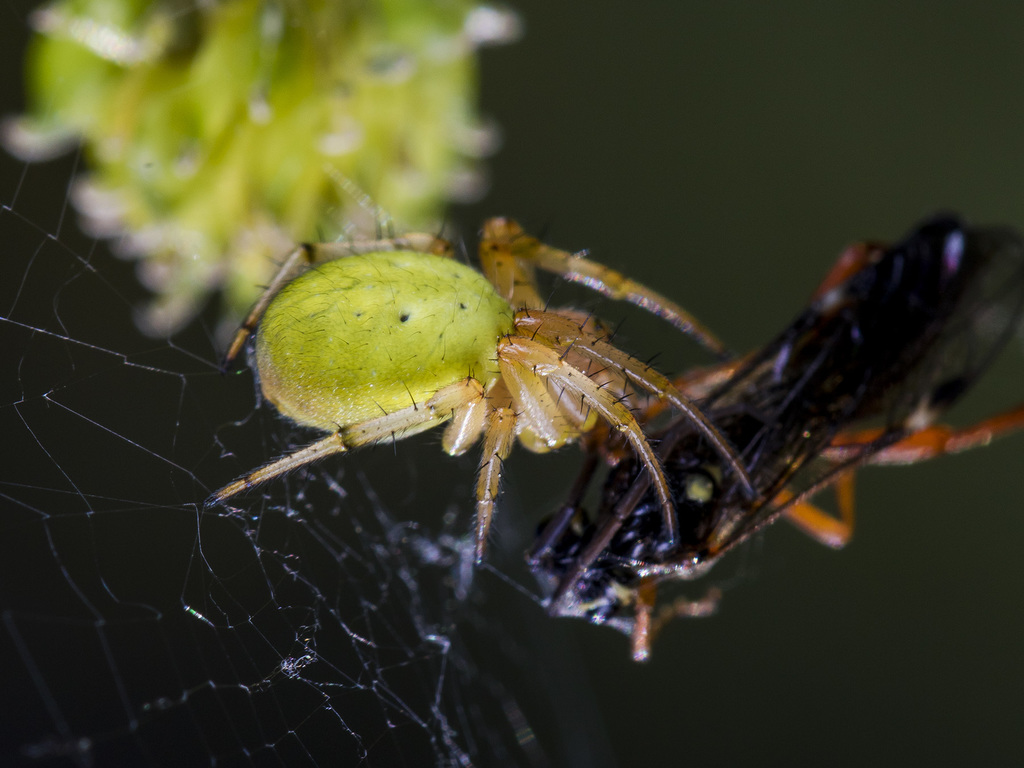
(c) Анатолий Озерной /Anatoly Ozernoy, some rights reserved (CC BY-SA) · licence
Family: Araneidae · Class: Arachnida · Order: Araneae
Araniella displicata (Six-spotted Orbweaver) is a California animal in the Araneidae family.
The six-spotted orbweaver is a small orb-weaver spider in the family Araneidae. Adult females measure 5.5 to 7 millimeters (0.2 to 0.3 inches) in body length, while males are slightly smaller at 5 to 6 millimeters. The species is distinguished by three pairs of small black spots arranged on the dorsal surface of the abdomen, though rarely four pairs may be present. This spotting pattern is somewhat diagnostic for the species (Sacher 1990). The abdomen typically displays a greenish coloration with these distinctive dark markings. Araniella displicata has an extensive North American range, extending from Nova Scotia west to Alaska and south to North Carolina in the eastern portion of its range, and south to California and New Mexico in the western United States. The species is notably absent from the southern Great Plains region (BugGuide). In California, citizen science observations show the species is active from February through October, with peak activity occurring from April through June based on recorded sightings. The species has been documented across numerous states including Alaska, Arizona, California, Colorado, Connecticut, Idaho, and others. The six-spotted orbweaver inhabits diverse environments across its broad range, from boreal forests in Alaska and Canada to temperate regions in the continental United States. Like other orb-weavers, this species constructs circular webs to capture flying prey. The webs are typically built in vegetation, shrubs, or between structures where flying insects are abundant. The species shows seasonal activity patterns, with adult spiders most commonly observed during spring and early summer months. As an orb-weaver, A. displicata is a predatory species that feeds primarily on flying insects caught in its web. The spider constructs a typical orb web with radial threads and a spiral capture area coated with sticky droplets. When prey becomes entangled, the spider quickly moves to subdue and wrap the victim. Mating likely occurs during the spring activity period, with females producing egg sacs that overwinter. Like many temperate spiders, the species probably has an annual life cycle with adults dying after reproduction and eggs surviving through winter. The six-spotted orbweaver is not federally or state listed and appears to maintain stable populations across its extensive range. The species demonstrates considerable adaptability, occurring across diverse climatic zones from subarctic Alaska to temperate California. Its broad distribution and presence in multiple habitat types suggest the species is not currently facing significant conservation threats. However, like many arthropods, local populations may be affected by habitat loss, pesticide use, and climate change impacts on prey availability and seasonal timing.
Classification
Class: Arachnida · Order: Araneae · Family: Araneidae
Frequently asked questions
How is Araniella displicata classified?
Araniella displicata belongs to class Arachnida, order Araneae, family Araneidae.
What family does Araniella displicata belong to?
Araniella displicata is in the Araneidae family.
What is Araniella displicata?
The six-spotted orbweaver is a small orb-weaver spider in the family Araneidae.
Is Araniella displicata found in California?
Yes. Araniella displicata is recorded in California in The California Species Project's catalogue.
Related species
Other California species in the same genus, family, or bioregion.
Data from The California Species Project — 14,000+ California species with verified data from CNPS, CDFW, USFWS, and more.