Aratinga nenday
Nanday Parakeet
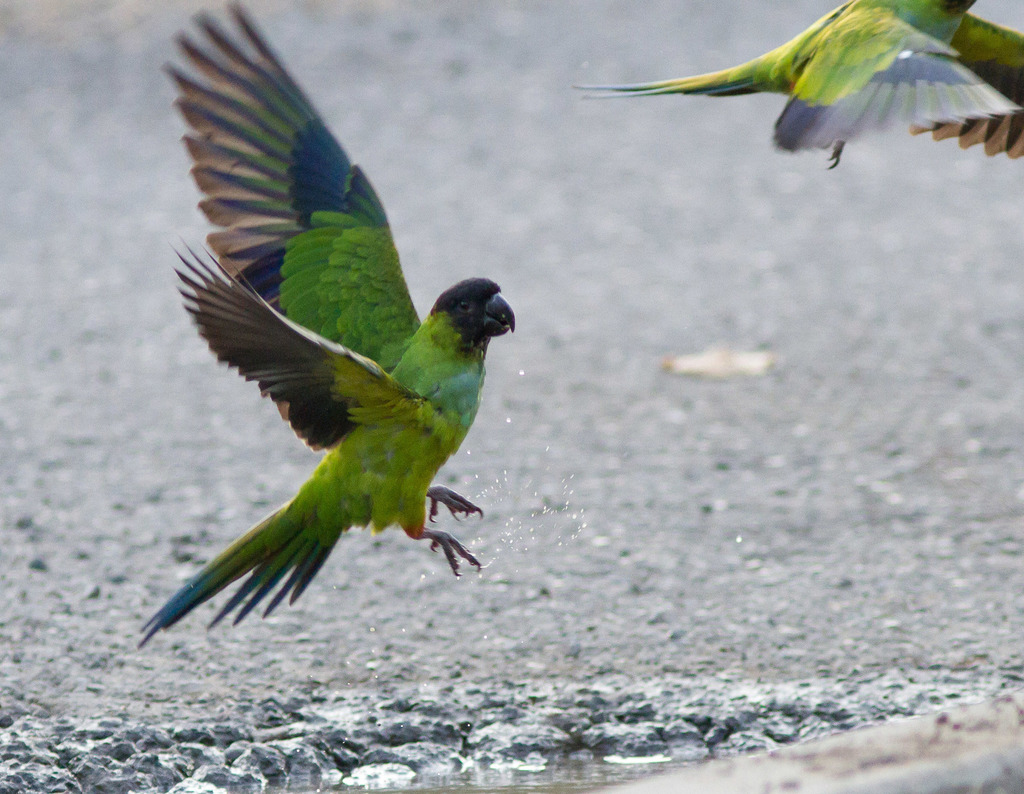
(c) Adam J. Searcy, some rights reserved (CC BY) · licence
Family: Psittacidae · Class: Aves · Order: Psittaciformes
Aratinga nenday (Nanday Parakeet) is a California animal in the Psittacidae family.
The Nanday Parakeet is a distinctive medium-sized parrot measuring approximately 30-37 cm (12-14.5 inches) in length. The species is characterized by its black hood covering the head and upper throat, contrasting sharply with bright green body plumage. The wings display blue flight feathers, and the tail shows blue-green coloration with yellowish undertones. The bill is black, and the eyes are dark brown surrounded by white periorbital skin. Natively, the Nanday Parakeet occurs in south-central South America, ranging from southeastern Bolivia and southwestern Brazil south through Paraguay to northern Argentina (del Hoyo et al. 2020). The species' natural range encompasses parts of the Pantanal wetlands and adjacent dry forest regions. However, established introduced populations now exist in several locations outside their native range, including parts of California, though specific population data for California requires further documentation. In its native habitat, the species occupies gallery forests along waterways, deciduous woodlands, and palm stands, primarily within the Pantanal ecosystem. The parakeets also utilize moist chaco woodland and low dry scrubland environments. They show particular association with palm-dominated landscapes and areas providing suitable nesting cavities in mature trees. Elevation preferences in the native range typically fall below 500 meters (del Hoyo et al. 2020). Nanday Parakeets are highly social birds that form large, mobile flocks outside the breeding season. Their diet consists primarily of palm nuts, supplemented by various seeds, fruits, flowers, and buds, which they often forage from the ground (del Hoyo et al. 2020). The species exhibits nomadic behavior, with flocks wandering widely in search of food resources. They are cavity nesters, utilizing natural holes in tree trunks, palm stems, or occasionally artificial structures like fence posts for breeding (Juniper & Parr 1998). Breeding typically occurs during the dry season in their native range, with females laying 3-4 white eggs in the nest cavity (del Hoyo et al. 2020). The Nanday Parakeet is not currently listed under the U.S. Endangered Species Act, and its native populations appear stable throughout most of its South American range. However, like many parrot species, it has faced pressure from habitat loss and the pet trade. In areas where introduced populations have established, the species may compete with native cavity-nesting birds for nesting sites. The long-term impacts of introduced populations on local ecosystems require ongoing monitoring and research to assess potential ecological effects on native bird communities. As an introduced species in California, the Nanday Parakeet represents part of the state's growing community of established exotic parrots, though comprehensive population surveys and impact assessments remain limited as of December 2025.
Classification
Class: Aves · Order: Psittaciformes · Family: Psittacidae
Frequently asked questions
How is Aratinga nenday classified?
Aratinga nenday belongs to class Aves, order Psittaciformes, family Psittacidae.
What family does Aratinga nenday belong to?
Aratinga nenday is in the Psittacidae family.
What is Aratinga nenday?
The Nanday Parakeet is a distinctive medium-sized parrot measuring approximately 30-37 cm (12-14.5 inches) in length.
Is Aratinga nenday found in California?
Yes. Aratinga nenday is recorded in California in The California Species Project's catalogue.
Related species
Other California species in the same genus, family, or bioregion.
Data from The California Species Project — 14,000+ California species with verified data from CNPS, CDFW, USFWS, and more.