Arborimus albipes
White-footed Vole
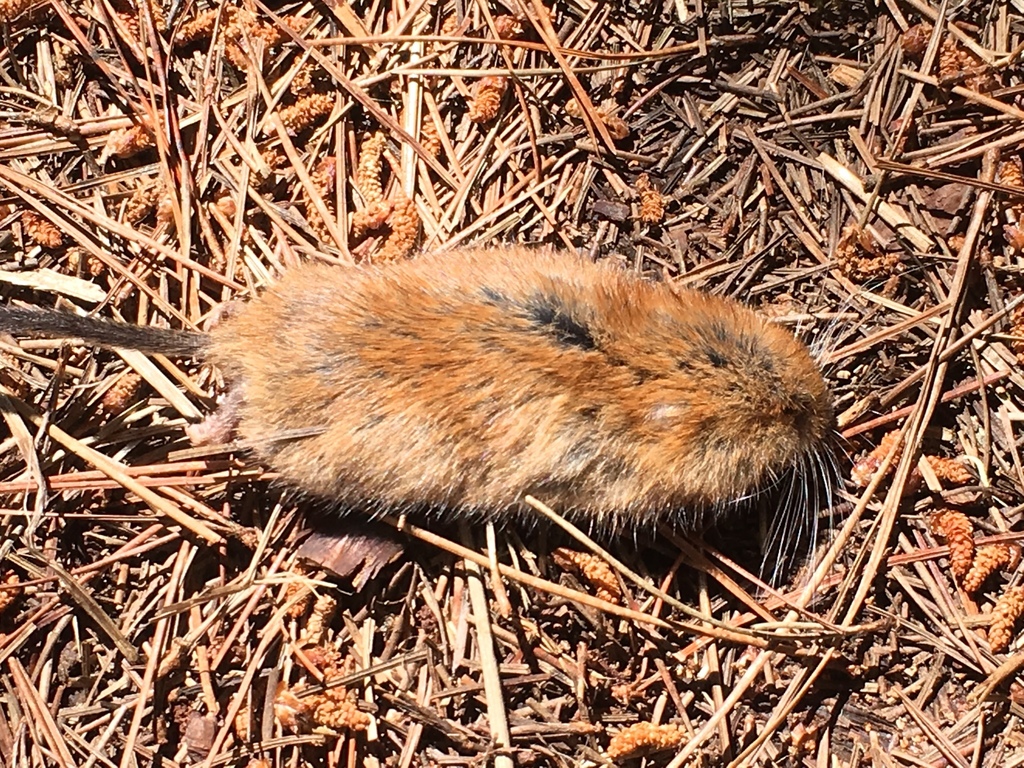
(c) Chris Sulots, some rights reserved (CC BY) · licence
Family: Cricetidae · Class: Mammalia · Order: Rodentia
Conservation status: G3G4 S2
Arborimus albipes (White-footed Vole) is a California animal in the Cricetidae family.
The white-footed vole is a small, semi-arboreal rodent endemic to the coastal forests of the Pacific Northwest. Adults measure 95 to 115 mm (3.7 to 4.5 inches) in total length, with a tail comprising approximately 40% of total body length. The species weighs 18 to 30 grams (0.6 to 1.1 ounces). The dorsal pelage is dark reddish-brown to chestnut, contrasting sharply with the white or cream-colored ventral surface. The feet are distinctively white, giving the species its common name. The tail is bicolored, dark above and light below, and densely furred. The ears are small and nearly hidden in the fur. The white-footed vole occurs in a narrow coastal strip from southwestern Oregon through northwestern California. In California, the species is documented from Humboldt and Del Norte counties, with populations extending south to approximately Prairie Creek in Humboldt County. The species' range encompasses an area of less than 5,000 square kilometers, making it one of the most geographically restricted voles in North America. Historical records suggest the range may have extended slightly further south, but current populations are limited to old-growth and mature second-growth coniferous forests. This species inhabits dense coastal coniferous forests dominated by redwood, Douglas fir, Sitka spruce, and western hemlock. White-footed voles require forests with complex vertical structure, including abundant epiphytes, fallen logs, and dense understory vegetation. They are primarily arboreal, spending much of their time in the forest canopy up to 60 meters (200 feet) above ground. The species constructs spherical nests of moss, lichen, and plant fibers in tree branches, particularly in areas where epiphytes provide cover and nesting materials. White-footed voles are primarily folivorous, feeding on the leaves, bark, and growing tips of various tree and shrub species. Their diet includes Douglas fir needles, huckleberry leaves, and various ferns and mosses. Unlike most voles, they rarely consume seeds or roots. The species is active year-round and primarily nocturnal. Breeding occurs from spring through fall, with females producing multiple litters of 2 to 4 young after a gestation period of approximately 23 days. The species exhibits low reproductive rates compared to other voles, likely due to their specialized habitat requirements. The white-footed vole is not federally listed but is considered a species of conservation concern due to its restricted range and specialized habitat requirements. The species has a NatureServe global rank of G3G4 (vulnerable to apparently secure globally) and a California state rank of S2 (imperiled). Primary threats include habitat loss from logging, particularly the removal of old-growth forests, and habitat fragmentation. Climate change poses additional risks through alterations to coastal fog patterns and forest composition. Forest management practices that maintain canopy complexity and epiphyte communities are essential for the species' long-term persistence.
Classification
Class: Mammalia · Order: Rodentia · Family: Cricetidae
Conservation status
G3G4 S2
Frequently asked questions
How is Arborimus albipes classified?
Arborimus albipes belongs to class Mammalia, order Rodentia, family Cricetidae.
What family does Arborimus albipes belong to?
Arborimus albipes is in the Cricetidae family.
Is Arborimus albipes protected or of conservation concern?
Arborimus albipes carries the following status: G3G4 S2.
What is Arborimus albipes?
The white-footed vole is a small, semi-arboreal rodent endemic to the coastal forests of the Pacific Northwest.
Is Arborimus albipes found in California?
Yes. Arborimus albipes is recorded in California in The California Species Project's catalogue.
Related species
Other California species in the same genus, family, or bioregion.
Data from The California Species Project — 14,000+ California species with verified data from CNPS, CDFW, USFWS, and more.