Arborimus pomo
Sonoma Red Tree Vole
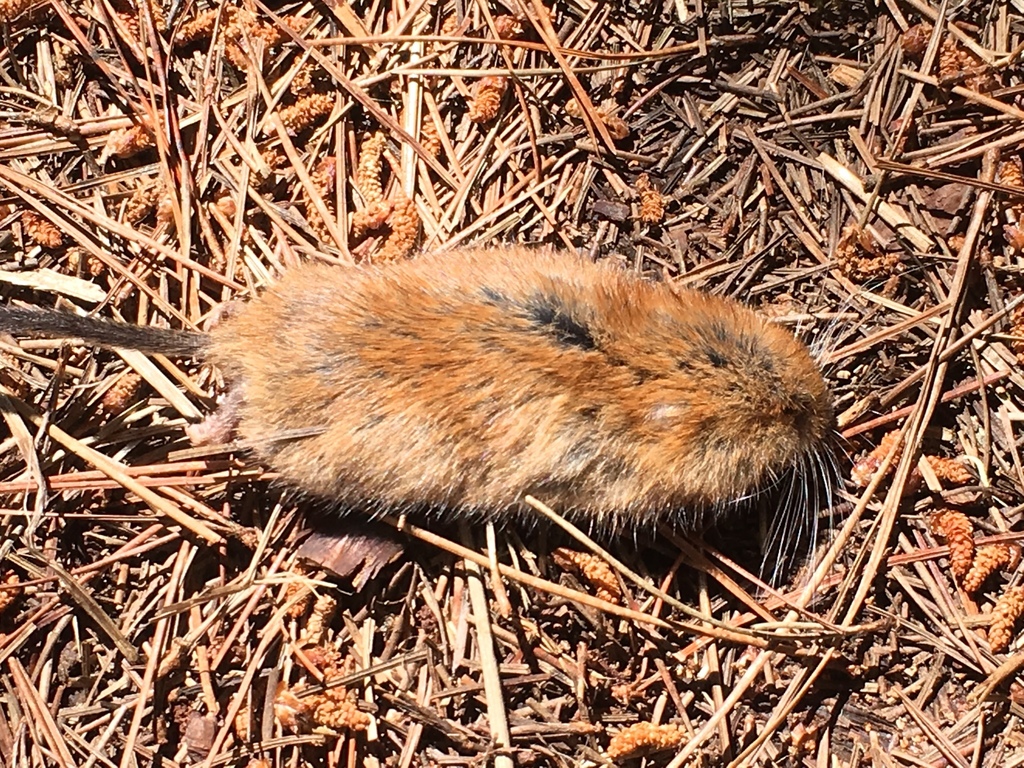
(c) Chris Sulots, some rights reserved (CC BY) · licence
Family: Cricetidae · Class: Mammalia · Order: Rodentia
Conservation status: G3 S3
Arborimus pomo (Sonoma Red Tree Vole) is a California animal in the Cricetidae family.
The Sonoma red tree vole is a small, specialized arboreal rodent endemic to coastal northern California. Adults measure 95 to 115 mm (3.7 to 4.5 inches) in head-body length, with a tail length of 65 to 85 mm (2.6 to 3.3 inches). The species weighs 25 to 40 grams (0.9 to 1.4 ounces). The dorsal pelage is reddish-brown to chestnut, while the ventral surface is grayish-white to buff. The tail is distinctly bicolored, dark above and light below, and is moderately furred. The eyes are relatively large and dark, adapted for their arboreal lifestyle. The hind feet are equipped with strong claws for gripping bark and branches. The Sonoma red tree vole is restricted to coastal redwood and Douglas fir forests in Sonoma and southern Mendocino counties, California. The species' range extends from the Russian River valley northward to approximately the Navarro River. This represents one of the most limited distributions among North American microtine rodents. Historical records suggest the range may have been slightly more extensive, but habitat conversion has reduced available forest area. The species inhabits mature and old-growth coniferous forests dominated by coast redwood (Sequoia sempervirens) and Douglas fir (Pseudotsuga menziesii). Tree voles construct spherical nests of Douglas fir needles in the forest canopy, typically 4 to 60 meters (13 to 197 feet) above ground. Nests are usually positioned near the trunk on large horizontal branches or in branch forks. The species shows strong fidelity to specific trees and may use the same nesting sites across multiple generations. Forest stands with complex vertical structure and diverse age classes provide optimal habitat conditions. Sonoma red tree voles are highly specialized folivores, feeding almost exclusively on Douglas fir needles. They consume both current-year and older needles, obtaining water primarily from their food rather than drinking. The species exhibits nocturnal activity patterns and rarely descends to the ground. Reproduction occurs from spring through early fall, with females producing one to three litters per year. Litter size ranges from one to four young, with an average of two. Gestation period is approximately 28 days. Young remain in the natal nest for several weeks before dispersing to establish their own territories. The Sonoma red tree vole is not federally listed but carries a global and state conservation rank of G3 S3, indicating the species is vulnerable throughout its range. The restricted distribution makes populations particularly susceptible to habitat loss and fragmentation. Primary threats include logging of mature forest stands, residential development in coastal areas, and climate change impacts on forest composition. Fire represents both a natural disturbance factor and an increasing threat due to changing fire patterns. Conservation efforts focus on protecting remaining old-growth forest stands and maintaining forest connectivity within the species' limited range. Continued monitoring is essential given the species' narrow habitat requirements and small geographic range.
Classification
Class: Mammalia · Order: Rodentia · Family: Cricetidae
Conservation status
G3 S3
Frequently asked questions
How is Arborimus pomo classified?
Arborimus pomo belongs to class Mammalia, order Rodentia, family Cricetidae.
What family does Arborimus pomo belong to?
Arborimus pomo is in the Cricetidae family.
Is Arborimus pomo protected or of conservation concern?
Arborimus pomo carries the following status: G3 S3.
What is Arborimus pomo?
The Sonoma red tree vole is a small, specialized arboreal rodent endemic to coastal northern California.
Is Arborimus pomo found in California?
Yes. Arborimus pomo is recorded in California in The California Species Project's catalogue.
Related species
Other California species in the same genus, family, or bioregion.
Data from The California Species Project — 14,000+ California species with verified data from CNPS, CDFW, USFWS, and more.