Archilestes californicus
California Spreadwing
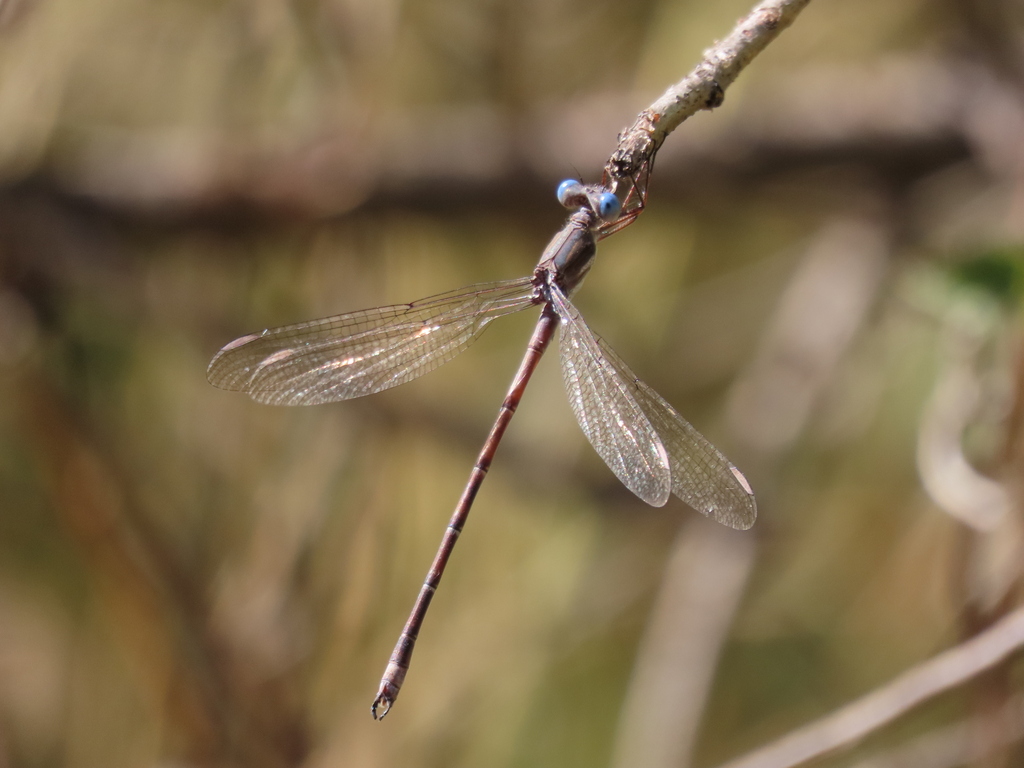
(c) John Hibbard, some rights reserved (CC BY) · licence
Family: Lestidae · Class: Insecta · Order: Odonata
Archilestes californicus (California Spreadwing) is a California animal in the Lestidae family.
The California spreadwing (Archilestes californicus) is a large damselfly in the family Lestidae, distinguished by its robust build and distinctive wing positioning. Adults typically measure 50-60 mm (2.0-2.4 inches) in length with a wingspan reaching 65-75 mm (2.6-3.0 inches), making it one of the larger North American damselflies. Unlike most damselflies that fold their wings along their body when at rest, spreadwings hold their wings partially open at an angle, giving them their common name. Males display metallic bronze-green coloration on the thorax and abdomen with pale blue pruinescence developing on the abdomen with age. Females are generally more brownish with less metallic sheen and lack the blue coloration. Archilestes californicus is endemic to California and Baja California, Mexico. The species occurs primarily in the Central Valley, Coast Ranges, and southern California lowlands, with documented populations from Shasta County south to San Diego County. Historical records indicate the species was once more widespread throughout suitable habitat in California's interior valleys and coastal plains. Current distribution appears fragmented compared to historical ranges, with populations concentrated in areas where suitable aquatic habitat persists. This species inhabits warm, shallow lentic waters including ponds, marshes, slow-moving streams, and agricultural ditches. California spreadwings prefer habitats with emergent vegetation such as cattails (Typha species) and tule (Schoenoplectus species), which provide egg-laying substrate and perching sites. They typically occur at elevations below 500 meters (1,640 feet) in areas with Mediterranean climate patterns. Adults are often found in riparian corridors and wetland edges where they hunt for small flying insects. California spreadwings are active from late spring through early fall, with peak emergence typically occurring in June and July. Mating occurs through typical damselfly tandem positioning, with pairs remaining connected during oviposition. Females insert eggs into plant stems and other vegetation at or just below the water surface using their well-developed ovipositor. The species likely has a single generation per year in most areas, with larvae developing through multiple instars in aquatic environments over 10-11 months. Adults are generalist predators, capturing small flies, mosquitoes, and other soft-bodied insects both in flight and from perches. While not federally or state listed, California spreadwing populations face significant pressure from habitat loss and degradation. Wetland destruction, agricultural intensification, and urban development have eliminated substantial portions of historically suitable habitat throughout California. Water diversions and altered hydrological regimes affect breeding sites, while pesticide applications in agricultural areas may impact both larval and adult stages. Climate change poses additional threats through altered precipitation patterns and increased temperatures that may affect the timing of emergence and breeding cycles. Conservation efforts focus on protecting remaining wetland habitats and maintaining water quality in areas where populations persist.
Classification
Class: Insecta · Order: Odonata · Family: Lestidae
Frequently asked questions
How is Archilestes californicus classified?
Archilestes californicus belongs to class Insecta, order Odonata, family Lestidae.
What family does Archilestes californicus belong to?
Archilestes californicus is in the Lestidae family.
What is Archilestes californicus?
The California spreadwing (Archilestes californicus) is a large damselfly in the family Lestidae, distinguished by its robust build and distinctive wing positioning.
Is Archilestes californicus found in California?
Yes. Archilestes californicus is recorded in California in The California Species Project's catalogue.
More California species
This species has no close relatives in our California data — here are other species to explore.
Data from The California Species Project — 14,000+ California species with verified data from CNPS, CDFW, USFWS, and more.