Archilochus colubris
Ruby-throated Hummingbird
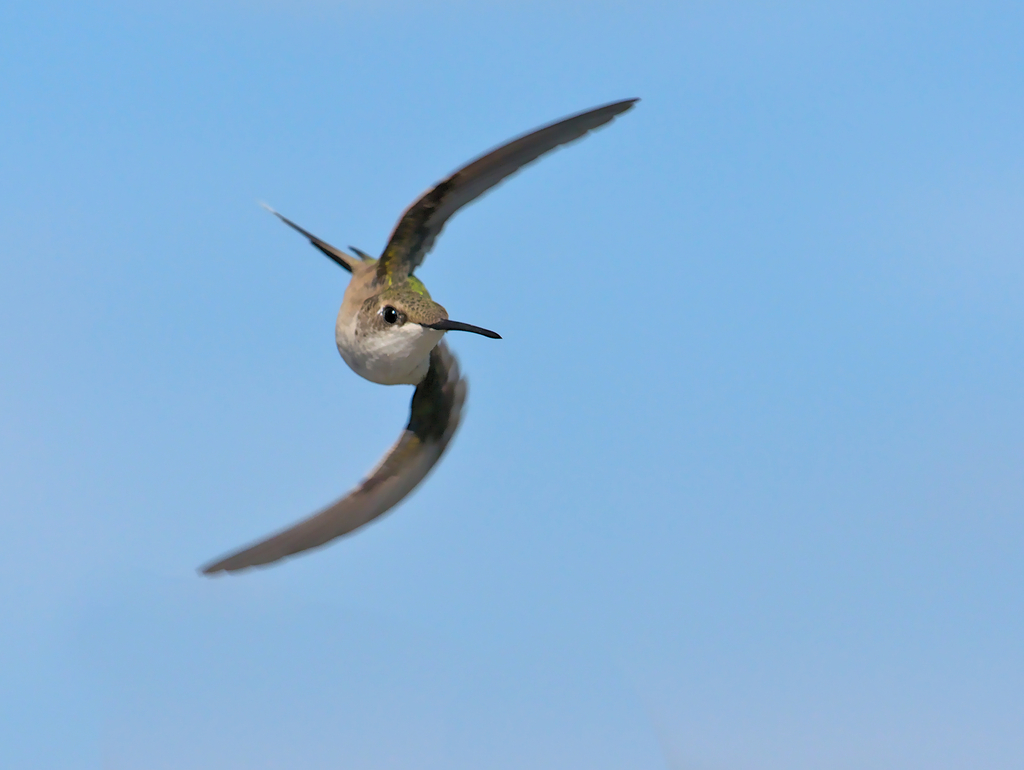
(c) Blake Ross, some rights reserved (CC BY) · licence
Family: Trochilidae · Class: Aves · Order: Apodiformes
Archilochus colubris (Ruby-throated Hummingbird) is a California animal in the Trochilidae family.
The Ruby-throated Hummingbird (Archilochus colubris) is a small passerine bird measuring 7 to 9 cm (2.8 to 3.5 inches) in length with a wingspan of 8 to 11 cm (3.1 to 4.3 inches). Adult males weigh 2 to 6 grams, while females are slightly larger at 2 to 6 grams. Males display an iridescent ruby-red throat patch (gorget) that appears black in poor lighting, emerald green upperparts, and grayish-white underparts. Females lack the red throat patch, instead showing white throats with dark streaking, and have white tips on their outer tail feathers. Both sexes possess needle-like bills measuring 15 to 20 mm in length and wings that beat at frequencies of 53 beats per second in males and 50 beats per second in females. The Ruby-throated Hummingbird breeds primarily in eastern North America, from southern Canada south to the Gulf of Mexico. The breeding range extends from Nova Scotia west to Alberta and south to Florida and central Texas. In California, this species is considered a rare vagrant, with occasional sightings documented primarily during fall migration. Most California records occur along the coast and in desert regions during September and October, when individuals may become displaced from their typical migration routes. Breeding habitat consists of deciduous and mixed forests, forest edges, orchards, and gardens with abundant flowering plants. The species shows preference for areas with canopy cover of 25 to 75 percent and requires both nesting sites and nectar sources within close proximity. Nests are constructed on horizontal branches 3 to 6 meters above ground, typically in deciduous trees such as oak, maple, or birch. During migration, Ruby-throated Hummingbirds utilize a variety of habitats including parks, gardens, and natural areas with appropriate nectar sources. Ruby-throated Hummingbirds feed primarily on nectar from flowers, supplementing their diet with small insects and spiders for protein. Preferred nectar sources include native plants such as bee balm, cardinal flower, and trumpet vine, as well as cultivated species like petunias and salvias. Breeding occurs from April through July, with females constructing cup-shaped nests from plant down, spider silk, and lichen. Clutch size is typically 2 white eggs, measuring 12.9 by 8.5 mm on average. Incubation lasts 11 to 16 days, performed solely by the female. Young fledge after 18 to 22 days and may receive parental care for an additional 7 to 10 days. The species undertakes one of the most demanding migrations among North American birds, with many individuals crossing the Gulf of Mexico non-stop, a journey of approximately 800 kilometers requiring 18 to 22 hours of continuous flight. Fall migration begins in August, with most birds departing breeding areas by September. The Ruby-throated Hummingbird maintains stable populations across most of its range and is not federally listed. According to the North American Breeding Bird Survey, populations have remained relatively stable from 1966 to 2019, with some regional variations. Primary threats include habitat loss, pesticide use affecting insect prey, and collision with human-made structures. Climate change may affect migration timing and nectar plant phenology.
Classification
Class: Aves · Order: Apodiformes · Family: Trochilidae
Frequently asked questions
How is Archilochus colubris classified?
Archilochus colubris belongs to class Aves, order Apodiformes, family Trochilidae.
What family does Archilochus colubris belong to?
Archilochus colubris is in the Trochilidae family.
What is Archilochus colubris?
The Ruby-throated Hummingbird (Archilochus colubris) is a small passerine bird measuring 7 to 9 cm (2.8 to 3.5 inches) in length with a wingspan of 8 to 11 cm (3.1 to 4.3 inches).
Is Archilochus colubris found in California?
Yes. Archilochus colubris is recorded in California in The California Species Project's catalogue.
Related species
Other California species in the same genus, family, or bioregion.
Data from The California Species Project — 14,000+ California species with verified data from CNPS, CDFW, USFWS, and more.