Archips argyrospila
Fruit-tree Leafroller Moth
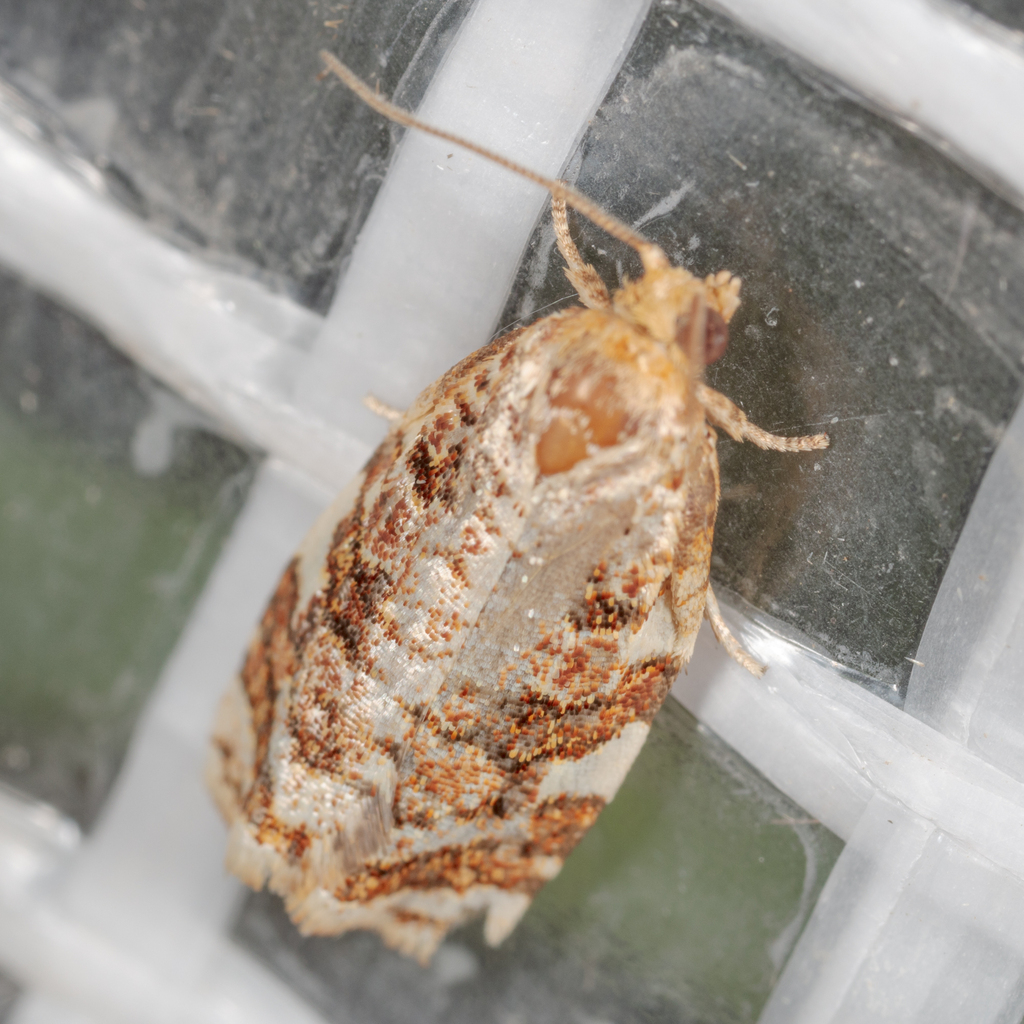
(c) Victor Engel, some rights reserved (CC BY) · licence
Family: Tortricidae · Class: Insecta · Order: Lepidoptera
Archips argyrospila (Fruit-tree Leafroller Moth) is a California animal in the Tortricidae family.
The fruit-tree leafroller moth (Archips argyrospila) is a small to medium-sized moth in the family Tortricidae. Adults have a wingspan of 18 to 25 mm (0.7 to 1.0 inches), with forewings that are typically orange to reddish-brown with darker reticulated patterns and a distinctive metallic silver or gray band along the outer margin. The hindwings are pale gray to whitish. Males are generally smaller and more brightly colored than females. The larvae are pale green to yellowish-green caterpillars that reach 20 to 25 mm (0.8 to 1.0 inches) in length when fully mature, with a dark brown to black head capsule. This species occurs throughout eastern North America, extending from southeastern Canada south to the Gulf Coast states and west to the Great Plains. In California, the fruit-tree leafroller is not considered native but has been documented as an occasional agricultural pest, likely introduced through the transport of infested plant material. The species' western range expansion has been facilitated by human activities and suitable host plant availability. Fruit-tree leafroller moths inhabit areas where their host plants are abundant, including orchards, woodlands, forest edges, and suburban landscapes. They are particularly associated with deciduous fruit trees and show strong preferences for members of the Rosaceae family. The species utilizes an extremely broad range of host plants, including apple, pear, apricot, cherries, peaches, plums, alfalfa, beans, blueberries, cedar, grapes, elms, oaks, onions, and Prunus species. This polyphagous feeding habit contributes to the species' success across diverse habitats. Adult moths are active from late spring through early summer, typically emerging in May and June. Females deposit eggs in masses of 50 to 150 on bark surfaces or leaf undersides. Larvae emerge in early summer and construct characteristic leaf shelters by rolling or folding leaves together with silk webbing, from which the common name derives. The caterpillars feed within these protective shelters, consuming leaf tissue and sometimes fruit surfaces. Development is univoltine, with one generation per year. Larvae overwinter in the pupal stage within cocoons attached to bark crevices or leaf litter. The fruit-tree leafroller moth is not considered a species of conservation concern and holds no federal or state listing status. Population levels appear stable across most of its range. The species is primarily significant from an agricultural perspective, as larvae can cause economic damage to fruit crops, particularly apples and stone fruits. Management typically involves integrated pest management approaches including pheromone traps for monitoring, biological control agents such as parasitic wasps, and selective insecticide applications when populations exceed economic thresholds. The species' broad host range and adaptability suggest it will likely maintain stable populations across its current distribution.
Classification
Class: Insecta · Order: Lepidoptera · Family: Tortricidae
Frequently asked questions
How is Archips argyrospila classified?
Archips argyrospila belongs to class Insecta, order Lepidoptera, family Tortricidae.
What family does Archips argyrospila belong to?
Archips argyrospila is in the Tortricidae family.
What is Archips argyrospila?
The fruit-tree leafroller moth (Archips argyrospila) is a small to medium-sized moth in the family Tortricidae.
Is Archips argyrospila found in California?
Yes. Archips argyrospila is recorded in California in The California Species Project's catalogue.
Related species
Other California species in the same genus, family, or bioregion.
Data from The California Species Project — 14,000+ California species with verified data from CNPS, CDFW, USFWS, and more.