Arctia caja
Garden Tiger Moth or Great Tiger Moth
no rights reserved · CC0
Family: Erebidae · Class: Insecta · Order: Lepidoptera
Arctia caja (Garden Tiger Moth or Great Tiger Moth) is a California animal in the Erebidae family.
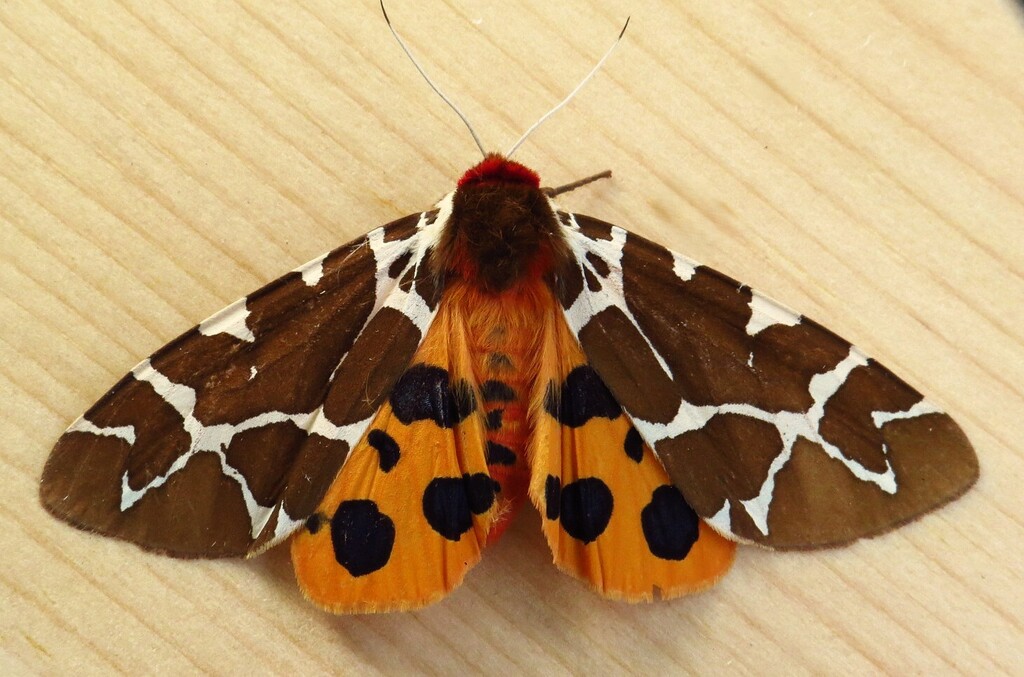
The Garden Tiger Moth (Arctia caja) is a large, robust moth in the family Erebidae, subfamily Arctiinae. Adults have forewings measuring 30-35 mm in length, with a wingspan reaching 45-65 mm (1.8-2.6 inches). The forewings display a distinctive pattern of dark brown or black irregular markings on a cream or white background, creating a complex mosaic appearance. The hindwings are bright orange-red with large black spots, typically numbering 4-7 per wing. Males are generally smaller than females and have more feathered antennae. The thorax is covered in dense, brownish hair-like scales, while the abdomen shows alternating bands of orange and black. Historically widespread across northern regions of North America, Europe, and Asia, the Garden Tiger Moth has experienced significant range contractions in many areas. In North America, the species occurs across Canada and the northern United States, including Alaska. California populations represent the southernmost extent of the species' western North American range, primarily documented in mountainous regions and higher elevations of the Sierra Nevada and Cascade ranges. The species has become increasingly rare in southern portions of its range, with scattered records from northern California counties including Shasta, Siskiyou, and Modoc counties. Garden Tiger Moths inhabit diverse habitats including meadows, grasslands, woodland edges, gardens, and disturbed areas. In California, they are typically found at elevations above 1,500 meters (4,900 feet), favoring areas with abundant herbaceous vegetation. The species shows preference for locations with mixed plant communities that support the broad dietary requirements of larvae. Adults are most commonly encountered in areas adjacent to forest openings, riparian zones, and mountain meadows. The species is univoltine, producing one generation per year. Adults are active from late June through August, with peak flight occurring in July. Mating typically occurs at night, with females releasing pheromones to attract males. After mating, females deposit clusters of 100-300 spherical eggs on host plant leaves or nearby surfaces. Larvae, known as woolly bears, are highly polyphagous, feeding on over 60 plant families including dandelion, plantain, dock, nettle, and various grasses and shrubs. The caterpillars are densely covered in stiff bristles and overwinter as larvae, pupating in spring within loosely woven cocoons constructed among leaf litter or low vegetation. Garden Tiger Moths are not federally or state-listed as threatened or endangered, but populations have declined significantly across much of their range over the past several decades. The species is considered secure globally but vulnerable in peripheral populations. Primary threats include habitat loss, agricultural intensification, light pollution affecting adult behavior, and climate change impacts on high-elevation habitats. In California, the species faces additional pressure from habitat fragmentation in mountain ecosystems and potential upward elevational shifts due to warming temperatures. Long-term monitoring data suggests continued population declines in southern portions of the range, making California populations of particular conservation interest.
Classification
Class: Insecta · Order: Lepidoptera · Family: Erebidae
Frequently asked questions
How is Arctia caja classified?
Arctia caja belongs to class Insecta, order Lepidoptera, family Erebidae.
What family does Arctia caja belong to?
Arctia caja is in the Erebidae family.
What is Arctia caja?
The Garden Tiger Moth (Arctia caja) is a large, robust moth in the family Erebidae, subfamily Arctiinae.
Is Arctia caja found in California?
Yes. Arctia caja is recorded in California in The California Species Project's catalogue.
Related species
Other California species in the same genus, family, or bioregion.
Data from The California Species Project — 14,000+ California species with verified data from CNPS, CDFW, USFWS, and more.