Arctosa littoralis
Shoreline Wolf Spider
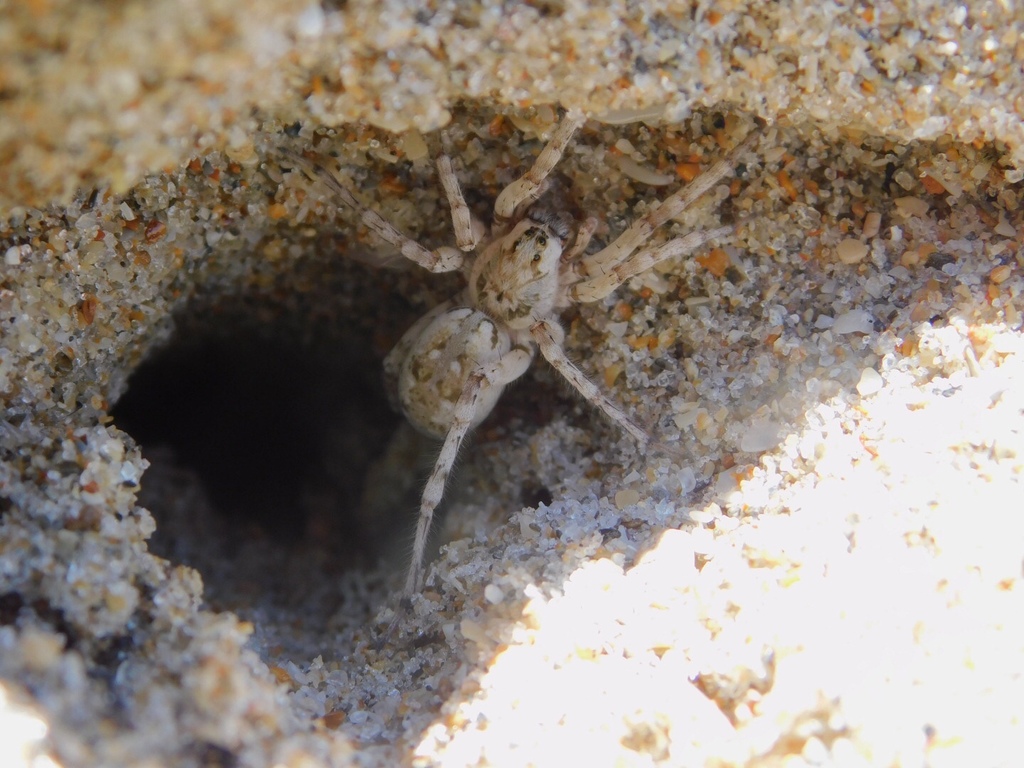
no rights reserved · CC0
Family: Lycosidae · Class: Arachnida · Order: Araneae
Arctosa littoralis (Shoreline Wolf Spider) is a California animal in the Lycosidae family.
The shoreline wolf spider (Arctosa littoralis) is a medium-sized arachnid belonging to the family Lycosidae. Like other wolf spiders, this species exhibits the characteristic eight dark eyes of unequal size arranged in three rows, with four eyes comprising the front row. The abdomen and cephalothorax are typically as long as they are wide, and the long legs terminate in three microscopic claws at each tip. Wolf spiders in the genus Arctosa are generally distinguished by their robust build and ground-dwelling habits. Arctosa littoralis has a broad distribution across North America, ranging from the Arctic to subtropical regions. The species occurs throughout much of the continental United States and extends into Canada and Mexico. In California, the shoreline wolf spider can be found in suitable coastal and inland habitats, though specific distributional records within the state require further documentation. As its common name suggests, the shoreline wolf spider inhabits coastal environments, particularly sandy beaches, dunes, and shoreline areas. The species demonstrates a preference for sandy substrates and open terrain typical of beach ecosystems. Wolf spiders in general occupy diverse habitats including grasslands, suburban areas, deciduous forests, deserts, coastal dunes, and wetland margins, though A. littoralis appears specialized for shoreline environments. The species' habitat preferences make it particularly associated with dynamic coastal ecosystems subject to tidal influences and sand movement. Shoreline wolf spiders are active predators that hunt primarily insects and other small arthropods. Like most wolf spiders, they are cursorial hunters that pursue prey on foot rather than constructing webs. Females carry their egg sacs attached to their spinnerets and subsequently carry newly hatched spiderlings on their backs until the young are capable of independent survival. The species likely exhibits seasonal activity patterns influenced by temperature and prey availability, with peak activity occurring during warmer months. Currently, Arctosa littoralis lacks formal conservation status designations at federal or state levels. According to NatureServe, the species maintains a global conservation status of G5, indicating it is secure globally with no immediate conservation concerns (NatureServe 2025). However, shoreline-dependent species face ongoing pressures from coastal development, habitat modification, and sea level rise. Beach habitats are particularly vulnerable to human disturbance, including recreational activities, shoreline armoring, and sand mining operations. The species' apparent specialization for coastal sandy environments may make local populations susceptible to habitat degradation, though the broad geographic range likely provides population stability. Long-term monitoring of coastal arthropod communities would help assess potential impacts from climate change and increasing coastal development pressures on shoreline-dependent species like A. littoralis.
Classification
Class: Arachnida · Order: Araneae · Family: Lycosidae
Frequently asked questions
How is Arctosa littoralis classified?
Arctosa littoralis belongs to class Arachnida, order Araneae, family Lycosidae.
What family does Arctosa littoralis belong to?
Arctosa littoralis is in the Lycosidae family.
What is Arctosa littoralis?
The shoreline wolf spider (Arctosa littoralis) is a medium-sized arachnid belonging to the family Lycosidae.
Is Arctosa littoralis found in California?
Yes. Arctosa littoralis is recorded in California in The California Species Project's catalogue.
Related species
Other California species in the same genus, family, or bioregion.
Data from The California Species Project — 14,000+ California species with verified data from CNPS, CDFW, USFWS, and more.