Ardea alba
Great Egret
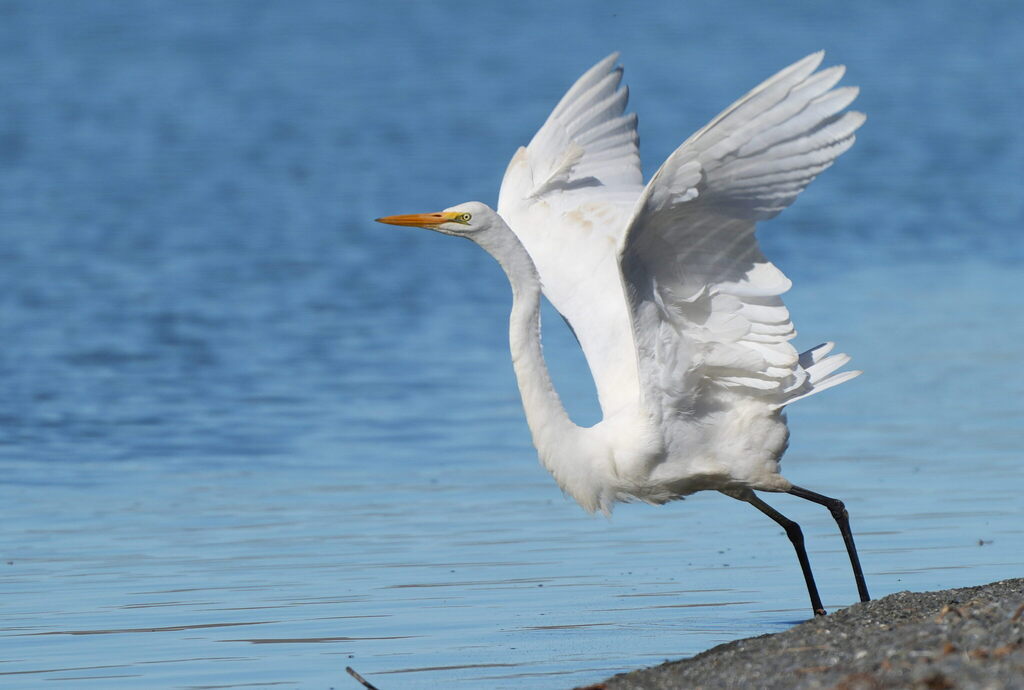
(c) William Harland, some rights reserved (CC BY) · licence
Family: Ardeidae · Class: Aves · Order: Pelecaniformes
Conservation status: G5 S4
Ardea alba (Great Egret) is a California animal in the Ardeidae family.
The Great Egret is a large wading bird standing 94 to 104 cm (37 to 41 inches) tall with a wingspan of 131 to 170 cm (52 to 67 inches). Adults weigh between 0.7 to 1.5 kg (1.5 to 3.3 pounds). During breeding season, adults display entirely white plumage with long, delicate plumes extending from the back over the tail. The bill is yellow during breeding and darker during non-breeding periods. Legs are black year-round, while the feet may show yellow coloration. The neck is distinctively long and S-shaped, allowing for rapid striking at prey. Great Egrets maintain a nearly cosmopolitan distribution across temperate and tropical regions worldwide. In California, they occur throughout the Central Valley, coastal areas, and suitable wetland habitats from sea level to approximately 1,500 meters elevation. According to the North American Breeding Bird Survey, California supports substantial breeding populations, particularly in the Sacramento-San Joaquin Delta region and San Francisco Bay Area. The species also occurs in southern California coastal wetlands and inland water bodies. The species inhabits freshwater and saltwater marshes, swamps, ponds, lakes, tidal flats, and irrigation canals. Great Egrets require areas with water depths of 5 to 25 cm (2 to 10 inches) for optimal foraging. They nest colonially in trees or shrubs, typically 3 to 10 meters above ground or water. Nesting sites include riparian woodlands, isolated tree groves in wetlands, and occasionally on artificial structures. The species shows tolerance for human-modified environments when suitable foraging habitat remains available. Great Egrets are primarily piscivorous, consuming fish ranging from 2 to 25 cm in length. Diet includes carp, sunfish, perch, and other shallow-water species, supplemented by frogs, salamanders, snakes, aquatic invertebrates, and occasionally small mammals and birds. Foraging occurs through patient stalking in shallow water, using rapid bill strikes to capture prey. Breeding typically begins in March, with peak activity from April through June. Females lay 2 to 5 pale blue-green eggs, with an average clutch size of 3.2 eggs. Both parents incubate eggs for 25 to 26 days and feed young for 6 to 7 weeks until fledging. The Great Egret is not federally listed and maintains a global conservation rank of G5 (secure) and California state rank of S4 (apparently secure). However, the species faced severe population declines in the late 1800s and early 1900s due to plume hunting for the millinery trade. Protection under the Migratory Bird Treaty Act and establishment of wildlife refuges enabled population recovery. Current threats include habitat loss from wetland conversion, water diversions affecting foraging areas, and contamination from pesticides and heavy metals. Climate change may alter precipitation patterns and affect wetland availability. The species serves as an indicator of wetland ecosystem health, with stable populations suggesting adequate habitat conditions.
Classification
Class: Aves · Order: Pelecaniformes · Family: Ardeidae
Conservation status
G5 S4
Frequently asked questions
How is Ardea alba classified?
Ardea alba belongs to class Aves, order Pelecaniformes, family Ardeidae.
What family does Ardea alba belong to?
Ardea alba is in the Ardeidae family.
Is Ardea alba protected or of conservation concern?
Ardea alba carries the following status: G5 S4.
What is Ardea alba?
The Great Egret is a large wading bird standing 94 to 104 cm (37 to 41 inches) tall with a wingspan of 131 to 170 cm (52 to 67 inches).
Is Ardea alba found in California?
Yes. Ardea alba is recorded in California in The California Species Project's catalogue.
Related species
Other California species in the same genus, family, or bioregion.
Data from The California Species Project — 14,000+ California species with verified data from CNPS, CDFW, USFWS, and more.