Ardenna creatopus
Pink-footed Shearwater
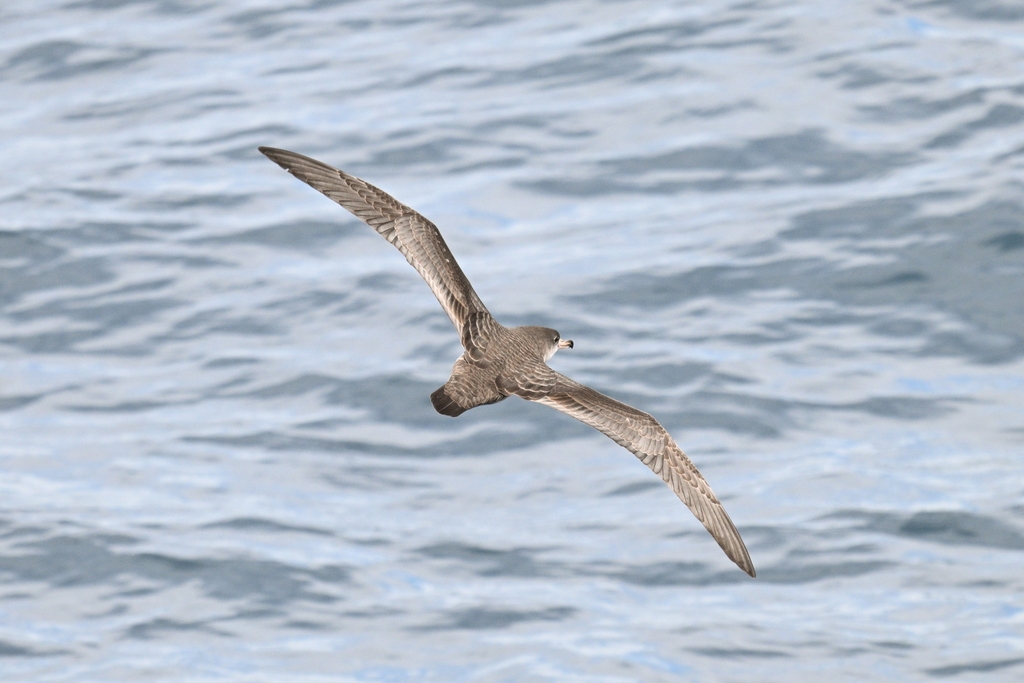
(c) Charlotte Kirchner, some rights reserved (CC BY) · licence
Family: Procellariidae · Class: Aves · Order: Procellariiformes
Ardenna creatopus (Pink-footed Shearwater) is a California animal in the Procellariidae family.
The Pink-footed Shearwater (Ardenna creatopus) is a large seabird in the family Procellariidae, distinguished by its robust build and distinctive plumage pattern. Adults measure 48 to 51 cm (19 to 20 inches) in length with a wingspan of 109 to 112 cm (43 to 44 inches), weighing between 650 to 850 grams (1.4 to 1.9 pounds). The species exhibits characteristic "tube-nose" morphology with fused nostrils positioned on the upper mandible. The dorsal surface is dark brownish-gray, while the ventral surface is white with variable dark mottling on the underwing coverts. The bill is yellowish-pink with a dark tip, and the legs and feet are pink, giving the species its common name. Pink-footed Shearwaters breed exclusively on islands off the coast of Chile, primarily on Juan Fernández Islands and Mocha Island. During the non-breeding season, the species undertakes extensive trans-Pacific migrations, traveling northward along the western coasts of North and South America. Off California, Pink-footed Shearwaters are regular visitors from April through October, with peak abundance occurring from May through September. The species ranges from British Columbia south to central California, with concentrations noted in the Monterey Bay area and waters off Point Reyes. At sea, Pink-footed Shearwaters inhabit pelagic waters over the continental shelf and slope, typically in depths exceeding 200 meters (656 feet). The species shows preference for areas of upwelling where cold, nutrient-rich waters support abundant prey populations. Birds are frequently observed in mixed-species feeding aggregations with other seabirds and marine mammals. During migration periods, individuals may venture closer to shore, particularly around submarine canyons and seamounts. Pink-footed Shearwaters are surface-seizing and shallow-diving feeders, primarily consuming small schooling fish including anchovies, sardines, and juvenile rockfish. The species also feeds on squid and euphausiid krill. Foraging typically occurs during daylight hours, with birds employing a combination of surface-picking and shallow plunge-diving techniques. Breeding occurs from October through April in the Southern Hemisphere. Pairs excavate burrows in soft soil on vegetated slopes, with females laying a single white egg. The incubation period lasts approximately 53 days, followed by a nestling period of 95 to 120 days. The Pink-footed Shearwater is classified as Vulnerable by the International Union for Conservation of Nature, with the global population estimated at fewer than 20,000 breeding pairs and continued decline documented at breeding colonies. Primary threats include introduced mammalian predators at breeding sites, particularly rats and cats, which prey on eggs and chicks. Fishing operations pose additional risks through bycatch in longline and gillnet fisheries. Climate change affects prey distribution and availability, potentially altering foraging success and breeding productivity. Light pollution from coastal development disrupts nocturnal movements at breeding colonies, leading to collisions and disorientation of fledgling birds.
Classification
Class: Aves · Order: Procellariiformes · Family: Procellariidae
Frequently asked questions
How is Ardenna creatopus classified?
Ardenna creatopus belongs to class Aves, order Procellariiformes, family Procellariidae.
What family does Ardenna creatopus belong to?
Ardenna creatopus is in the Procellariidae family.
What is Ardenna creatopus?
The Pink-footed Shearwater (Ardenna creatopus) is a large seabird in the family Procellariidae, distinguished by its robust build and distinctive plumage pattern.
Is Ardenna creatopus found in California?
Yes. Ardenna creatopus is recorded in California in The California Species Project's catalogue.
Related species
Other California species in the same genus, family, or bioregion.
Data from The California Species Project — 14,000+ California species with verified data from CNPS, CDFW, USFWS, and more.