Ardenna grisea
Sooty Shearwater
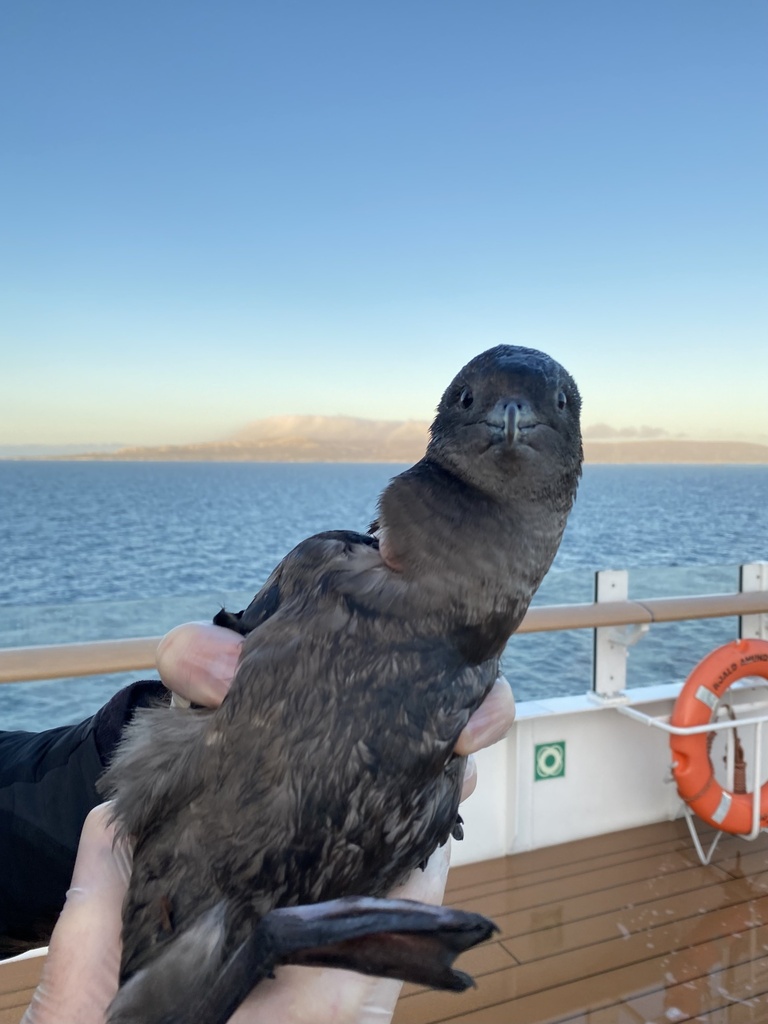
(c) Ingvild Riska, some rights reserved (CC BY) · licence
Family: Procellariidae · Class: Aves · Order: Procellariiformes
Ardenna grisea (Sooty Shearwater) is a California animal in the Procellariidae family.
The Sooty Shearwater (Ardenna grisea) is a large seabird in the family Procellariidae, measuring 40 to 46 cm (16 to 18 inches) in length with a wingspan of 94 to 109 cm (37 to 43 inches). Adults weigh between 650 to 950 grams (1.4 to 2.1 pounds). The species exhibits uniform dark brown to sooty gray plumage on the dorsal surface, with slightly paler underparts that appear silvery-white in flight when viewed from below. The underwing coverts display a distinctive pale silvery stripe. The bill is long, dark, and slightly hooked at the tip, characteristic of tube-nosed seabirds. The legs and webbed feet are dark gray to black. Sooty Shearwaters breed primarily on islands around New Zealand and in the Falkland Islands, with smaller populations on islands off southern Chile and southeastern Australia. During the non-breeding season, they undertake one of the longest migrations in the animal kingdom, traveling in a figure-eight pattern across the Pacific Ocean. Along the California coast, they are most abundant from April through October, with peak numbers occurring during July and August. The species occurs in California waters from the Mexican border north to Oregon, typically within 200 km (124 miles) of shore but occasionally ranging farther offshore. In California waters, Sooty Shearwaters inhabit the continental shelf and slope waters, favoring areas with upwelling currents that concentrate prey. They are most abundant over waters 50 to 200 meters (164 to 656 feet) deep, particularly in areas where cold, nutrient-rich water supports high productivity. The species shows strong associations with upwelling zones off Point Reyes, Monterey Bay, and the Channel Islands. During migration, flocks may number in the hundreds of thousands along the central California coast. Sooty Shearwaters are pursuit divers, feeding primarily on small schooling fish including anchovies, sardines, and juvenile rockfish. They also consume squid, krill, and other crustaceans. The species exhibits dynamic soaring flight patterns, using wind gradients over ocean waves to travel efficiently across vast distances. Breeding occurs in burrows excavated in soft soil on predator-free islands. Females lay a single white egg between October and December, with both parents sharing incubation duties for approximately 56 days. Chicks fledge after 86 to 106 days. The species is not federally listed under the Endangered Species Act, and its global conservation status remains relatively stable according to BirdLife International. However, Sooty Shearwater populations have experienced declines in some breeding areas due to introduced predators, habitat degradation, and climate-driven changes in prey availability. In California waters, the species faces threats from gill net fisheries, oil spills, and plastic pollution. Climate change may alter prey distribution and abundance, potentially affecting migration timing and foraging success. Population monitoring through standardized seabird surveys indicates fluctuations correlating with oceanographic conditions and El Niño events.
Classification
Class: Aves · Order: Procellariiformes · Family: Procellariidae
Frequently asked questions
How is Ardenna grisea classified?
Ardenna grisea belongs to class Aves, order Procellariiformes, family Procellariidae.
What family does Ardenna grisea belong to?
Ardenna grisea is in the Procellariidae family.
What is Ardenna grisea?
The Sooty Shearwater (Ardenna grisea) is a large seabird in the family Procellariidae, measuring 40 to 46 cm (16 to 18 inches) in length with a wingspan of 94 to 109 cm (37 to 43 inches).
Is Ardenna grisea found in California?
Yes. Ardenna grisea is recorded in California in The California Species Project's catalogue.
Related species
Other California species in the same genus, family, or bioregion.
Data from The California Species Project — 14,000+ California species with verified data from CNPS, CDFW, USFWS, and more.