Ardenna pacifica
Wedge-tailed Shearwater
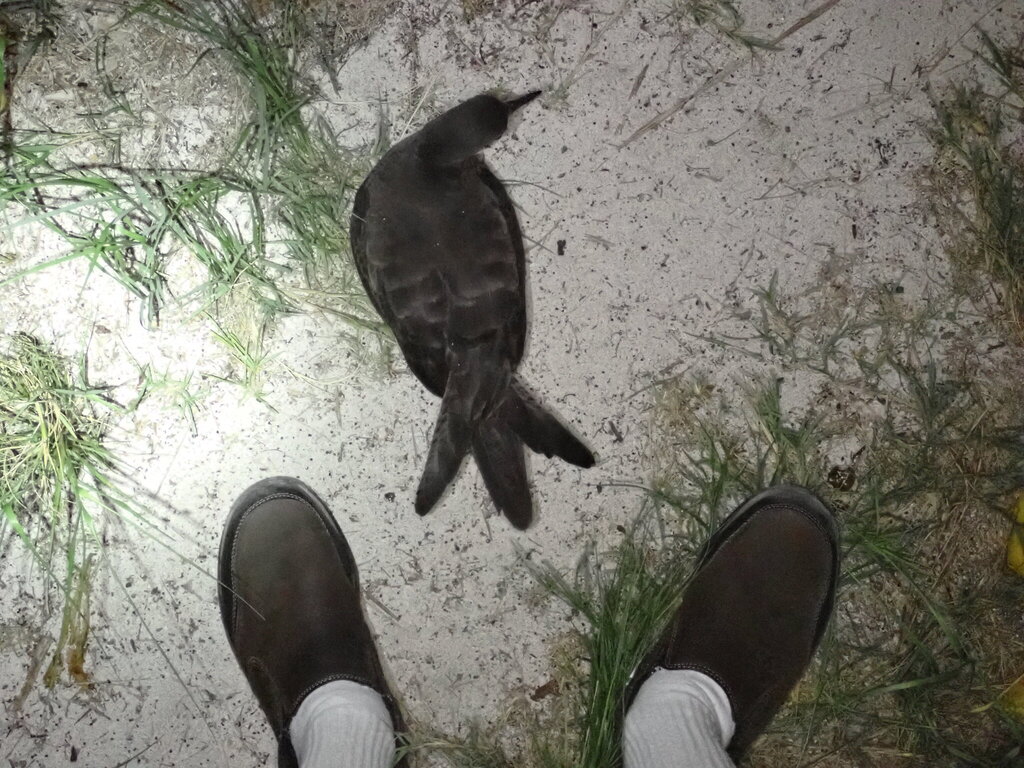
(c) Daniel Eisenhauer, some rights reserved (CC BY) · licence
Family: Procellariidae · Class: Aves · Order: Procellariiformes
Ardenna pacifica (Wedge-tailed Shearwater) is a California animal in the Procellariidae family.
The Wedge-tailed Shearwater (Ardenna pacifica) is a large seabird belonging to the family Procellariidae. Adults measure 38 to 46 cm (15 to 18 inches) in length with a wingspan of 97 to 105 cm (38 to 41 inches). Body weight ranges from 315 to 565 grams (11 to 20 ounces). The species exhibits two distinct color morphs: a dark morph with uniformly dark brown to blackish plumage, and a light morph featuring dark upperparts and white underparts with a pale throat. Both morphs share the characteristic wedge-shaped tail that tapers to a point, distinguishing this species from other shearwaters. The bill is long, slender, and dark with prominent tube-shaped nostrils typical of petrels and shearwaters. Wedge-tailed Shearwaters breed primarily on tropical and subtropical islands throughout the Pacific and Indian Oceans. In the Pacific, breeding colonies occur from Hawaii and Japan south to New Zealand and east to islands off Mexico. The species is considered vagrant to California waters, with occasional sightings documented along the coast, particularly during El Niño events when warmer ocean conditions extend northward. Most California records occur between July and November in offshore waters beyond the continental shelf. Breeding habitat consists of oceanic islands with suitable nesting sites including sandy or rocky ground, cliff faces, and areas with sparse vegetation. Nests are constructed in burrows excavated in soft soil, under rock overhangs, or among dense vegetation. At sea, the species inhabits pelagic waters over deep ocean basins, typically remaining beyond the continental shelf in waters exceeding 200 meters depth. Wedge-tailed Shearwaters prefer areas with surface water temperatures above 20°C (68°F). Wedge-tailed Shearwaters are highly pelagic outside the breeding season, spending months at sea without touching land. They feed primarily by surface-seizing and shallow diving, capturing squid, small fish, and crustaceans. Flying fish, sardines, and various cephalopods comprise the majority of their diet. The species exhibits nocturnal activity patterns at breeding colonies to avoid predation and thermal stress. Breeding is highly synchronized within colonies, with egg-laying occurring from April to July depending on location. Females lay a single white egg in the burrow nest, and both parents share incubation duties for approximately 50 to 55 days. Chicks fledge after 103 to 115 days, among the longest fledging periods of any shearwater species. Globally, Wedge-tailed Shearwaters are listed as Least Concern by the International Union for Conservation of Nature, with an estimated population exceeding 4 million individuals. However, local populations face threats from introduced predators such as rats, cats, and pigs on breeding islands. Habitat degradation, marine pollution, and fisheries interactions also impact some populations. Climate change poses emerging threats through altered ocean productivity and sea-level rise affecting low-lying nesting islands. In California, the species remains an uncommon visitor with no established breeding populations or specific conservation measures in place.
Classification
Class: Aves · Order: Procellariiformes · Family: Procellariidae
Frequently asked questions
How is Ardenna pacifica classified?
Ardenna pacifica belongs to class Aves, order Procellariiformes, family Procellariidae.
What family does Ardenna pacifica belong to?
Ardenna pacifica is in the Procellariidae family.
What is Ardenna pacifica?
The Wedge-tailed Shearwater (Ardenna pacifica) is a large seabird belonging to the family Procellariidae.
Is Ardenna pacifica found in California?
Yes. Ardenna pacifica is recorded in California in The California Species Project's catalogue.
Related species
Other California species in the same genus, family, or bioregion.
Data from The California Species Project — 14,000+ California species with verified data from CNPS, CDFW, USFWS, and more.